

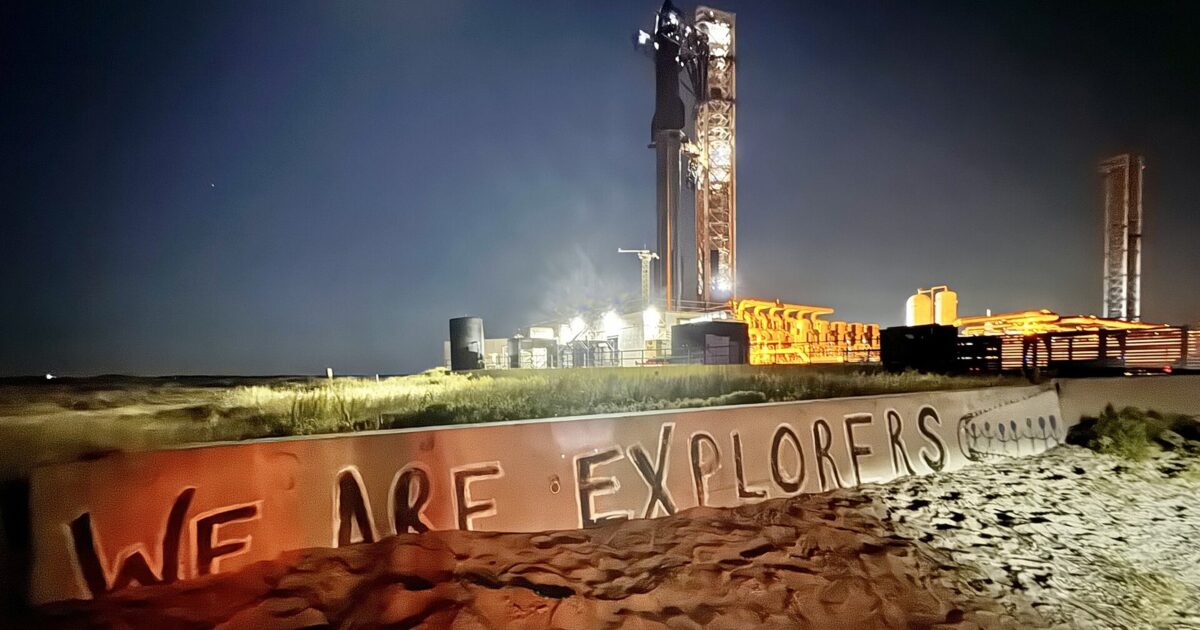
SpaceX just turned a bruising launch week into a milestone flight.
Starship Flight 13 did something the giant rocket had never done before: it released 20 next-generation Starlink V3 test satellites in space.
The upper stage then relit a Raptor engine, survived reentry and finished the job with a soft splashdown in the Indian Ocean.
This was not a routine batch of Starlinks headed into permanent service. These short-lived spacecraft were sent up to prove that Starship and the next generation of the Starlink network can begin working together.
The deployment video showed the new satellites leaving Starship one by one:
Deployment of these V3 satellites will help us test and learn as we prepare to launch the next generation Starlink constellations to orbit https://t.co/A002iIHWLM
— Starlink (@Starlink) July 24, 2026
SpaceX laid out an ambitious test sequence for Flight 13. Super Heavy was supposed to launch, separate, turn back and attempt an offshore landing burn, while Starship carried the payload portion of the mission across the globe.
The upper stage had three major jobs after ascent: deploy 20 Starlink V3 test satellites, restart one Raptor engine in space and gather more entry data before descending into the Indian Ocean.
SpaceX also built hardware and software changes into the flight after engine trouble spoiled Super Heavy’s return on Flight 12. Flight 13 was the second outing for the new V3 generation of Starship and Super Heavy.
Instead of risking a tower catch, SpaceX sent the booster toward an offshore landing point. That let the team test the return sequence while keeping the launch site out of the experiment.
The in-space engine restart came through cleanly:
Starship has successfully ignited one of its Raptor engines while in space, testing a maneuver that will be needed on future orbital missions pic.twitter.com/xjPA2ugZF5
— SpaceX (@SpaceX) July 24, 2026
The restart lasted only long enough to perform the test, but the capability is fundamental. Starship will eventually need reliable in-space engine starts for orbital maneuvering, controlled returns and missions far beyond low Earth orbit.
The Associated Press reports that all 33 Super Heavy engines fired at liftoff after SpaceX replaced six engines following the July 16 launch abort. The ascent worked, but the booster did not complete its offshore return as planned.
Too few engines relit during the landing sequence. Super Heavy came down too fast and struck the Gulf instead of making a controlled splashdown.
Friday’s mission followed a last-second launch abort on July 16 and another delay when thick clouds from Tropical Storm Bertha moved across the area. SpaceX used the extra time to replace six booster engines and get the full stack back to the pad.
Flight 13 was the thirteenth integrated test of the 407-foot rocket and the second flight of the V3 design. Neither stage was meant to be recovered for reuse on this mission, although both were supposed to finish with controlled water landings.
Starship kept going. At roughly 124 miles above Earth, it pushed the 20 V3 test satellites out one at a time.
The spacecraft then connected by laser with older Starlinks already operating in the constellation.
Six of the new satellites carried cameras pointed back at Starship’s heat shield. SpaceX also used pressure sensors and painted some thermal tiles white as part of an experiment simulating missing protection.
The test satellites were expected to fly independently for no more than about 20 minutes before reentering. Their purpose was data, not a permanent orbital deployment.
The upper stage traveled more than 10,000 miles from South Texas toward its Indian Ocean landing zone. Its onboard cameras kept sending views through the final descent.
NASA monitored the flight because a lunar version of Starship is central to the Artemis III landing plan. The agency needs the vehicle to keep advancing toward orbital operations and crewed lunar work.
Flight 13 closed with the upper stage still under control:
Splashdown confirmed! Congratulations to the entire SpaceX team on the 13th flight test of Starship! pic.twitter.com/g27YJCQgiN
— SpaceX (@SpaceX) July 24, 2026
Space.com explained before liftoff that these were the first Starlink V3 spacecraft slated to deploy from Starship in space. They were test vehicles built to reenter, not a normal operational batch that would remain in the constellation.
The full Starship stack stands about 407 feet tall, and all 33 Raptor engines on Super Heavy can generate roughly 18 million pounds of thrust at liftoff. The booster was expected to separate a little more than two minutes into flight before beginning its return.
The upper-stage plan stretched to roughly 65 minutes from launch to splashdown. That gave SpaceX one mission to test payload deployment, an engine restart, heat-shield behavior, guidance and final descent.
The V3 deployment was the payload breakthrough. Starship’s capacity is central to SpaceX’s plan to launch the larger next-generation satellites at a scale Falcon 9 was never designed to handle.
Starship matters to more than SpaceX’s broadband network. NASA is counting on a lunar version of the vehicle for its Artemis landing plans, and every successful flight sequence proves another piece of the system in the real world.
Flight 13 was not a clean sweep. Super Heavy’s failed return burn means the booster team still has real work to do.
The upper stage, however, delivered a powerful run: payload deployment, laser links, camera data, a Raptor restart, controlled entry and splashdown in one flight.
SpaceX still has to repeat those results and bring Starship hardware home for reuse. Friday gave the program something better than hype—it gave engineers a thick stack of real flight data and a new milestone they can build on.
Join the conversation!
Please share your thoughts about this article below. We value your opinions, and would love to see you add to the discussion!