

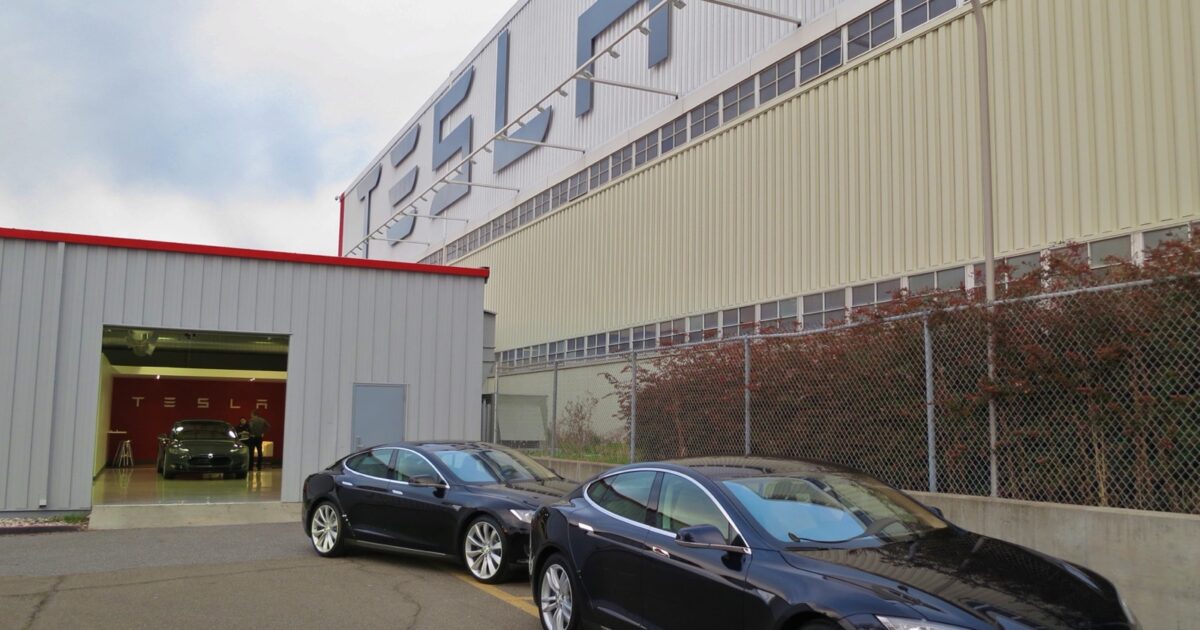
Tesla has now built 10 million vehicles worldwide, and the car that crossed the line did it at Fremont Factory.
The milestone vehicle is a new Model Y. Tesla showed it moving through the Fremont line in a short video released Thursday morning; the company gave no trim, VIN, buyer or destination.
That location matters. Fremont built Tesla’s one-millionth vehicle only six years ago.
This week, the California factory brought the company’s global total to 10 million.
Produced our 10 millionth Tesla globally at Fremont Factory this week!
— Tesla (@Tesla) July 30, 2026
Only 6 years ago, Fremont Factory made our 1 millionth vehicle pic.twitter.com/ps4H6tFgUQ
This is a production milestone, not a delivery or sales milestone. Tesla’s total was built across its global factory network, even though Fremont produced the landmark car.
Drive Tesla reported that Tesla reached nine million vehicles in late December 2025, when a Model Y came off the line at Giga Shanghai. The outlet calculates that only about 209 days separated that car from the 10-millionth vehicle at Fremont.
It also estimates that each of Tesla’s last two million-vehicle intervals took roughly seven months. Drive Tesla’s math comes to about 4,800 vehicles per day across the company’s factories, a useful measure of the production scale behind another million.
The same report notes that the 10-millionth vehicle was another Model Y and ties the milestone to Tesla’s 480,126 second-quarter deliveries, its best second quarter to date. That makes the new marker more than a ceremonial round number: it arrived during a quarter when vehicle deliveries returned to year-over-year growth after two years of declines.
Tesla Investor Relations reported 451,758 vehicles produced from April through June and 480,126 delivered. Model 3 and Model Y accounted for 442,936 of the vehicles built during the quarter.
The higher delivery total does not mean Tesla built 480,126 cars in those three months. Deliveries can draw from vehicles produced in an earlier period, which is why production and deliveries need to stay separate.
Tesla Manufacturing put the people behind the number on camera, showing employees and production work from across the company’s factory system:
10 million vehicles produced globally.
— Tesla Manufacturing (@gigafactories) July 30, 2026
Congrats to all Tesla teams! pic.twitter.com/JkcraR63bs
The two-minute video is the better reminder of what a number this large actually represents. It focuses on the teams and production work behind the milestone as well as the finished Model Y.
Tesla provides another checkpoint in its Q2 2025 update. The company said it produced its eight-millionth vehicle in June 2025, described Model Y as the world’s best-selling vehicle for three straight years and noted the vehicle’s July launch in India.
Roughly thirteen months later, the total is two million higher.
That update also showed how widely Tesla’s capacity had spread by then. The company listed Model 3 and Model Y capacity above 550,000 vehicles a year in California, above 950,000 in Shanghai, above 375,000 in Berlin and above 250,000 in Texas.
Tesla also listed Cybertruck capacity above 125,000 vehicles a year in Texas. Those figures describe installed capacity rather than guaranteed output, but they show the factory footprint that made a two-million-vehicle jump possible in roughly thirteen months.
At that checkpoint, Tesla still listed the Cybercab line in Texas and the Semi line in Nevada as under construction—another reminder that the 10-million total came from the established vehicle lines.
The growth did not happen at Fremont alone. Shanghai, Berlin and Texas turned Tesla into a global manufacturer, while Fremont remains the place where the modern production story began.
The California factory took Tesla from low-volume Model S manufacturing into the Model 3 and Model Y era, and now it owns the symbolic 10-millionth build.
There is also something fitting about the milestone vehicle being a Model Y. Tesla has expanded into trucks, energy storage, robotaxis and robotics, but its global vehicle volume still rests overwhelmingly on Model 3 and Model Y.
The Q2 production mix made that plain: those two products represented nearly 98 percent of Tesla’s vehicle output during the quarter.
Ten million does not answer every question about Tesla’s next phase. It does not guarantee the pace of the next million, settle the company’s production constraints or say how quickly newer products will scale.
But it is a clean measure of what Tesla has already built. A company that spent years fighting to prove electric cars could be manufactured at real scale has now put 10 million vehicles through its factories.
And the car that made the number official rolled out of Fremont.
Join the conversation!
Please share your thoughts about this article below. We value your opinions, and would love to see you add to the discussion!