
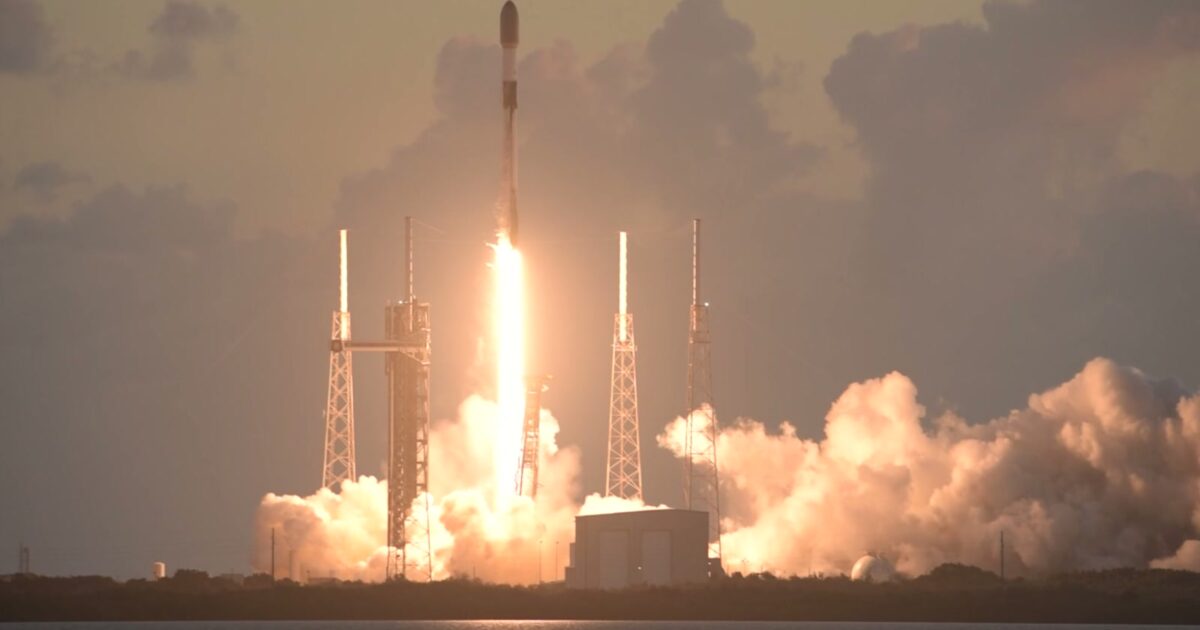
SpaceX put another national-security payload into orbit before most of Florida was awake Thursday morning—and brought the Falcon 9 first stage right back to the Cape.
NROL-95 lifted off from Space Launch Complex 40 at 3:10 a.m. EDT. The National Reconnaissance Office confirmed the payload reached orbit, while the booster completed its return to Landing Zone 2.
The spacecraft remains classified. The parts everyone could see were classic Falcon 9: a clean climb from pad 40, stage separation, and another return to land.
Falcon 9 launches NROL-95 to orbit from pad 40 in Florida pic.twitter.com/ToFvNYwHFj
— SpaceX (@SpaceX) July 30, 2026
The National Reconnaissance Office says the mission paired the agency with U.S. Space Force Space Systems Command, System Delta 80, Space Launch Delta 45, and SpaceX. It was the third NRO mission flown by SpaceX under the National Security Space Launch Phase 2 contract awarded in August 2020.
That partnership is built around assured access to orbit for national-security missions.
NRO launch director Col. Kathryn Cantu said the combined effort is helping field more resilient intelligence, surveillance, and reconnaissance systems while preserving the flexibility needed to respond to changing threats.
The release also points to a faster rhythm ahead. The NRO says it has launched hundreds of satellites over the past several years and expects its 2026 launch frequency to accelerate through the end of the year.
Space Systems Command’s launch team, meanwhile, validated the flight hardware and integration work before Space Launch Delta 45 operated the range for Thursday’s mission.
NROL-95 is a reminder that Falcon 9’s repeatability matters for more than Starlink. The same launch system that routinely builds a commercial broadband constellation is also a workhorse for missions where reliability and schedule discipline carry national-security weight.
The agency posted its own confirmation shortly after the payload reached orbit.
MISSION SUCCESS: NROL-95 launched today at 3:10 a.m. EDT on a @SpaceX Falcon 9 rocket from Cape Canaveral Space Force Station.
Today’s successful mission highlights the close working relationship between NRO and @USSF_SSC.
Press release: https://t.co/YW33hDZhW6 pic.twitter.com/v5dhh05CNS
— NRO (@NRO_gov) July 30, 2026
The NRO press kit identifies the spacecraft only as a national-security payload designed, built, and operated by the agency. It does not disclose the spacecraft’s identity, orbit, or specific intelligence mission, and there is no need to guess.
The kit explains that the NSSL program uses commercial-style contracts and pricing to obtain launch service while preserving the government’s assured access to space. NROL-95 was the NRO’s fourth launch of 2026, following NROL-105, NROL-172, and NROL-179.
It also gives the hardware story behind Thursday’s flight. Falcon 9’s first stage uses nine Merlin engines and produces more than 1.7 million pounds of thrust at sea level.
After stage separation, hypersonic grid fins steer the booster through reentry before the landing burn brings it home.
The fairing protects the payload during ascent and is discarded about three minutes into flight. SpaceX recovers those fairings for reuse, extending the company’s reuse system beyond the first stage.
SLC-40 has its own long history. The complex supported 55 Titan III and Titan IV missions between 1963 and 2005 before SpaceX leased it in 2007 and rebuilt it for Falcon 9.
The rocket made its first flight from the pad in June 2010.
Sixteen years later, the pad is still busy—and Falcon 9 keeps making hard missions look remarkably routine.
That is the real headline from NROL-95. A classified American payload is safely in orbit, the first stage is back on the ground, and the launch team is already moving on to whatever comes next.
Join the conversation!
Please share your thoughts about this article below. We value your opinions, and would love to see you add to the discussion!