
Tesla Powerwalls are being pulled into a new Bay Area experiment with a very practical goal: create more usable grid capacity without waiting years for another major transmission project.
PG&E calls the program SHARE, short for Smart Home Assets for Reliability and Efficiency. Tesla, Sunrun and Renew Home will help enroll nearly 21,000 existing home-energy devices, while Google will fund the customer incentives, technology deployment and program delivery.
Thousands of Powerwalls will meet growing energy demand in San Jose, CA – without delays from building new grid infrastructure https://t.co/54AXMKvvyU
— Tesla Energy (@teslaenergy) September 3, 2026
Tesla Energy’s announcement puts San Jose at the center of the Powerwall portion of the project. The larger program reaches into Santa Clara and Alameda counties, where selected households will also be offered deeply discounted home upgrades, including Carrier battery-enabled heat pumps that can shift when they draw electricity.
PG&E says the enrolled batteries, smart devices and heat pumps will be coordinated as one distributed power plant. During periods of heavy demand, the network can reduce consumption or dispatch stored energy where it is useful instead of leaving thousands of devices to operate as isolated household equipment.
The utility expects the resource to begin supporting the grid as early as fall 2026. PG&E and Demand Side Analytics will handle orchestration, planning and performance validation, with the proof of concept scheduled to run through 2027.
The location is deliberate. SHARE is aimed at places where electricity demand is growing and conventional upgrades can take years to permit and build.
PG&E wants to test whether flexible equipment already sitting in homes can open capacity sooner while larger transmission and distribution projects continue. The utility says the added flexibility could also help serve new businesses and other large electricity users more quickly.
Google’s role is unusually direct. PG&E says the company will fully fund the incentives, new technology and program delivery.
That structure is intended to keep the proof-of-concept costs from falling on existing utility customers while supporting the power needs driving growth in the region. PG&E will still measure customer impacts and system performance before deciding whether the approach deserves a wider rollout.
Rewiring America will work with households and local installers on the new equipment. Eligible customers in Santa Clara and Alameda counties could receive high-efficiency battery-enabled heat pumps, lower monthly energy costs through smarter management and added resilience at home.
Outreach is expected to begin this fall. The partners plan to publish initial findings in late 2026 or early 2027, giving them an early look at customer savings, local grid performance and whether this neighborhood-by-neighborhood approach can be expanded.
Rewiring America will also coordinate with local contractors so the new installations meet program standards. The goal is to combine equipment already in place with carefully targeted upgrades, then test both sides as one resource through 2027 rather than treating SHARE as a one-day emergency program.
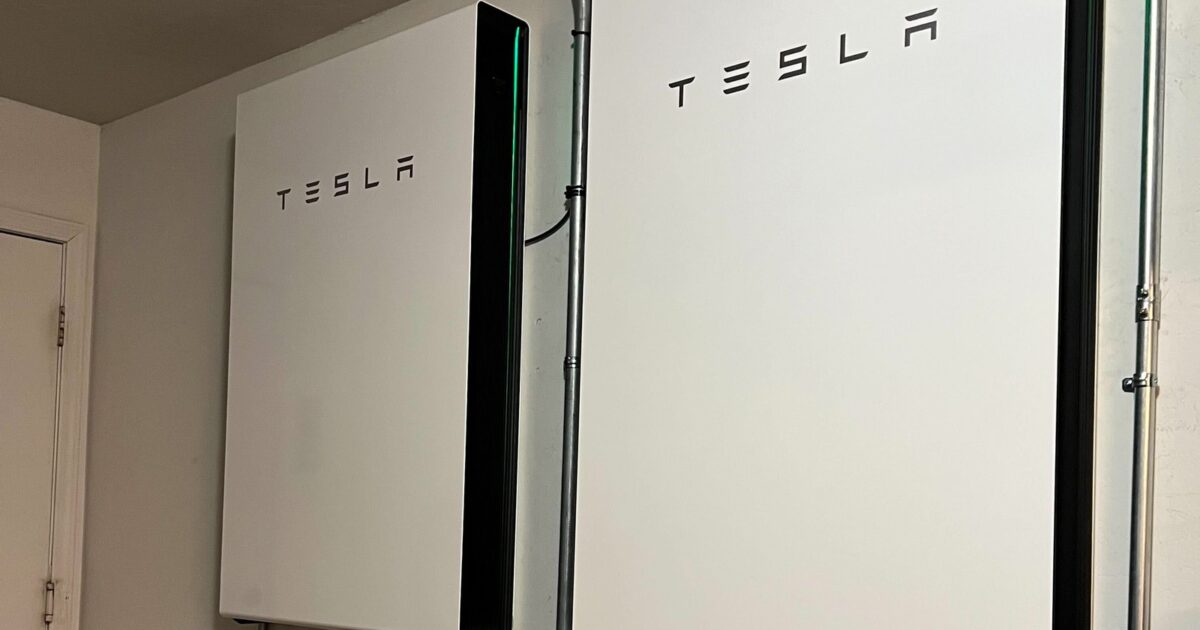
Tesla’s contribution is bigger than shipping white battery boxes. Tesla Energy Software explains that the company runs a common platform across Powerwall, Megapack and other energy products, using forecasting, optimization and real-time control to manage distributed resources.
That software layer is what lets thousands of Powerwalls behave like a single grid asset. A homeowner still has a battery mounted on the wall, but the utility can see a coordinated pool of flexible capacity that can respond quickly when demand rises.
Tesla says the platform can also manage non-Tesla equipment used in microgrids and utility-scale plants. That capability fits SHARE’s mixed fleet, which includes home batteries, smart devices and battery-enabled heating systems from several companies rather than a Powerwall-only network.
Tesla and PG&E already have a separate virtual-power-plant program, so the basic owner experience is not starting from zero. Tesla’s PG&E Virtual Power Plant guide says eligible Powerwall owners in that established program can set a backup reserve, receive notice before events and earn compensation for extra energy delivered to the grid.
Those are the terms of the existing program and should not be assumed for every SHARE participant. They do show how Tesla has already balanced grid dispatch with an owner’s need to keep backup energy available at home.
The new project now has to prove that the model works at a much more targeted level. Coordinating nearly 21,000 existing devices is one challenge; installing new flexible equipment in the neighborhoods where capacity is tight adds another.
If SHARE delivers, Tesla’s Powerwall business gains another showcase for something cars cannot do: turn equipment already distributed across thousands of homes into a grid resource that can be expanded far faster than a conventional power plant.
Join the conversation!
Please share your thoughts about this article below. We value your opinions, and would love to see you add to the discussion!