

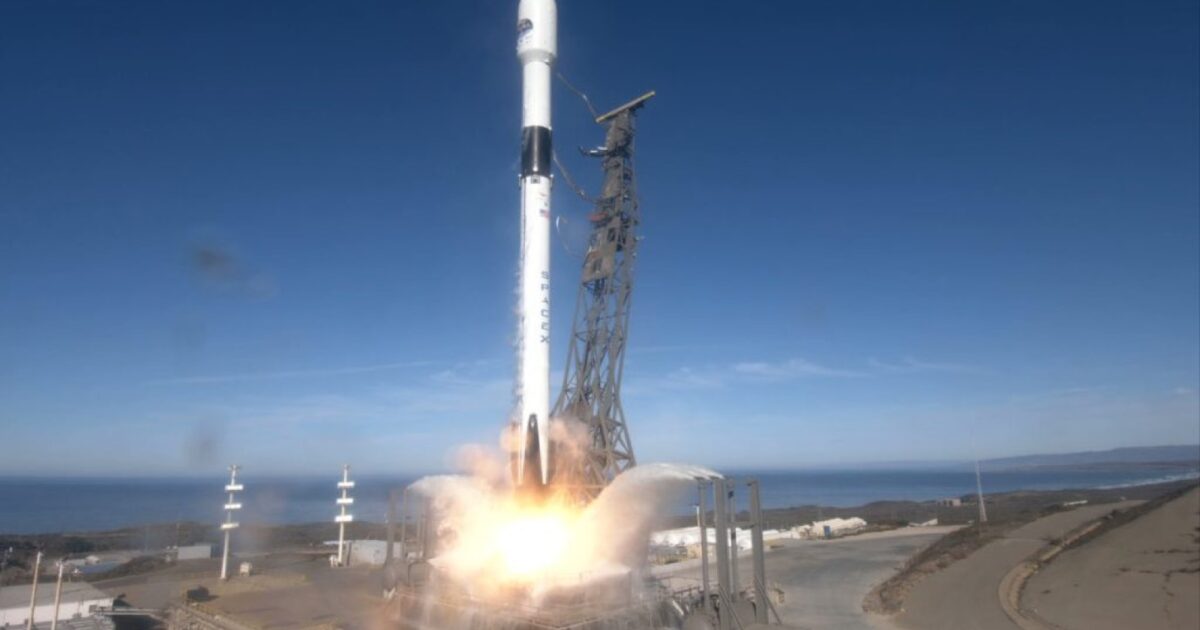
SpaceX sent 27 more Starlink satellites into orbit from California Thursday night, then landed the same Falcon 9 booster for the 36th time.
The Starlink 15-15 mission lifted off from Space Launch Complex 4 East at Vandenberg Space Force Base at 3:48 p.m. Pacific time on October 22 after weather forced three delays.
About eight and a half minutes later, booster B1063 touched down on the drone ship Of Course I Still Love You in the Pacific. SpaceX confirmed deployment of all 27 satellites roughly an hour after launch.
Watch Falcon 9 launch 27 @Starlink satellites to orbit from California https://t.co/7PhslAU5ac
— SpaceX (@SpaceX) October 22, 2026
The launch itself was familiar. The number attached to the booster was not.
SpaceX identified the payload as 27 Starlink satellites flying from Vandenberg on a southbound mission over the Pacific. The company’s webcast showed Falcon 9 clearing the coastal pad, the stages separating normally and B1063 beginning its return while the second stage continued toward orbit.
The first stage then completed its entry and landing burns before settling onto Of Course I Still Love You. That recovery matters because SpaceX’s launch system depends on repeatedly returning the most expensive portion of the rocket instead of discarding it after one flight.
The mission also continued the company’s split-coast Starlink campaign, with California launches serving orbital paths that are especially useful for expanding and refreshing the network.
SpaceX’s deployment confirmation closed the mission’s main operational sequence: launch, stage recovery, orbital insertion and satellite release. B1063 completed all of it on its 36th trip to space.
Next Spaceflight lists B1063 as the first stage for Starlink Group 15-15 and records this as the booster’s 36th mission. Its previous work includes the Sentinel-6 Michael Freilich ocean-monitoring satellite, NASA’s DART asteroid-deflection mission, Transporter-7, Iridium and OneWeb payloads, national-security flights and a long run of Starlink deployments.
That history explains why the flight number is more than a curiosity. B1063 has carried scientific, commercial, defense and broadband missions from the West Coast, then returned for another assignment.
It flew again only 52 days after its previous mission, according to the launch tracker, illustrating how refurbishment and pad scheduling now shape Falcon 9 cadence as much as manufacturing new first stages.
A 36-flight booster would have sounded implausible when Falcon 9 first began landing at sea. It is now working hardware inside SpaceX’s regular manifest, even if weather can still hold the entire system on the ground.
Once the second stage reached the planned deployment point, SpaceX posted the result:
Deployment of 27 @Starlink satellites confirmed
— SpaceX (@SpaceX) October 23, 2026
The short confirmation came after a longer wait than the launch window suggested. SpaceX had to work through repeated weather delays before the rocket finally left California.
Space.com reported that B1063’s landing marked the booster’s 36th successful launch-and-return cycle and noted that DART was among its best-known earlier missions. NASA used DART to test whether a spacecraft impact could alter an asteroid moonlet’s orbit, giving this same first stage a place in a planetary-defense experiment before it became one of SpaceX’s most heavily flown Starlink boosters.
The outlet also counted Starlink 15-15 as SpaceX’s 116th Falcon 9 launch of 2026. That total shows how thoroughly the reusable rocket has become the company’s operational workhorse even while attention shifts toward Starship.
Falcon 9 is still carrying the near-term manifest: crew, cargo, government payloads, commercial spacecraft and the satellites SpaceX needs to maintain its own broadband constellation.
The mission therefore joins two different measures of scale. One is fleet-wide—the number of Falcon 9 launches SpaceX can conduct in a year.
The other is vehicle-specific—the number of times one booster can keep returning to service.
The Tech Signal tracked the difficult run-up to liftoff, reporting that SpaceX scrubbed three earlier attempts as coastal weather interfered with the schedule. The successful launch finally came at 22:48 UTC on October 22, followed by the first-stage landing and confirmation that the 27 satellites had separated from the second stage.
That timeline is useful because a high launch cadence can make these missions look automatic. A flight-proven booster reduces the need to build a new first stage for every mission, but weather, range coordination, drone-ship positioning, stage inspections and precise orbital work remain.
Reusability changes the economics and tempo; it does not turn orbital launch into a routine airline departure.
The report also places the mission inside Starlink’s continuing buildout rather than treating the satellites as an isolated payload. Each group joins a large low-Earth-orbit network that must be expanded, replaced and managed over time.
That recurring demand is one reason Falcon 9 boosters accumulate flight counts that once belonged only to theoretical discussions.
B1063’s 36th landing does not mean the booster can fly forever, and SpaceX has not published a final lifetime limit for this stage.
It does show where Falcon 9 reusability stands today. A rocket that once launched a one-of-a-kind asteroid mission can return years later, survive three weather scrubs, send another 27 satellites toward orbit and land on a moving ship—ready to be inspected for flight 37.
Join the conversation!
Please share your thoughts about this article below. We value your opinions, and would love to see you add to the discussion!