
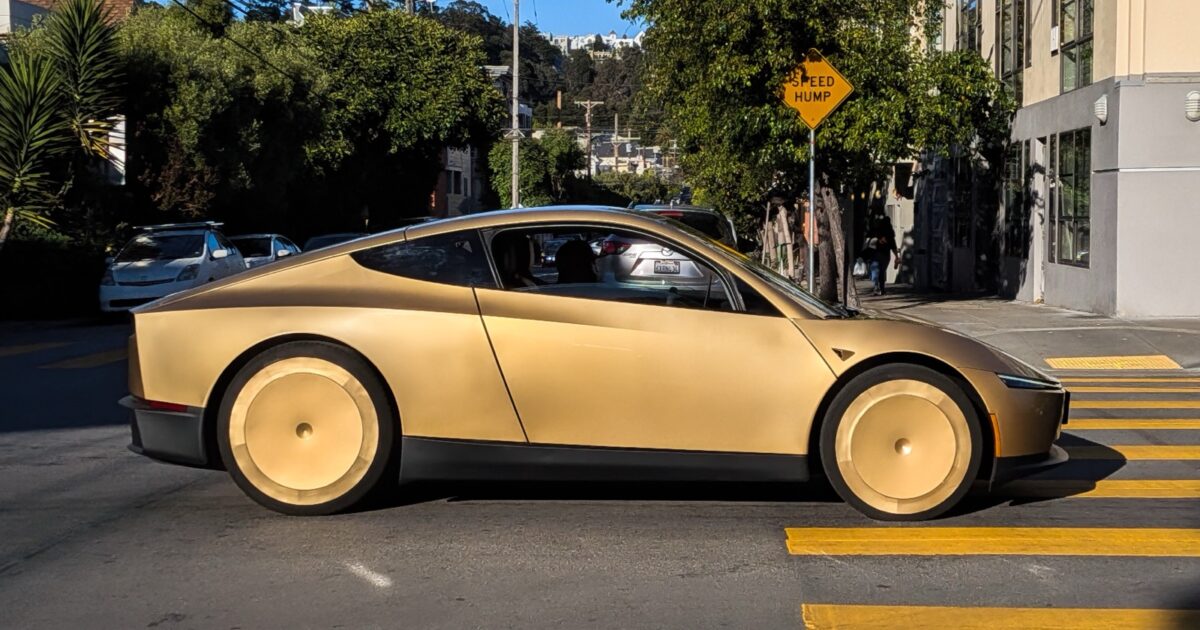
Tesla did not use the United States Grand Prix weekend for a quiet Robotaxi test.
It sent Cybercabs into one of Austin’s toughest traffic surges, stretched the service area to Circuit of the Americas and kept nearby ride requests open until 1 a.m.
By Sunday afternoon, the gold two-seaters were lined up near the track alongside Tesla’s driverless Model Y fleet. After the race, riders were still calling them for the trip home.
This was not a polished launch event with a controlled guest list. It was a public test built around real crowds, real pickup pressure and the messy traffic of Formula 1 weekend.
Tesla AI chief Ashok Elluswamy captured the scale in one same-day post:
Robotaxis as far as the eye can see! 🤩 https://t.co/paOI889y24
— Ashok Elluswamy (@aelluswamy) October 25, 2026
Teslarati reports that Tesla expanded the Austin Robotaxi map toward Circuit of the Americas before race weekend and allowed ride requests until 1 a.m. A message in the app told riders that the late window was limited to nearby drop-offs, while some destinations at the venue initially remained blocked.
The outlet also documented how busy the system became. Cybercab Spotter counted 1,250 Cybercab sightings around Austin on Saturday, beating an earlier single-day high of 1,072.
That is an activity count, not a fleet count. The same vehicle can be seen more than once as it completes multiple trips.
That distinction keeps the numbers honest. Tesla has not said how many rides it completed to or from the circuit, and it has not said whether the track expansion or 1 a.m. service will remain now that the race is over.
The useful fact is simpler. Tesla moved beyond its normal Austin pattern and put a visible number of driverless cars into a large, time-sensitive transportation event.
Formula 1 confirms that the United States Grand Prix ran Sunday at Circuit of the Americas, with the 56-lap race beginning at 3 p.m. Central. The Austin event has drawn enormous crowds for years; Formula 1 notes that the 2022 weekend brought roughly 440,000 people through the gates across three days.
That does not mean 440,000 people attended this year’s race, and Tesla was never going to carry more than a small fraction of the crowd. It does explain why the weekend offered something an ordinary geofence expansion cannot: a predictable wave of riders converging on one difficult destination and leaving at nearly the same time.
For a driverless service, following the route is only the beginning. The fleet must keep cars available, manage pickups, handle congestion and get riders out when demand spikes all at once.
Tesla’s own published data shows the Austin operation already had meaningful mileage before the race.
Tesla lists 3.1 million autonomous Robotaxi miles from January 22 through October 18, including 2,118,015 miles in Austin. The company’s safety report says 862,000 fleet miles occurred after dark, 113,000 in rain and 575,000 during rush hour across its operating cities.
The company reports zero people injured in incidents where Robotaxi made first contact, zero Robotaxi airbag deployments and zero pedestrians or cyclists hit during the covered period. Its methodology says the report includes every collision Tesla submits to federal regulators while a Robotaxi is operating autonomously without a safety monitor, including cases involving remote assistance.
Those figures deserve precision. They are Tesla’s published results through October 18, not an independent audit of the Formula 1 weekend, and the live mileage counter is an estimate based on the fleet’s current pace.
Still, they establish the scale behind Sunday’s scene. The Cybercabs near COTA were not isolated demonstration vehicles.
They were part of an Austin operation that had already logged more than two million autonomous miles.
The post-race demand gave the fleet its second test of the day:
Race is over. People are requesting Cybercabs to get home. pic.twitter.com/YjCnZNy3YP
— Cybercab Spotter (@CybercabSpotter) October 25, 2026
The video matters because it shows the other half of a transportation event. Getting people to a venue can be spread across hours.
Getting them home starts when the checkered flag falls.
Tesla has spent years promising that autonomy would become a service rather than a feature demonstration. Formula 1 weekend offered a glimpse of that transition: cars moving through public streets, responding to rider requests and serving a destination outside the fleet’s usual routine.
Tesla’s Q3 filing says the company has continued expanding and refining Robotaxi operations since the service began in June 2025, including the September 2026 rollout of Cybercab. Tesla describes that rollout as part of a shift toward a service-driven business model built on its autonomy software and mobility infrastructure.
The filing does not turn Sunday’s crowd into proof that the model is finished. Tesla still needs to show how efficiently it can reposition vehicles, prevent long waits, manage charging and maintain service when a city produces repeated peaks instead of one special weekend.
It also needs to disclose more operational data. Ride totals, completion rates, wait times and remote-assistance frequency would tell us far more than sighting counts about how the fleet actually performed.
But the COTA expansion was a meaningful step because it forced the product into a problem every ride-hailing network eventually faces: everybody wants a car at the same time.
The Cybercabs showed up. Tesla’s next job is proving how well they handled the rush.
Join the conversation!
Please share your thoughts about this article below. We value your opinions, and would love to see you add to the discussion!