

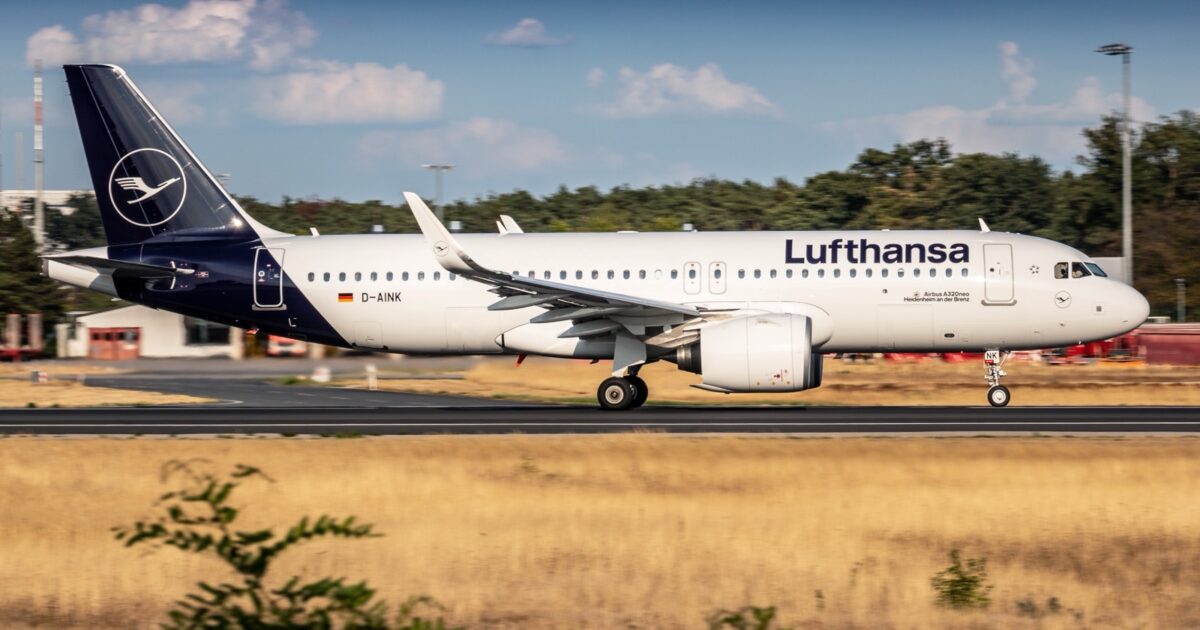
Lufthansa passengers can finally use Starlink in the air.
The airline’s first Starlink-equipped Airbus A320neo entered service today, turning a giant fleet promise into a product real people can use.
The connection goes well beyond messaging, and it is available outside the premium cabins. Travelers can stream, work in the cloud and connect multiple devices in every cabin.
And if they sign in with a free Travel ID or a Miles & More account, the high-speed service costs nothing.
Starlink marked the first day of service with a look at the hardware installation and the connection in use onboard:
Starlink’s high-speed internet is now available onboard @lufthansa 🛰️✈️ pic.twitter.com/KswsHNGk3t
— Starlink (@Starlink) August 19, 2026
The first airplane is only the opening move. Lufthansa Group plans to put Starlink on roughly 850 aircraft across its airlines by 2029.
Lufthansa Group set August 19 as the inaugural flight date when it detailed the rollout earlier this month. The first aircraft is a Lufthansa A320neo, followed by planes from SWISS, Austrian Airlines and Brussels Airlines.
The conversion then reaches the rest of the group: ITA Airways, Edelweiss, Discover Airlines, Air Dolomiti, Lufthansa City Airlines and Eurowings are all preparing for Starlink service.
That is a serious installation program. It spans short-haul aircraft that may fly several legs a day and long-haul jets where a stable connection can change hours of dead time into useful time.
Lufthansa says the system can support video, cloud-based work and other heavy internet use. The airline group calls it the fastest passenger connection currently available in flight and says no other European airline group is planning more Starlink-equipped aircraft.
The service is free in Economy, Premium Economy, Business and First Class for Miles & More customers and Travel ID users. Creating a Travel ID is also free, so the practical barrier is an account login rather than a Wi-Fi charge.
There are still cabin rules. Passengers must use headphones, and Lufthansa does not allow active voice calls, video calls or live broadcasts from the aircraft.
That may be the best possible balance: fast enough to use like normal internet, without turning a quiet cabin into 180 simultaneous conference calls.
Lufthansa Group Wi-Fi identifies the first equipped jet as Airbus A320neo D-AINM. The airline says the connection is designed to stay available from the gate to the destination and work at cruising altitude around 11,000 meters.
Passengers connect to the “Lufthansa Group Wi-Fi” network, open the onboard portal and sign in with a Travel ID or Miles & More service-card number. The same login is intended to work across equipped aircraft throughout the group.
Multiple devices are allowed. Messaging, email, web browsing, streaming and cloud documents are all supported, while passive listening to an online meeting is allowed with headphones.
The first-aircraft stage remains small enough that Lufthansa cannot yet promise Starlink on a particular booking. Its product page says the service is currently limited to selected flights and that a preflight search tool will come after availability expands.
One live A320neo proves the system works in Lufthansa service. Most booked flights will not have it yet.
The direction is clear, and it lines up with SpaceX’s larger plan for Starlink.
SpaceX’s June 2026 prospectus reported about 10.3 million Starlink subscribers and roughly 9,600 broadband and mobile satellites as of March 31. It put median residential download speed at about 225 Mbps during peak hours and median latency near 25 milliseconds.
Airplanes are a different operating environment, but SpaceX says low latency and high throughput are exactly what separates Starlink from older in-flight systems. The company is targeting streaming, real-time work and other uses that used to be impractical in the air, including high-latitude routes where traditional satellite coverage can struggle.
SpaceX also lists Lufthansa alongside United, Southwest, American, Qatar Airways, British Airways, Alaska and Hawaiian among airlines that have installed or committed to fleet-wide Starlink conversions.
That list explains why today’s flight matters. Starlink no longer needs to prove airlines will buy the idea.
Now it has to install fast enough to make slow airplane Wi-Fi feel obsolete.
Lufthansa’s first connected A320neo is a modest start against an 850-aircraft target.
For the passengers onboard today, though, the future of in-flight internet is already here.
Join the conversation!
Please share your thoughts about this article below. We value your opinions, and would love to see you add to the discussion!