

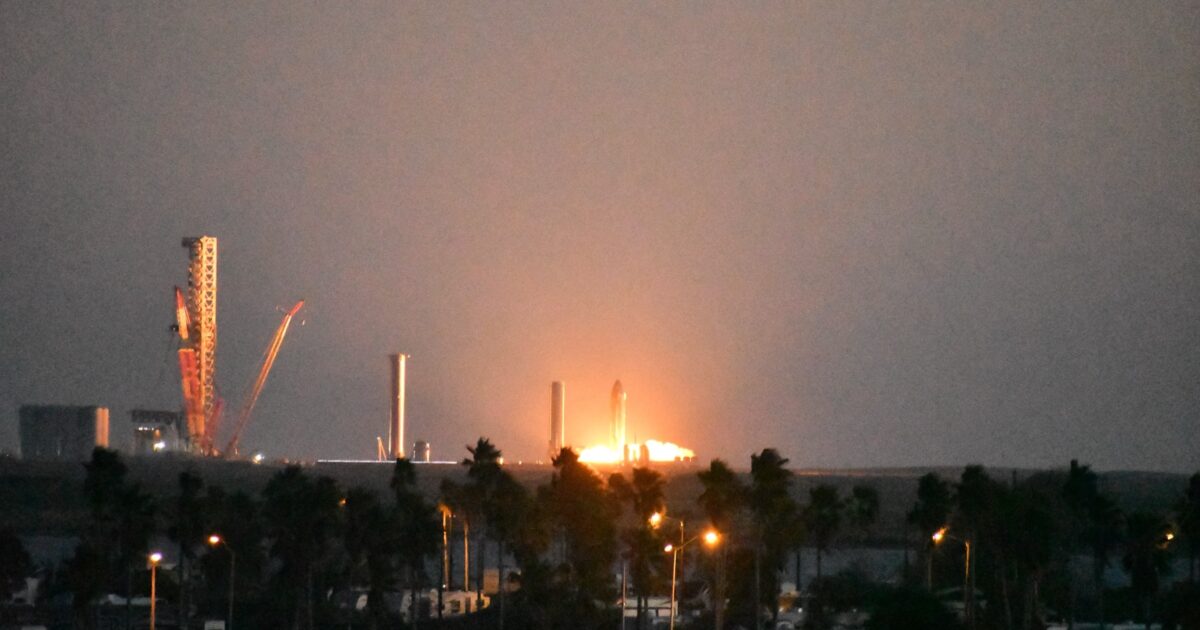
SpaceX just lit up the next Starship.
Ship 41 completed its first static fire late Wednesday night at the Massey’s test site in South Texas. The brief engine firing marked the opening of a test campaign for the upper stage assigned to Starship Flight 14.
It was one engine, roughly 15 seconds, and a whole lot of orange light across the Starbase sky.
Here is the moment Ship 41 fired:
STATIC FIRE: Ship 41 fires up ahead of Starship Flight 14. Opening test, looks like single engine.https://t.co/HSumkyMfYU pic.twitter.com/XkXJU1LglK
— NSF – NASASpaceflight.com (@NASASpaceflight) August 20, 2026
The firing took place shortly after 11 p.m. Central. Live observers described it as a single-engine test lasting about 15 seconds; SpaceX had not posted its own test confirmation as of early Thursday morning.
That distinction matters. Ship 41 has cleared an important first engine check, but it has not finished its ground campaign, and Flight 14 does not yet have a firm launch date.
Next Spaceflight’s Starship tracker lists the August 20 single-engine static fire as complete and identifies Ship 41 as the Version 3 upper stage expected to fly with Super Heavy Booster 21. The tracker currently places Flight 14 no earlier than September rather than treating the old late-August target as settled.
Its readiness board shows why caution is warranted. Only three of 19 listed milestones are marked complete.
Ship 41 and Booster 21 have their Raptor 3 engines installed, and Ship 41 has begun static-fire testing. The booster’s firing campaign still sits ahead.
SpaceX also needs to finish the remaining vehicle tests, move both stages to the launch site, stack them, confirm the mission publicly and close out the usual airspace, maritime and road restrictions. That is a lot of machinery—and paperwork—between one clean flame and liftoff.
Still, this is how Starship campaigns begin to feel real. Hardware that spent months moving through factories, proof tests and transport operations has now fired an engine under its own tanks.
Flight 14 is not a routine repeat of Flight 13. SpaceX has been signaling that the next mission could raise the stakes in two major ways.
Space.com reported after SpaceX’s August 4 earnings call that Elon Musk wanted Flight 14 to attempt the first tower catch of a Starship upper stage, assuming regulators approve the maneuver. SpaceX has caught Super Heavy boosters with Starbase’s giant mechanical arms, but it has never tried to bring the 171-foot Ship back to the tower.
The same report said Flight 14 is intended to carry Starlink V3 satellites into an operational orbit. Flight 13 released 20 V3 test articles on a suborbital path, proving the deployment mechanism without leaving working spacecraft in orbit.
Putting real V3 satellites into orbit would require Ship to complete the orbital mission profile that SpaceX has been building toward. Catching the upper stage afterward would be an even bigger leap: it would turn the most expensive half of Starship from a vehicle recovered at sea into one that could, eventually, be inspected and flown again from the launch site.
Neither goal is guaranteed. The catch depends on regulatory approval and real-time vehicle health, while the mission still has to survive its test program before SpaceX can lock a launch attempt.
What changed the company’s confidence was Flight 13.
Ship 40 survived reentry, made a controlled ocean landing and remained afloat. SpaceX then spent more than three weeks guiding the vehicle toward calmer water near Christmas Island so engineers could get a closer look:
After approx. 24 days at sea, the SpaceX Recovery team successfully guided Starship to a location just off the coast of Christmas Island. A team of SpaceX engineers is on their way to conduct additional analysis on the vehicle in calmer waters before attempting to return it to… pic.twitter.com/h6YYWb0LT5
— SpaceX (@SpaceX) August 18, 2026
That recovery gives SpaceX something far more valuable than a dramatic video. Engineers can examine a flown heat shield, structure, plumbing and control system after an actual high-energy return through the atmosphere.
Ship 41 is the next place those lessons get tested.
SpaceX’s June 2026 prospectus says Starship V3 is designed to carry 100 metric tons to orbit in a fully reusable configuration. The company says future versions could reach 200 metric tons, a scale that only becomes economical if both stages can return and fly repeatedly.
The filing also lays out the immediate business case. SpaceX expects Starship eventually to take launch volume from Falcon 9 and says one Starship could deploy as many as 60 next-generation Starlink V3 satellites at once.
That would deliver roughly 20 times more Starlink downlink capacity per launch than Falcon 9, according to the company.
Those numbers explain why a 15-second engine firing matters. Ship 41 is the upper stage SpaceX wants to send into orbit with working satellites.
If everything lines up, it is also the Ship the company wants to bring back to the tower.
There are many boxes left to check. But overnight, the first one involving fire turned green.
Join the conversation!
Please share your thoughts about this article below. We value your opinions, and would love to see you add to the discussion!