
NASA’s next great space telescope has crossed one of the last major physical milestones separating it from launch.
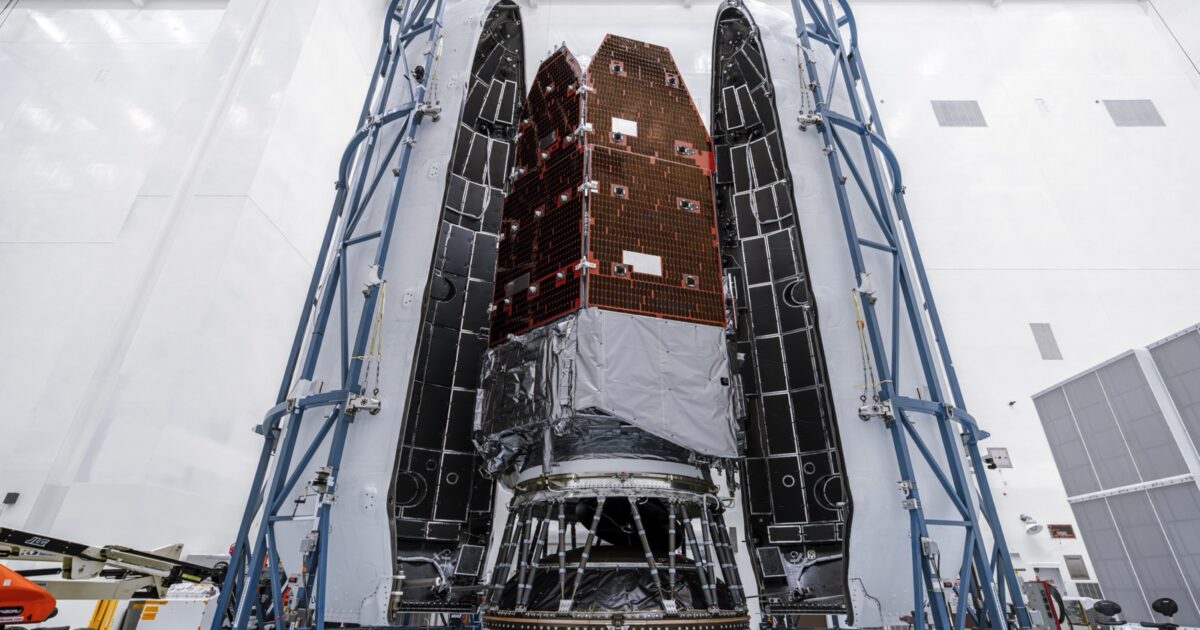
The Nancy Grace Roman Space Telescope is now sealed inside the payload fairing of a SpaceX Falcon Heavy rocket. The operation was completed Friday inside the Payload Hazardous Servicing Facility at NASA’s Kennedy Space Center in Florida.
Roman is no longer sitting in a cleanroom as a finished observatory waiting for a ride. It is packed as flight hardware, protected for the trip to the launch pad and the violent first minutes through Earth’s atmosphere.
SpaceX released the first close look at the completed operation Monday, showing Roman positioned between the two towering halves of the Falcon Heavy fairing.
NASA’s Roman Space Telescope was encapsulated into Falcon Heavy’s fairing this past week ahead of launch on Sunday, August 30 from pad 39A in Florida → https://t.co/oacS4jED83 pic.twitter.com/Qg3Ui1AL46
— SpaceX (@SpaceX) August 24, 2026
NASA says the 43-foot fairing creates a controlled environment around Roman while it is moved and mounted to the rocket. At liftoff, those same composite shells will shield the observatory from acoustic vibration, aerodynamic pressure and heating.
A few minutes into flight, after Falcon Heavy reaches thinner air, the two fairing halves will separate. Roman will continue toward deep space while SpaceX recovers the fairings for future missions.
The next move is short in distance and enormous in consequence. Teams will transport the encapsulated observatory to SpaceX’s hangar at pad 39A and attach it to Falcon Heavy’s upper stage.
Once that integration is complete, the full rocket can roll to Launch Complex 39A for final checks and the countdown.
NASA’s Flight Readiness Review brought NASA, Roman program and SpaceX mission managers together Friday. The teams reviewed the observatory, launch vehicle and mission status, then certified Roman to begin final launch preparations.
The review did not guarantee an August 30 liftoff. It established that the mission was healthy enough to proceed into the tightly controlled sequence of transport, rocket integration, rollout and launch-day operations.
It also closed the loop on months of work at Kennedy. Roman arrived in Florida in June, passed post-shipment inspections, deployed its solar panels for testing, received roughly 290 gallons of hydrazine propellant and completed a full rehearsal of launch-day procedures before managers gave the final-preparation sequence a green light.
The payload still has to reach the hangar without disturbing the observatory’s alignment or contamination controls. Technicians must then connect Roman to Falcon Heavy’s upper stage, verify the combined stack and prepare the rocket for rollout.
Kennedy’s launch team followed Monday with its own confirmation that Roman is packed and that the SpaceX hangar is the next stop.
Roman is packed up and ready to roll! 🚀
NASA's @NASARoman is now encapsulated in the Falcon Heavy fairing ahead of a targeted launch on Aug. 30 from Kennedy.
Next stop, the hangar at Launch Complex 39A. https://t.co/VU2E0Sm0G8 pic.twitter.com/bdqTU82Tra
— NASA's Kennedy Space Center (@NASAKennedy) August 24, 2026
NASA’s Roman launch page lists liftoff for no earlier than 7:26 a.m. EDT, or 6:26 a.m. Central, on Sunday, August 30. Falcon Heavy will depart from pad 39A, the same Kennedy launch complex SpaceX uses for its largest operational rocket.
NASA’s Launch Services Program is managing the launch service for the agency. Weather, technical checks and range conditions still have the final say, so August 30 remains a target rather than a promise.
The launch page will carry NASA’s countdown updates and live coverage as the mission moves toward flight. After liftoff, mission controllers will spend the first months commissioning Roman, deploying its aperture cover, checking its instruments and guiding it into its operating orbit around L2.
That destination sits on the far side of Earth from the Sun. It gives Roman a stable thermal environment and keeps the Sun, Earth and Moon in roughly the same direction from the spacecraft, simplifying the work of shielding sensitive instruments from heat and stray light.
SpaceX has opened a dedicated Roman mission page as the launch approaches. The company is carrying an unusually valuable payload: a flagship observatory built to operate roughly one million miles from Earth at Sun-Earth Lagrange Point 2, commonly called L2.
L2 allows a spacecraft to orbit the Sun while remaining in a stable relationship with Earth. Roman will join the James Webb Space Telescope in that distant neighborhood, where a clear view of the cosmos and a cold, stable operating environment support sensitive infrared observations.
Roman is built around a 7.9-foot primary mirror, the same diameter as Hubble’s. The resemblance ends when the cameras start taking pictures.
Falcon Heavy’s job is to provide the energy needed to send the 18,000-pound-class observatory away from low Earth orbit and onto its transfer path. The mission page will also carry SpaceX’s launch webcast and flight timeline once final launch information is posted.
NASA’s Roman mission overview says the observatory’s 300-megapixel Wide Field Instrument will capture an area of sky at least 100 times larger than Hubble can cover in a comparable image. Roman combines Hubble-like sharpness with the speed of a survey machine.
Over its five-year primary mission, NASA expects the telescope to measure light from a billion galaxies. Those observations will help astronomers study how matter is distributed across the universe and investigate dark energy, the unknown force associated with the universe’s accelerating expansion.
Roman will also search for planets by watching the way gravity from stars and planets bends and magnifies background light. That microlensing survey is designed to find more than 1,000 exoplanets, including worlds that orbit far from their stars and planets that may drift through the galaxy without a star at all.
A separate coronagraph technology demonstration will block the glare of nearby stars so Roman can attempt direct observations of much fainter planets and planet-forming disks. The hardware could help shape instruments for future missions designed to study potentially habitable worlds.
For years, Roman existed as mirrors, detectors, sunshields, electronics and test articles spread across teams and facilities. Those pieces became a spacecraft.
Now that spacecraft is inside the hardware that will carry it off Earth.
Launch weather, range conditions and final technical checks can still move the date. The sight of Roman inside Falcon Heavy’s fairing changes the mission from a distant promise into something far more immediate.
NASA’s newest eye on the universe is packed. SpaceX’s Falcon Heavy is almost ready to take it the rest of the way.
Join the conversation!
Please share your thoughts about this article below. We value your opinions, and would love to see you add to the discussion!