
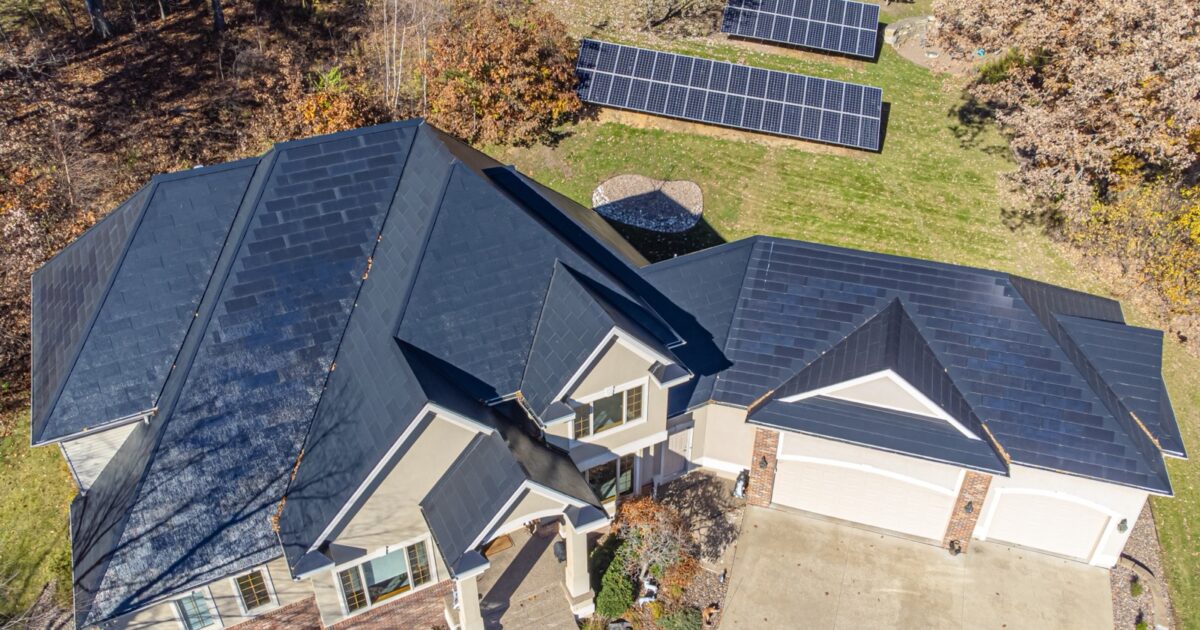
Tesla’s Solar Roof has reached the end of the line after nearly a decade.
The company has reportedly stopped supplying the glass solar tiles to certified installers. Tesla has also removed Solar Roof from its Energy sales menu, and the old product page now sends shoppers to the company’s conventional Solar Panels.
There has been no standalone announcement from Tesla. But the installer communications, the disappearing sales path and the company’s sharp pivot toward a new conventional panel make the direction hard to miss.
Drive Tesla reported that American Home Contractors, a Tesla-certified installer, told customers the product was being discontinued as Tesla shifted its attention to the company’s new solar panels. The installer’s original post was later deleted, but vice president David Silverstein’s public reaction remains live.
“It was a great run,” Silverstein wrote, while pointing to one last push before the installer begins its next chapter. His reaction came from a company that built part of its business around putting these roofs on real homes.
😢 it was a great run. One last push before we start the next chapter (or book) https://t.co/EIQR9GeLms
— David Silverstein (@SolarRoofer) August 20, 2026
The change closes a chapter that started in 2016, when Elon Musk presented a roof that could generate electricity without looking like a conventional rack of solar panels. Solar Roof blended active photovoltaic glass tiles with visually matched inactive tiles, turning the roof itself into the power system.
It was a striking idea. It was also a brutal product to scale.
TechCrunch independently confirmed that Tesla had scrubbed public-facing mentions of Solar Roof and redirected the main product and support sales paths. The outlet also reported that two installers were still offering Solar Roof work, although availability depended on the project timeline.
A discontinued product does not vanish from every active job overnight. Some projects may still be completed with tiles already allocated or held by installers, even though new customers no longer have a normal Tesla sales path.
The deeper problem was economics and complexity. Solar Roof required a roofing project and a solar project to happen together.
Crews had to remove the old roof, install waterproofing, place both active and inactive glass tiles, wire the generating sections and integrate the system with an inverter and, often, Powerwall.
That is a very different proposition from mounting standardized panels above an existing roof. Solar Roof looked cleaner, but every unusual roofline, flashing detail, inspection and labor hour made repeatable installation harder.
In its 2025 annual report, Tesla still described Solar Roof as a consumer product sold directly and through channel customers. It placed the tiles alongside conventional solar panels and Powerwall inside a residential-energy business built around design, installation and ongoing system management.
The filing said Tesla continued to manufacture Solar Roof after numerous engineering iterations. In the same section, Tesla said it began manufacturing a new residential retrofit panel in 2025 and delivered the first units in January 2026.
That filing was published in early 2026 and gave investors no indication that Solar Roof sales were about to disappear. Months later, Tesla is steering prospective customers to conventional panels, a clear contraction of the lineup and a fast simplification of the business.
Tesla introduced its latest in-house Solar Panels in March. The company says they are engineered in California, assembled at Gigafactory New York and built with an all-black appearance, concealed electrical connections and a low-profile skirt.
The technical pitch is practical rather than theatrical. Tesla says its cascading-cell design creates 18 electrical production zones, three times the number in a conventional panel, so shade or dirt on one area does not drag down the entire panel as severely.
That is the new bet: keep the integrated Tesla energy experience, but use a product installers already understand. Pair panels with Powerwall, a Tesla inverter and the Tesla app without asking the roof itself to become a bespoke piece of energy hardware.
The sales retreat immediately raises a harder question for people who already have Solar Roof: who services a 25-year roof when the tiles are no longer being sold?
Tesla’s current Solar Roof warranty remains online. It describes 25-year product and weatherization coverage, plus a module-performance guarantee that calls for at least 95 percent of rated peak power after five years and no more than 0.5 percent annual decline for the following 20 years, subject to the warranty’s terms and exclusions.
Tesla also still hosts Solar Roof manuals, service guidance and owner-support material. Parts availability remains an open question, while the company’s written obligations to existing customers remain in place.
Owners should save their contract, installation records, system serial numbers and the warranty that applied when their roof was installed. If service is needed, Tesla’s own support material warns that work by a technician who is not Tesla-certified may affect warranty coverage.
Solar Roof was one of Tesla’s best-looking ideas. A house could generate its own electricity without advertising a layer of hardware bolted above the shingles.
Elegance did not beat installation math. Conventional panels are easier to manufacture, quote, install and replace one module at a time.
Tesla’s new strategy accepts that reality while keeping Powerwall and the rest of its home-energy ecosystem in the sale.
The Solar Roof did make it onto real homes, and the product proved that solar shingles could look genuinely good. It just never became simple enough to become ordinary.
Join the conversation!
Please share your thoughts about this article below. We value your opinions, and would love to see you add to the discussion!