

NASA and SpaceX have pulled Crew-13 off its September launch target after finding an oxidizer leak in the spacecraft that will carry four people to orbit.
The leak was discovered in Dragon’s propulsion system during standard processing before flight. NASA has not announced a replacement launch date.
This goes beyond a weather delay or a range conflict. Teams are testing the spacecraft, reviewing the data and preparing whatever rework the hardware requires before they put the crew on top of Falcon 9.
NASA’s Kennedy Space Center delivered the schedule change plainly:
NASA and SpaceX are adjusting the launch date for Crew-13 after teams identified an oxidizer leak in Dragon’s propulsion system during standard prelaunch processing. Mission teams are assessing upcoming launch opportunities, and a new target date will be announced once available.…
— NASA's Kennedy Space Center (@NASAKennedy) August 30, 2026
The NASA Crew-13 blog says the leak appeared during routine prelaunch processing, before astronauts were aboard. NASA and SpaceX are now performing additional tests and a joint data review.
The agency says any necessary rework will be completed before launch. It has not disclosed the leak’s size, the exact component involved, whether hardware must be replaced or how long the repair-and-verification cycle may take.
A new launch target will be announced only after that work is far enough along. Until then, the schedule is open.
The notice is deliberately narrow. It confirms a propulsion-system leak and a safety-driven hold, while leaving the failure mechanism, affected hardware and repair timeline to the engineers examining the spacecraft.
No severity estimate or launch opportunity has been published.
It also keeps the launch architecture intact: Crew-13 is still assigned to Dragon and Falcon 9 from Cape Canaveral. The hold is on flight readiness, not on the mission’s purpose or its four-person manifest.
NASA still lists Space Launch Complex 40 at Cape Canaveral Space Force Station as the departure point. Dragon will ride a SpaceX Falcon 9 to the International Space Station.
The live Crew-13 mission page now displays the launch status as “Under Review.” It describes the flight as the 13th crew rotation mission in SpaceX’s NASA transportation program and Dragon’s 14th mission with people when the Demo-2 test flight is included.
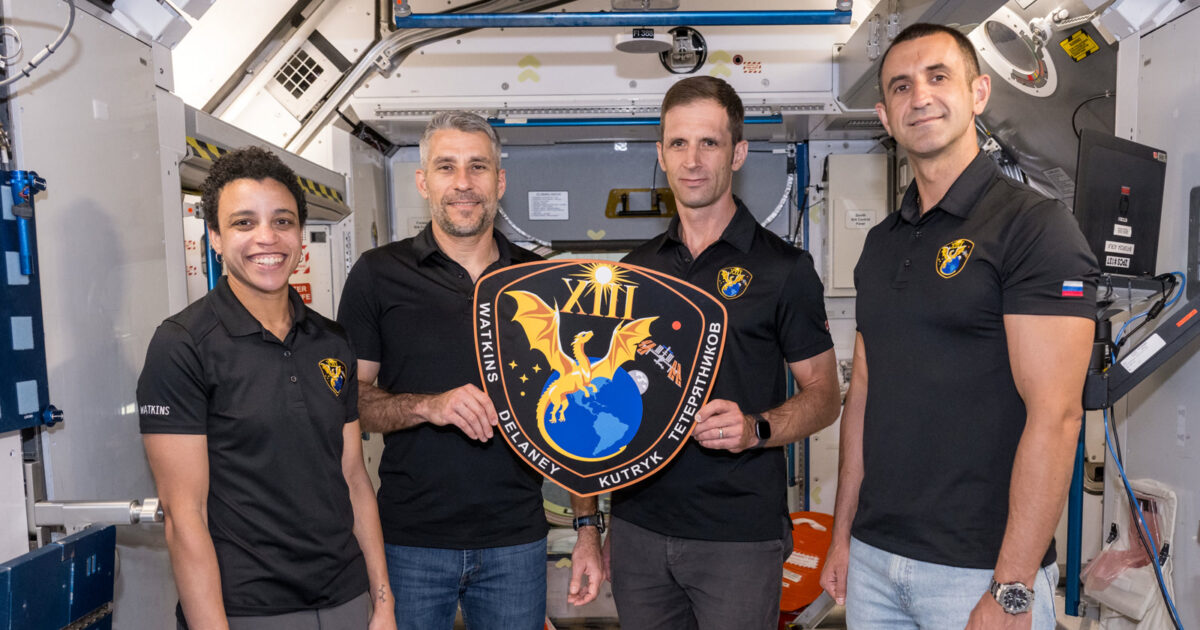
The four-person crew remains unchanged. NASA astronauts Jessica Watkins and Luke Delaney will serve as commander and pilot.
Canadian Space Agency astronaut Joshua Kutryk and Roscosmos cosmonaut Sergey Teteryatnikov are the mission specialists.
After docking, all four are scheduled to join Expedition 75. NASA says the crew will enter quarantine at Johnson Space Center roughly two weeks before flight, which makes the eventual date decision more than a simple launch-pad calendar change and ties it directly to crew preparation in Houston.
The mission page gives a 2027 landing window but does not replace the missing launch day with a new estimate. “Under Review” is the useful status here—not an invitation to guess.
NASA continues to classify Crew-13 as a future human-spaceflight mission and keeps its crew biographies, mission blog and briefing material live. The page preserves the mission while drawing a bright line around the one field engineers cannot yet responsibly fill in.
NASA’s Crew-13 briefing advisory shows what was already in place before the leak changed the plan. The mission had been framed for no earlier than mid-September, and the crew completed its final public briefings before traveling to Florida.
Watkins is the veteran of the group. She spent 170 days in space on Crew-4 and is set to become the first NASA astronaut to launch aboard Dragon twice.
Delaney, Kutryk and Teteryatnikov are all preparing for their first spaceflights. Delaney is a naval aviator and test pilot; Kutryk flew CF-18s and worked as an experimental test pilot; Teteryatnikov came through Russian naval engineering before joining the cosmonaut corps.
That mix of one Dragon veteran and three first-time space fliers is another reason the prelaunch process is supposed to be unforgiving. A leak found on the ground can be studied, repaired and tested without putting the crew in the loop.
Crew-13 had already appeared on WTT in early August when the astronauts completed their final public stop before launch. The oxidizer leak is the development that changes the mission now: the crew is ready, the launch system is identified, but the spacecraft has more work ahead of it.
NASA and SpaceX have not called the mission canceled. They have called the date unsettled—and made clear that Dragon will not fly until the leak is understood and the necessary work is finished.
Join the conversation!
Please share your thoughts about this article below. We value your opinions, and would love to see you add to the discussion!