

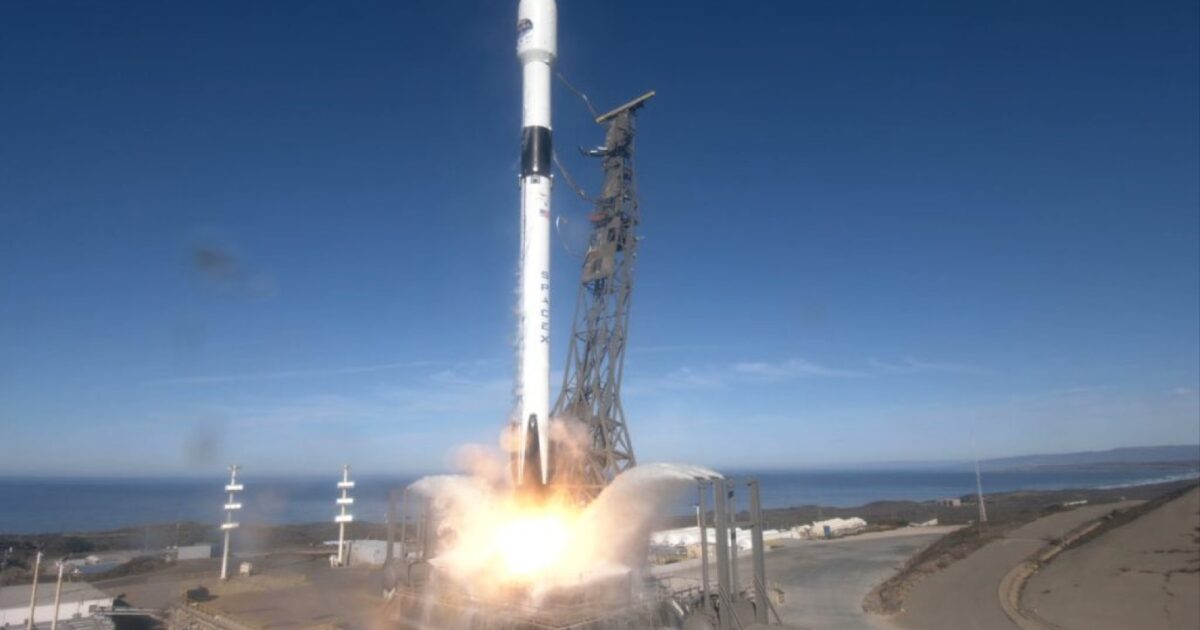
SpaceX has sent one of its most experienced Falcon 9 boosters into the sky for the 35th time—and brought it home again.
Booster B1063 lifted 27 Starlink satellites from Vandenberg Space Force Base early Wednesday morning before landing on the droneship Of Course I Still Love You in the Pacific.
Thirty-five flights on one first stage would have sounded absurd when Falcon 9 began flying. Now it is another working mission in a fleet that has turned rocket reuse from a spectacle into infrastructure.
The SpaceX mission page carried the live Starlink 15-23 coverage from liftoff through deployment. Falcon 9 launched from Space Launch Complex 4 East, sent its second stage and payload toward low Earth orbit, and separated from B1063 a little more than two minutes into flight.
The first stage then reversed roles from launch vehicle to returning aircraft. It completed its entry and landing burns, descended over the Pacific and settled onto Of Course I Still Love You roughly eight and a half minutes after leaving California.
The upper stage continued alone and deployed all 27 Starlink V2 Mini Optimized satellites about an hour after liftoff. That completed the mission rather than merely putting on a dramatic launch-and-landing show.
The Vandenberg Space Force Base notice confirmed the September 2 launch window and Space Launch Complex 4 East as the departure point. The four-hour window opened at 12:46 a.m. Pacific, giving SpaceX room to work through countdown holds without leaving the approved period.
The Western Range supported the flight path down the California coast and over the Pacific. Its teams manage airspace, maritime safety, weather, vehicle monitoring and the launch corridor that allows Falcon 9 to leave Vandenberg without putting the public in its path.
That work begins long before the engines light and continues after the rocket disappears from view. The official notice also directed the public to SpaceX’s mission coverage, connecting the range approval to the live launch operation.
Vandenberg posted the official approval before launch:
The U.S. Space Force has approved the launch of a SpaceX Falcon 9 rocket carrying the Starlink 15-23 mission to low-Earth orbit, Wednesday, Sept. 2, 2026, between 12:46 a.m. – 4:46 a.m. PT from Space Launch Complex 4 East (SLC-4E).
Watch live: https://t.co/Ir2qWBibxa pic.twitter.com/7mscH8fB6A
— Vandenberg Space Force Base (@SLDelta30) September 1, 2026
The numbers behind this flight are where an otherwise routine Starlink mission gets interesting.
Next Spaceflight tracked Starlink 15-23 as B1063’s 35th mission, with 27 satellites aboard and a turnaround of roughly 29 days since the booster’s previous launch. The first-stage destination was the same Pacific droneship that has received B1063 after many of its West Coast flights.
The tracker identifies B1063’s previous assignment as the August 4 Starlink 17-53 mission, also from Vandenberg. Returning the core to SLC-4E, preparing it and flying again before September was the ground-side work behind Wednesday’s 35th-flight headline.
B1063 is not the fleet record holder. SpaceX has already pushed another Falcon 9 first stage beyond this mark.
But 35 flights still places this vehicle in the small group doing the most to define what mature orbital reuse looks like.
It also shows what SpaceX means by a reusable rocket in practice. The company is not preserving an old stage for occasional demonstrations.
It is inspecting, processing and flying the same core again on a cadence measured in weeks, then expecting it to land and return for more work.
B1063’s first assignment was nothing like Wednesday’s broadband deployment.
NASA records the booster’s debut on November 21, 2020, when it launched the Sentinel-6 Michael Freilich satellite from the same Vandenberg complex. The rocket lifted off at 9:17 a.m. Pacific and sent the spacecraft toward an orbit designed for precise ocean observations.
Sentinel-6 was built to extend the long-running record of global sea-level measurements and improve scientists’ view of ocean conditions. The mission also collects atmospheric temperature and humidity data that can strengthen weather and climate models.
That first flight put a new booster under a major international Earth-science mission. The stage returned to Landing Zone 4, giving B1063 its first launch and first recovery on the same day before the vehicle began the long reuse career that reached flight 35 Wednesday.
Less than a year later, SpaceX assigned the booster another mission whose significance had nothing to do with communications satellites.
NASA’s DART mission page identifies Falcon 9 as the vehicle that launched the Double Asteroid Redirection Test from Vandenberg in November 2021. DART was the first mission built to demonstrate asteroid deflection by deliberately striking a small moonlet called Dimorphos.
The spacecraft hit its target in September 2022 and changed Dimorphos’ orbit around the larger asteroid Didymos. A booster that helped start humanity’s first full-scale planetary-defense test has since spent most of its working life building out Starlink.
That contrast is the real story in B1063’s manifest. Ocean science, planetary defense, national-security payloads, commercial rideshare missions and broadband satellites have all shared the same first-stage hardware.
Falcon 9 reuse no longer needs to prove that a rocket can land once. The harder question is how long SpaceX can keep individual boosters flying safely, how quickly it can turn them around and what operating limits eventually retire them.
B1063 just supplied another piece of that answer: flight 35, another successful landing, and 27 more satellites on orbit.
Join the conversation!
Please share your thoughts about this article below. We value your opinions, and would love to see you add to the discussion!