

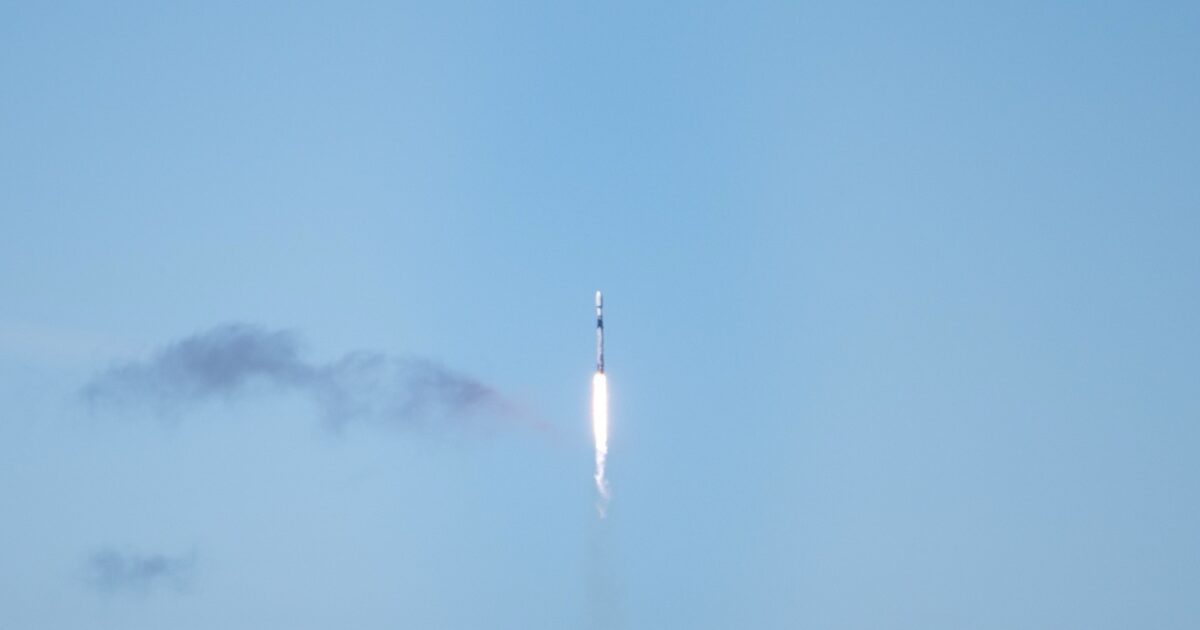
SpaceX is preparing to launch a classified U.S. Space Force mission from California on Thursday morning, and the payload is not the only part of the flight worth watching.
The Falcon 9 first stage assigned to USSF-153 is B1081, a booster making its 27th trip to space. That is a remarkable amount of work for one rocket stage, especially on a mission carrying satellites the government is not publicly identifying.
The three-hour launch window opens September 10 at 8:37 a.m. Pacific, 10:37 a.m. Central and 11:37 a.m. Eastern. Liftoff is scheduled from Space Launch Complex 4 East at Vandenberg Space Force Base.
Spaceflight Now reports that USSF-153 will carry an undisclosed number of satellites to low-Earth orbit. The public timeline ends after the first-stage landing, a familiar restriction on classified launches where SpaceX does not show later second-stage events or payload deployment.
B1081 has already flown four NASA missions, two missions for the National Reconnaissance Office, two for the European Space Agency, two rideshare flights and 16 Starlink missions. After Thursday’s ascent, the booster is scheduled to land on the droneship Of Course I Still Love You roughly eight and a half minutes after liftoff.
The same report identifies USSF-153 as SpaceX’s fifth national-security-related mission of 2026. The earlier flights included NROL-105 in January, NROL-172 in May, a Space Development Agency Tranche 1 mission in July and USSF-366 in August.
That cadence matters because these flights are not interchangeable with ordinary Starlink launches. National-security missions bring a government customer, tighter control over what the public sees and, in this case, no published description of the spacecraft riding above Falcon 9.
Next Spaceflight lists the mission as go for launch, with B1081 assigned to the flight and a recovery attempt planned in the Pacific. The manifest confirms the low-Earth-orbit destination, Vandenberg’s SLC-4E pad and the three-hour window, while leaving the payload details blank.
The booster history is unusually broad. B1081 first flew astronauts on Crew-7, then returned for NASA’s CRS-29 cargo mission.
It later launched the PACE climate spacecraft, ESA’s EarthCARE mission, rideshare payloads, National Reconnaissance Office missions and NASA’s TRACERS satellites before adding more Starlink flights.
That is the practical value of reuse in one hardware record: a single first stage has supported human spaceflight, station logistics, Earth science, intelligence work, commercial rideshares and broadband deployment. USSF-153 adds another government mission to the list.
That missing information has prompted outside analysis. One mission tracker has connected the R-2 designation and launch profile to SpaceX’s government-focused Starshield work and the Space Force’s Space Based Sensing and Targeting portfolio.
SpaceX' next launch from SLC-4E will be another Starshield launch! Scheduled for NET September 10th at 15:37 UTC, the mission is designated USSF-153 or R-2 and likely is the 2nd of 18 scheduled by the end of 2027 for the USSF's Space Based Sensing and Targeting (SBST) portfolio. https://t.co/7jZKGjiXTZ pic.twitter.com/3BZsyVq7wb
— Lukas C. H. (@GewoonLukas_) September 6, 2026
That interpretation remains unconfirmed. Neither SpaceX nor the Space Force has publicly named the satellites, so USSF-153 should not be presented as a confirmed Starshield mission unless one of them says so.
SpaceX has posted the official broadcast destination for the flight. Coverage is expected to begin shortly before liftoff, although launch times can move for weather, range or technical reasons.
For viewers, the most visible action should come early: launch from the California coast, stage separation and the landing attempt. The classified portion will continue out of public view.
SpaceX describes Falcon 9 as the first orbital-class rocket designed to be reflown. The first stage handles the initial climb, separates, steers back through reentry and lands for another possible mission while the upper stage continues with the payload.
Vandenberg is built for a different slice of the launch map than Florida. SpaceX says the California coast gives missions access to high-inclination and polar orbits over open ocean, routes often used by communications, Earth-observation and defense-intelligence satellites.
SpaceX is not saying which orbit inside that broad category USSF-153 will use. The confirmed public description goes no further than low-Earth orbit, and that boundary is part of the story.
B1081 is now an unusually experienced example of that system. Its record spans crew and cargo support, climate and Earth-science spacecraft, intelligence missions, rideshares and a long run of Starlink deployments.
Thursday’s assignment puts that veteran hardware beneath a payload the public may never see. If the launch and landing go as planned, SpaceX will have sent a Space Force mission toward orbit and recovered the same booster for a 27th time—even while the rest of the flight stays deliberately quiet.
Join the conversation!
Please share your thoughts about this article below. We value your opinions, and would love to see you add to the discussion!