

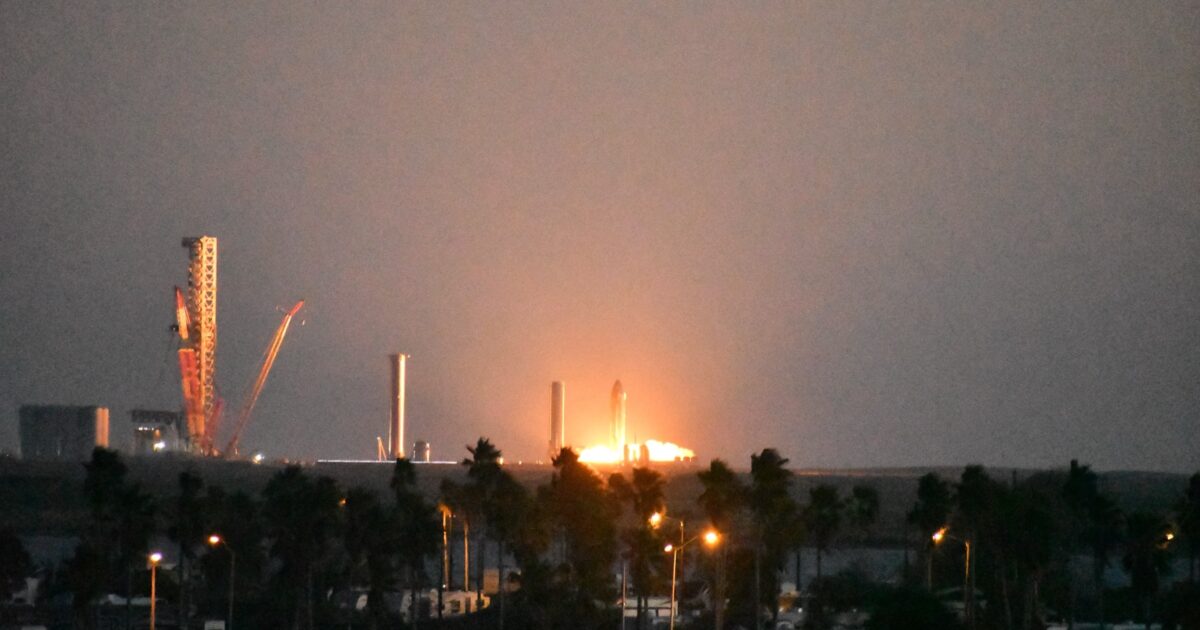
Starship’s next flight is supposed to do more than prove the vehicle can fly.
SpaceX says Flight 14 will carry production Starlink V3 satellites and become the first revenue-generating mission in the Starship program.
That is a meaningful change after years of test flights. Flight 14 is still a development mission, but its payload is meant to strengthen a service that already has paying customers.
The Fly reported the disclosure from SpaceX CFO Bret Johnsen’s appearance at the Goldman Sachs Communacopia + Technology Conference. Johnsen said the flight is planned for later this month and described the shift from demonstration flights to a production cadence.
The payload is the reason he called Flight 14 revenue-generating: SpaceX plans to put production Starlink V3 satellites into orbit. The company has not announced an exact launch date, so “later this month” remains the firmest public timing.
Johnsen’s wording puts two milestones on the same flight. SpaceX wants to begin launching operational V3 hardware while pushing Starship toward the repeatable production cadence its business plan requires.
The planned payload differs from carrying an outside customer’s primary spacecraft. SpaceX will use Starship to deploy its own operating assets for Starlink, where added capacity can support the company’s broadband business.
SpaceX’s Q2 2026 Form 10-Q said all Starship launches through June 30 had been classified as internal. The filing defines a customer launch as one built around an outside customer’s primary payload and mission requirements.
Flight 14 can therefore generate business value without becoming a conventional customer launch. It would move production Starlink hardware aboard Starship for the first time while remaining part of SpaceX’s own network buildout.
The distinction matters because SpaceX has always sold Starship as more than a very large test vehicle. Starlink V3 is where the rocket’s size starts to become commercially useful.
The filing also shows why that transition matters financially. SpaceX recognizes revenue from launch services and from its connectivity business under different arrangements, while Starlink subscriptions depend on the network capacity available to customers.
SpaceX’s 2026 prospectus says each V3 satellite is designed to deliver 1 terabit per second of downlink capacity. The company says Starship can deploy up to 60 V3 satellites at a time.
At those targets, one Starship launch would add about 20 times the downlink capacity of a Falcon 9 launch carrying V2 Mini satellites. SpaceX is aiming to put far more network capacity into orbit with every launch, well beyond an increase in satellite count alone.
The prospectus presents those figures as design and deployment expectations, not guarantees. Flight 14 still has to launch, release its payload and complete enough of its profile for SpaceX to call the mission a success.
Flight 13 supplied some of the engineering work feeding into the next attempt. SpaceX recovered Ship 40 after splashdown and said its teams spent several days inspecting the vehicle in the waters off Christmas Island.
The company collected heatshield samples and said the inspection produced information that will shape improvements on future vehicles:
SpaceX engineers spent several days inspecting Ship 40 in the waters off Christmas Island. They collected heatshield samples and gained vital insight into how the vehicle handled reentry with improvements now planned on future vehicles pic.twitter.com/8NWXpmhlLi
— SpaceX (@SpaceX) August 27, 2026
That is the other half of Flight 14’s story. Production satellites may be riding aboard, but the rocket itself is still evolving from one flight to the next.
The booster assigned to the mission has already completed a major ground test. On August 28, SpaceX fired all 33 Raptor engines for a full-duration static fire:
Full duration 33-engine static fire with the Super Heavy booster preparing for Flight 14 pic.twitter.com/0UXb7tvk7X
— SpaceX (@SpaceX) August 28, 2026
A static fire does not lock in a launch date, and SpaceX still has final testing and regulatory work to clear. It does show that the Flight 14 hardware campaign is well beyond the planning stage.
The pressure on this mission will be different from the first 13 flights. SpaceX is no longer flying only developmental hardware or payload simulators.
Production satellites introduce an asset the company expects to use after deployment.
That raises the stakes, but it also clarifies what Starship is for.
Falcon 9 built the current Starlink constellation. Starship is supposed to make the next generation of that network much faster to deploy and much larger in capacity.
If Flight 14 puts production V3 satellites into orbit, Starship will have crossed an important line. It will still be an experimental launch system—but one carrying hardware intended to earn its keep.
Join the conversation!
Please share your thoughts about this article below. We value your opinions, and would love to see you add to the discussion!