

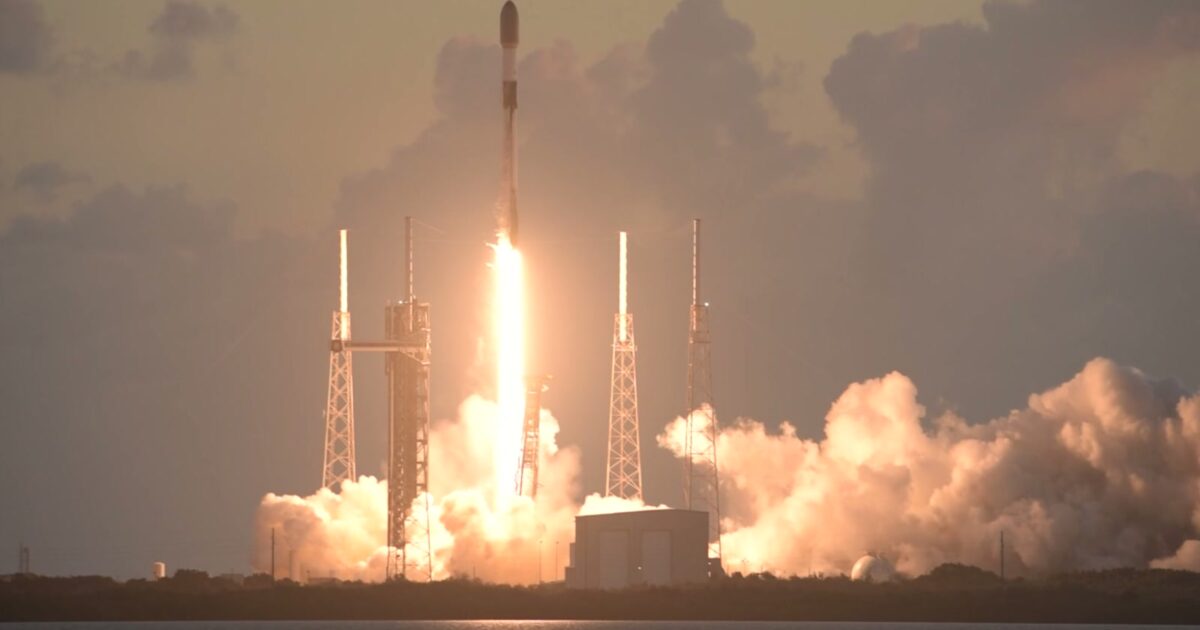
SpaceX’s next Falcon 9 launch is set to finish a satellite network in one unusually packed mission.
The company is scheduled to launch O3b mPOWER 11, 12 and 13 for SES from Cape Canaveral on Sunday, September 13. It will be the first and only O3b mPOWER flight to carry three satellites at once.
Those spacecraft are the final pieces of SES’s initial 13-satellite medium-Earth-orbit constellation.
Next Spaceflight lists the mission as Go for 1:49 p.m. Central from Space Launch Complex 40 at Cape Canaveral Space Force Station.
The mission is assigned to booster B1080 for its 29th flight. After stage separation, SpaceX plans to recover the first stage on the drone ship A Shortfall of Gravitas.
Previous O3b mPOWER launches carried two spacecraft at a time. This flight combines the final three into one Falcon 9 mission, making the payload more consequential than a routine schedule entry.
The payload is headed to medium Earth orbit rather than the low orbit used by Starlink. That higher-energy trajectory and the three-spacecraft stack make the mission profile distinct from SpaceX’s frequent broadband launches, even though the same Falcon 9 workhorse is doing the lifting.
SES says F11, F12 and F13 have arrived at Cape Canaveral and are being prepared for launch. They will join 10 O3b mPOWER satellites already operating in medium Earth orbit.
The complete network is built to add performance, resiliency and reach for mobility, government, enterprise and cloud customers. Rather than chasing the consumer broadband market alone, O3b mPOWER is aimed heavily at high-capacity managed connections for organizations, ships, aircraft and remote operations.
Completing the launch manifest matters because those customers need capacity they can count on across wide operating areas. The final three satellites are intended to strengthen the network rather than begin a separate experimental constellation.
The three spacecraft are real flight hardware, not a rendering or a future order. Boeing showed them stacked after delivery:
The final three — bound for MEO
We’ve delivered O3b mPOWER satellites F11, F12 and F13 to @SES_Satellites. The trio is set to complete the constellation, boosting global, low-latency broadband and mission-ready capacity.
Details: https://t.co/TzYtwR3ckp #O3bmPOWER pic.twitter.com/QQs2gSYOjJ
— Boeing Space (@BoeingSpace) September 2, 2026
Boeing says the satellites use software-defined payloads that can route bandwidth, concentrate beam power and move capacity as demand changes. That flexibility lets SES respond to shifting traffic without locking every coverage decision in before launch or leaving an entire region tied to a fixed allocation for the spacecraft’s operating life.
Boeing points to cruise lines, airlines, mobile operators, government organizations and remote communities as users of the broader MEO network. The same commercial architecture also supplies a technical baseline for hardened military communications programs.
Launch is not the same as immediate service. The spacecraft must separate, raise their orbits and complete initialization before joining the active network.
Boeing and SES expect F11, F12 and F13 to enter service in mid-2027.
The gap gives each satellite time to reach its assigned MEO position and complete the checks required before SES routes customer traffic through it.
That long checkout period comes from the destination. O3b mPOWER operates roughly 8,000 kilometers above Earth—much higher than Starlink’s low-Earth-orbit constellation and far below traditional geostationary satellites.
SES’s O3b mPOWER overview places the constellation about 8,000 kilometers above Earth. The system began providing global connectivity services in April 2024 and now carries traffic for mobile operators, cruise companies, energy businesses, governments and other institutions.
The middle ground is the system’s defining trade. SES can cover large service areas with a relatively small fleet while delivering lower latency than satellites parked more than 35,000 kilometers above the equator.
Falcon 9 has carried every O3b mPOWER spacecraft launched so far. The first pair went up in December 2022, and the network began providing commercial service in April 2024.
Sunday’s flight will complete the launch manifest for the initial constellation. Orbital commissioning will continue afterward, and SES will have all 13 O3b mPOWER satellites in service once the final three clear that process.
For SpaceX, it is another commercial Falcon 9 mission from a pad the company uses constantly. For SES, it is the flight that closes a multi-year deployment campaign in one three-satellite shot.
Join the conversation!
Please share your thoughts about this article below. We value your opinions, and would love to see you add to the discussion!