

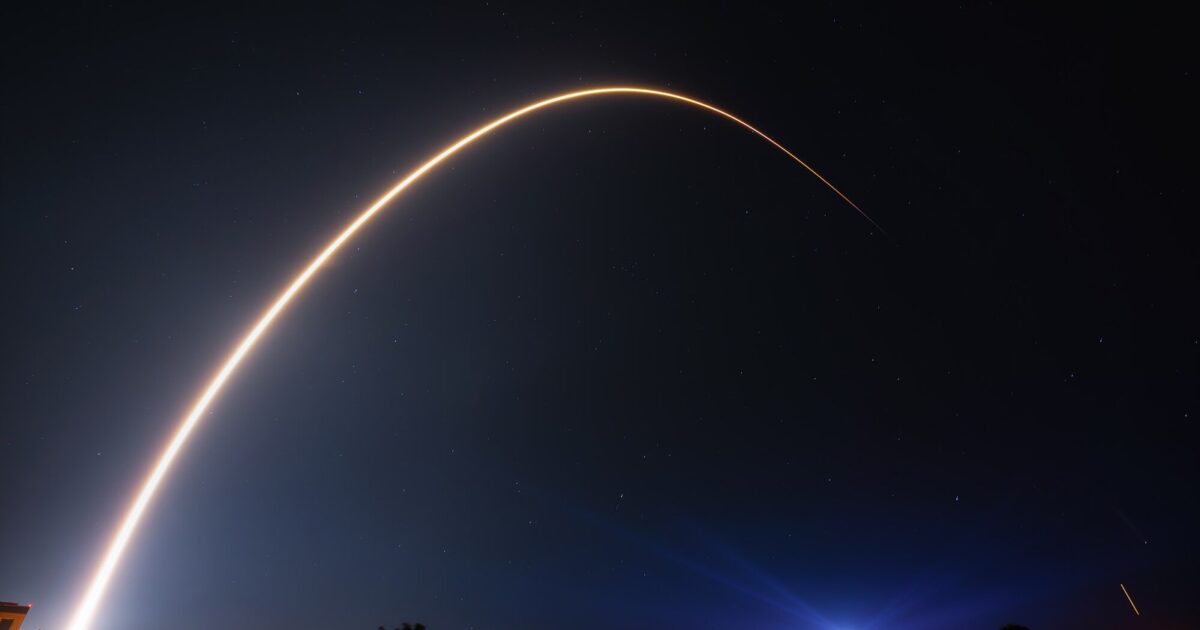
SpaceX has pushed the Falcon program across a new threshold: 700 missions.
The milestone came Sunday as a Falcon 9 launched the last three spacecraft in SES’s initial O3b mPOWER constellation, landed its first stage at sea and completed deployment of the full payload.
Liftoff came from Space Launch Complex 40 at Cape Canaveral Space Force Station at 1:49 p.m. Central. The payload was headed toward medium Earth orbit, far above the low Earth orbit used by Starlink.
The first stage, B1080, was flying for the 29th time. Minutes after launch, SpaceX confirmed another landing on the drone ship A Shortfall of Gravitas:
Falcon 9’s first stage has landed on the A Shortfall of Gravitas droneship pic.twitter.com/rljPtKP85D
— SpaceX (@SpaceX) September 13, 2026
Next Spaceflight records the mission as a success and identifies B1080’s 29th flight as coming after a 61-day turnaround. The same booster has supported a long mix of missions, including human spaceflight, science payloads and Starlink deployments.
The mission carried three Boeing-built spacecraft—O3b mPOWER 11, 12 and 13—with a combined launch mass of roughly 5,100 kilograms. It was the first and only O3b mPOWER flight to carry three satellites at once; previous missions carried pairs.
The site also records a successful landing on A Shortfall of Gravitas. That put the booster recovery alongside the payload milestone instead of making this a one-use sprint to orbit.
Falcon’s 700-mission total rests on a system in which boosters now routinely return, get inspected and fly again.
A 29th mission would once have sounded absurd for an orbital-class first stage. On Sunday, it was part of the operating plan.
SpaceX then confirmed the step that made the flight a full mission success:
Deployment of all three @SES_Satellites O3b mPOWER satellites confirmed
— SpaceX (@SpaceX) September 13, 2026
Boeing identifies the spacecraft as F11, F12 and F13 and says their delivery completed manufacturing for the initial 13-satellite system. The company expects them to enter service in mid-2027 after electric orbit raising and initialization.
The satellites use software-defined payloads that can route bandwidth, focus beam power and move capacity as demand changes. That flexibility is central to the design: O3b mPOWER is not meant to send the same blanket of capacity everywhere at all times.
Boeing says the network serves mobile operators, airlines, cruise lines, governments and other customers that need more than a consumer broadband terminal. The same payload architecture also feeds hardened military communications work, including technology for future U.S. Space Force satellite systems.
The final three spacecraft add capacity to the ten already in orbit. Their launch closes the deployment phase for the initial constellation, but not the work required before all 13 can operate together.
SES places O3b mPOWER at roughly 8,000 kilometers above Earth. That is much higher than Starlink’s low Earth orbit, but far below traditional geostationary satellites parked about 36,000 kilometers up.
The middle orbit gives SES a different set of tradeoffs. It can cover broad regions with far fewer spacecraft than a low-orbit constellation while still targeting roughly 150 milliseconds of predictable satellite latency across large areas.
SES says the system can deliver multiple gigabits per second per terminal and dynamically move forward and return capacity as customer needs change. Its focus is managed connectivity for operations where uptime, committed throughput and stable performance matter—ships, aircraft, remote energy sites, telecom backhaul and government networks.
O3b mPOWER began providing commercial service in April 2024. The final trio now begins its own climb and checkout sequence before adding to that live network.
There is a useful contrast here. SpaceX is best known for launching thousands of its own Starlink satellites, yet mission 700 helped finish a very different broadband architecture for another operator.
Starlink pursues scale through a vast low-orbit fleet. SES is building around a much smaller group of powerful, reconfigurable spacecraft in medium Earth orbit.
The two systems can even complement each other for customers that need both broad low-orbit coverage and committed medium-orbit capacity.
For Falcon, the flight compressed the program’s defining ideas into one afternoon: a high-value payload, a veteran booster, another drone-ship landing and an on-time deployment.
Seven hundred missions is the headline. The more important story is how ordinary SpaceX has made the machinery behind that number look.
Join the conversation!
Please share your thoughts about this article below. We value your opinions, and would love to see you add to the discussion!