

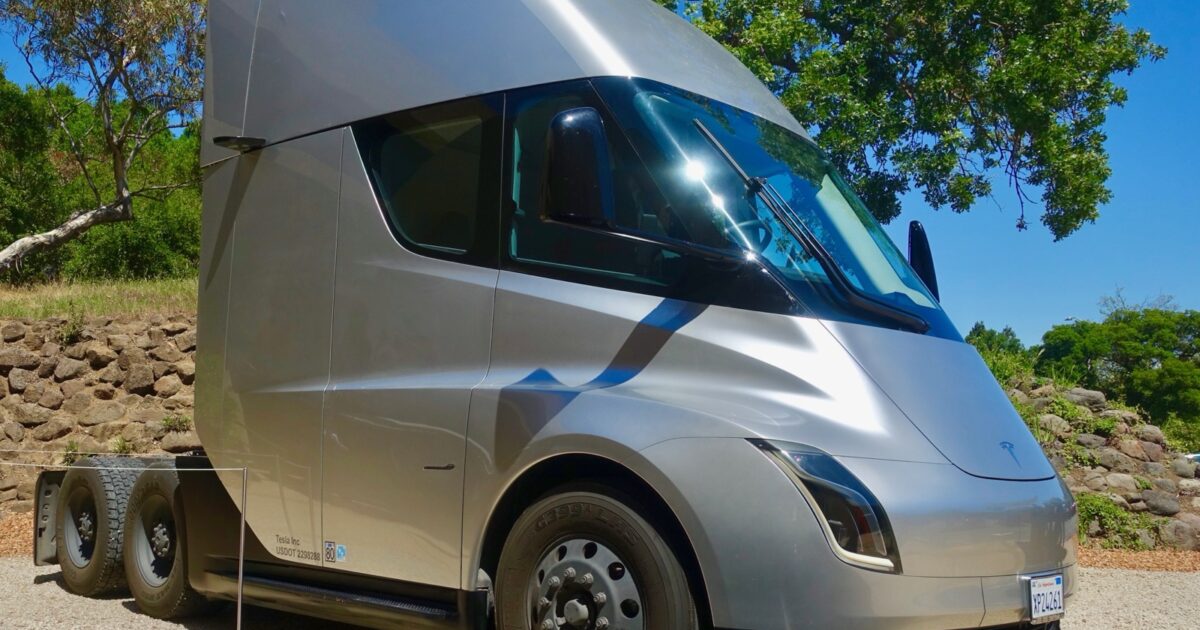
Tesla has finally put hard European numbers on the Semi.
The truck arrives at IAA Transportation in Hannover with an estimated 550 kilometers of range, roughly 342 miles, at a fully loaded gross combination weight of 40 tonnes.
Tesla also lists energy use at 1.0 kWh per kilometer, charging capability up to 800 kW and a curb weight below 9,100 kilograms. Customer deliveries are scheduled to begin in 2027.
Those figures turn Tesla’s earlier promise of a European launch into something fleet operators can actually begin evaluating.
Tesla Europe laid out the headline specifications in one compact announcement:
Semi is coming to Europe
– Up to 550km of range at 40T (fully loaded)
– 1 kWh/km energy consumption
– Megacharger at up to 800 kW recovers ~60% of range in 30 minutes
– ePTO up to 25kW
– 40T gross combination weight, 9,100kg curb weighthttps://t.co/sE4RpWb2w4 pic.twitter.com/swNCxNvfnV— Tesla Europe, Middle East & Africa (@teslaeurope) September 11, 2026
Tesla says the European Semi can recover up to 60 percent of its range in 30 minutes on a Megacharger. The specification also includes an electric power takeoff, or ePTO, rated at up to 25 kW for trailer equipment and other auxiliary loads.
The 550-kilometer estimate comes with important conditions. Tesla bases it on a 40-tonne combination traveling at 80 km/h in 20-degree Celsius weather on flat terrain, using a tandem-axle aerodynamic kit and a dry van trailer.
Tire choice, roof fairing and trailer configuration can all move the real-world number. Tesla is presenting a controlled engineering estimate, not a promise that every fleet route will return 550 kilometers in every season.
Even so, the weight figure is significant. A curb weight below 9,100 kilograms leaves roughly 30,900 kilograms for the trailer and payload before reaching the listed 40-tonne combination limit.
That does not mean every operator gets a 30.9-tonne cargo allowance; trailer weight and equipment come out of the same total. It does show why curb weight matters just as much as range in commercial trucking.
A truck that saves fuel but gives away too much payload is a hard sell.
The European model is a distinct market configuration rather than the longest-range American Semi converted to metric units. Tesla is leading with a truck aimed at the daily distances and weight rules common to European freight.
IAA Transportation opened its Hannover grounds to accredited media on September 14 before the public show runs from September 15 through September 20. The event says more than 80 commercial vehicles are available through its test-drive program, with Tesla among the participating manufacturers.
That gives this debut more substance than a specification page alone. Visitors can see the truck in the environment where European fleet managers are comparing electric tractors, charging systems and operating costs across manufacturers.
IAA says the show includes more than 150 world premieres and new products. Tesla is entering a crowded field where established truck makers already understand the continent’s cab dimensions, axle rules, service expectations and depot economics.
The event’s test-drive program is built around practical comparison, including acceleration, handling, braking and driver experience. For an electric tractor, that puts charging and range claims beside the daily realities of moving a 40-tonne combination.
electrive reports that Tesla’s European Semi is a 6×4 tractor with three independent motors driving its two rear axles. The publication also notes that Tesla has not disclosed the battery specification, European price or which countries will receive the first trucks.
The report places the truck at Tesla’s Hall 12 stand and in the show’s test-drive area. It also highlights Tesla’s planned service approach: dedicated Semi service centers, mobile service where available and certified third-party repair shops.
Those missing commercial details now matter more than another acceleration clip. Fleet buyers need purchase price, charging-site costs, service coverage, financing and a delivery schedule they can build into replacement cycles.
Tesla’s 2027 delivery statement gives Europe a year. It does not yet give operators a month, a price or a market-by-market rollout.
The company has nevertheless crossed an important line. Europe is no longer being asked to judge the Semi from an American demonstration truck and a promise that details are coming later.
There is now a regional specification with a defined loaded range, energy target, charging rate, curb weight and auxiliary-power rating.
The next test is whether Tesla can turn those numbers into dependable freight operations at scale. Hannover is where that conversation starts.
Join the conversation!
Please share your thoughts about this article below. We value your opinions, and would love to see you add to the discussion!