

The Boring Company just gave Tesla hardware a much heavier job.
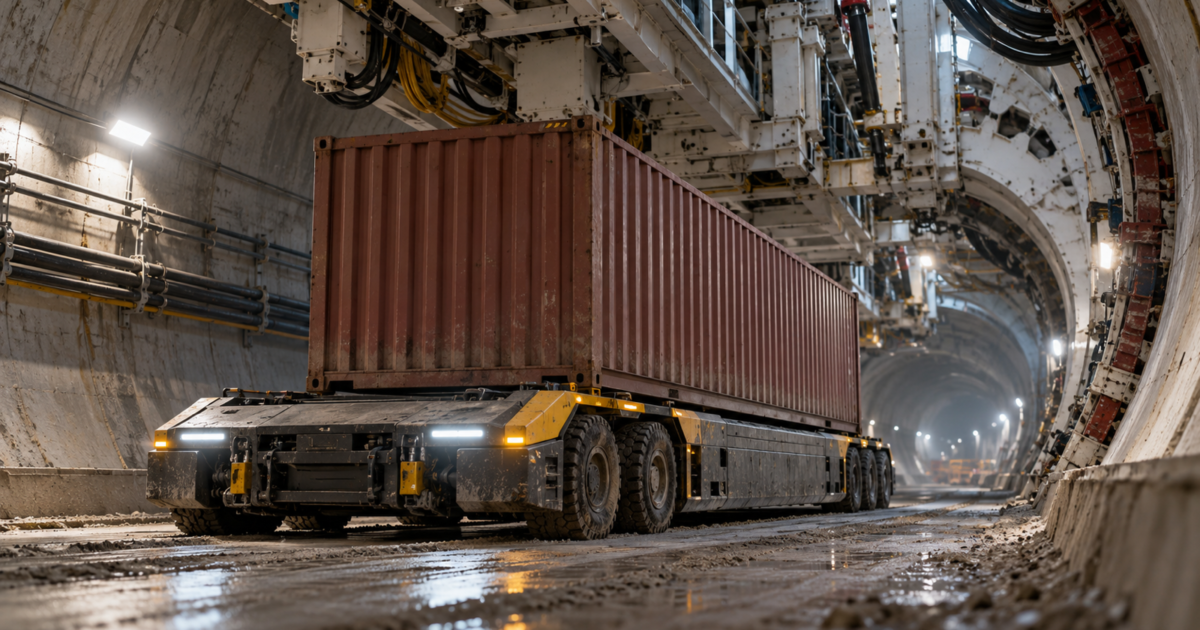
Its latest Prufrock Liner Truck has been modified to carry a standard 20-foot shipping container through a tunnel.
The low-slung electric truck uses Tesla Model 3 batteries and drive units. That turns familiar passenger-car hardware into the backbone of a potential underground freight system.
The company showed the completed configuration Monday, with a red container sitting squarely on the truck’s long white chassis.
Using TBC tunnels to transport freight.
The latest Prufrock Liner Truck (using Tesla Model 3 batteries and drive units) has been modified to carry a standard 20’ shipping container.
Fits like a glove! pic.twitter.com/VV0phWK4fc
— The Boring Company (@boringcompany) October 19, 2026
This is more than a clever photo opportunity.
A 20-foot container is a global freight standard. If the same tunnel vehicle can switch between hauling concrete liner segments and moving containers, The Boring Company gets more use from one specialized platform instead of building a separate machine for every task.
There are still important limits to the announcement.
The company did not name a customer, route, launch date or commercial contract. It did not say how many trucks will receive the modification, how much the container configuration can carry or whether it will use the same remote-control system as Liner Truck 3.
Teslarati reported that the photo shows the container mounted on a long, low chassis with the drive hardware visible at one end. The outlet also noted that the company has not disclosed where freight hauling would begin or when it might move beyond a demonstrated configuration.
The report connects Monday’s reveal to the truck’s original assignment: carrying precast concrete tunnel segments to the boring machine. That work remains essential because Prufrock cannot keep mining efficiently if its supply of liner segments falls behind.
The truck itself is already an unusual piece of Tesla engineering.
When The Boring Company introduced Liner Truck 3 in August, it said the fully electric vehicle could haul more than 22,000 pounds of concrete segments. It listed 28 miles of range and a maximum operating speed of 12 mph.
The Boring Company said when it introduced Liner Truck 3 in August that the vehicle is remotely piloted from its Global Operations Control Center in Texas. One operator can monitor or control more than eight trucks in the field.
That original engineering announcement also listed the truck’s 28-mile range, 12-mph maximum operating speed and ability to move more than 22,000 pounds of tunnel-liner segments. It included a preview of Monday’s news: the same platform could carry standard freight containers through the tunnel.
Monday’s update matters because it moves that claim from a line on a specification sheet to visible hardware.
The Boring Company Prufrock page describes a tunneling system built around remote operation and continuous work. Prufrock is designed to install tunnel lining while it mines, avoiding the repeated stop-and-start process used by conventional machines after roughly every five feet of progress.
The company’s Zero-People-In-Tunnel architecture is meant to keep crews out of the tunnel during normal operations. Machines and support vehicles are controlled from the Bastrop Operations Center, making reliable electric logistics equipment part of the safety design.
That helps explain the Liner Truck’s odd proportions.
It has to fit beneath tunnel equipment, move heavy loads in a confined space and keep working without exhaust fumes from a conventional diesel drivetrain. Model 3 battery packs and motors give The Boring Company a proven electric component base without forcing it to develop every propulsion part from scratch.
There is already a direct Tesla connection underground in Austin.
The Boring Company says its completed Giga Texas Cybertunnel moves finished Cybertrucks from the production line to a staging area on the other side of an eight-lane highway. The underground trip takes about 60 seconds, compared with a previous 12-minute drive on surface roads.
Prufrock 3 excavated that route, emerged inside the already-built factory and was removed on a self-propelled modular transporter. The project is complete and operational, giving Tesla a direct factory-logistics use for Boring Company infrastructure rather than a public demonstration alone.
The Cybertunnel carries finished vehicles. The Boring Company has announced no shipping-container service for Giga Texas.
The completed project still shows the two companies using a purpose-built tunnel to eliminate a real surface bottleneck.
The next test is scale.
The Boring Company says in its October Music City Loop update that Prufrock-MB1 and MB2 are actively tunneling in Nashville, MB3 is preparing for a late-October launch and MB4 is under construction. The company has folded more than 300 upgrades from the first machine into later builds.
The update also describes the support work behind the next launch: excavation, electrical capacity for two boring machines, chilled water, compressed air, networking and cameras. That growing construction fleet will need reliable vehicles moving heavy supplies to the tunnel face without interrupting mining.
A growing fleet creates more demand for support vehicles that can keep tunnel faces supplied. A truck that hauls liner segments during construction and freight after a tunnel opens could be far more valuable than a single-purpose carrier.
But the hard numbers still have to come.
The Boring Company has not published the container setup’s payload, throughput, charging plan, autonomy level or operating cost. It has shown that the box fits. It has not yet shown a complete freight business.
Still, the engineering direction is easy to see.
Tesla built the battery and drive hardware for a mass-market car. The Boring Company is steadily turning those same components into industrial muscle underground.
Join the conversation!
Please share your thoughts about this article below. We value your opinions, and would love to see you add to the discussion!