

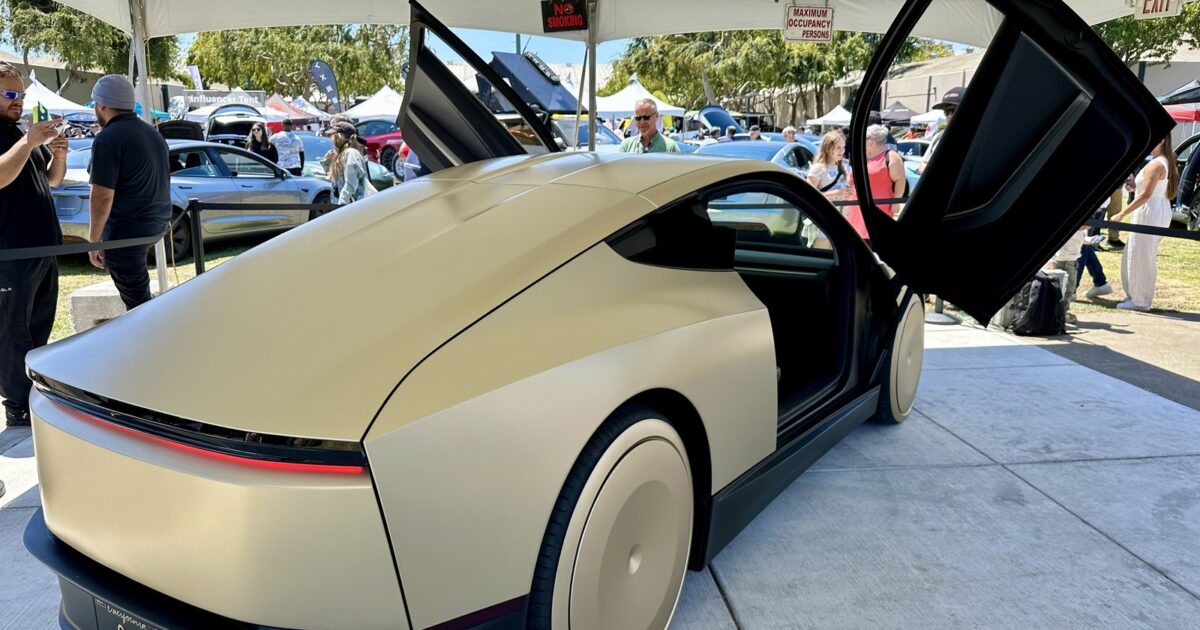
Tesla spent years telling investors that Cybercab would change how cars are built. Now the company says the factory is moving faster than the Robotaxi operation can put those cars to work.
Vice President of Vehicle Engineering Lars Moravy says Tesla does not run the Texas Cybercab line every day because it is already outpacing deployments.
That is an unusual bottleneck for a new vehicle program. The scarce thing is no longer a body coming off the line.
It is the operational work required to register, charge, clean, service and dispatch each car into a growing driverless fleet.
The line itself helps explain how Tesla reached that point so quickly.
Munro Live spent roughly 90 minutes walking through the Cybercab with Moravy and Tesla engineers responsible for manufacturing, batteries, drive units and thermal systems. The camera follows the actual hardware rather than a presentation deck.
The tour shows a production system built around modules instead of a conventional body moving down one long line. Front, rear, side and center sections are assembled and tested separately, then brought together near the end.
Tesla says that final assembly takes about 25 automated stations. A typical Model Y line needs roughly five to ten times as many, according to the comparison discussed during the tour.
The full Cybercab line is about 78% automated today. Its framing line is already at 100%, including robotic delivery of parts.
The modular layout gives robots access from several directions instead of forcing every task through a nearly complete car body. Tesla builds the side sections flat, tests the front and rear modules before final assembly and lowers the body onto a pallet carrying the drive unit, suspension and thermal hardware.
Wheels are installed at the second-to-last station. The first time a Cybercab supports its own weight is essentially when it is ready to leave the line.
That sequence turns final assembly into module joining instead of a long chain of unfinished work.
Tesla’s official Robotaxi account pointed viewers to the complete engineering session:
Cybercab engineering deep dive https://t.co/HyOGI9ebbO
— Robotaxi (@robotaxi) October 26, 2026
The 10-second number deserves careful handling.
Tesla designed the line around a target of 100% automation and a 10-second cycle time. That target forced engineers to remove parts and operations that would never fit inside such a short window.
It does not mean Tesla is currently producing one finished Cybercab every 10 seconds around the clock. Moravy’s own comment that the line does not run every day makes that distinction clear.
The meaningful fact is that line capability has moved ahead of fleet deployment even before Tesla reaches its stated end-state.
Tesla‘s Q3 2026 shareholder update lists installed annual Cybercab manufacturing capacity in Texas at more than 125,000 vehicles. The same table warns that actual output depends on equipment uptime, component supply, factory upgrades, regulatory considerations and other constraints.
The filing says Cybercab entered Tesla’s Austin Robotaxi fleet during the quarter. The broader service reached nearly two million cumulative unsupervised miles by quarter-end, with Austin operating from 6 a.m. to midnight.
Tesla also says it is working to reduce wait times through more vehicles and better fleet-orchestration software. That is the demand side of Moravy’s production race: a factory can make cars faster than an autonomous network can absorb them if service areas, charging, maintenance and dispatch do not scale at the same pace.
Manufacturing still carries real constraints. Tesla says 4680-cell output must rise to support Cybercab, Semi and higher Model Y volume at the same time.
The Cybercab line attacks a different constraint by deleting whole sections of a normal auto plant.
TeslaNorth details how Tesla cut the production footprint by about half per vehicle. The front module alone carries roughly half the car’s parts and arrives at final assembly with its computers connected and its systems already tested.
The wheels go on at the second-to-last station. Until then, the car exists as a collection of verified modules rather than a nearly finished vehicle waiting for more work, which shortens the final path dramatically.
Tesla also removed the conventional paint shop, one of the most expensive and space-hungry areas in an auto factory.
Only the steel side modules receive an anti-corrosion dip coating. The aluminum front and rear castings skip that step, while exterior plastic panels receive their color during molding.
Removing ovens, spray booths and repeated body handling is central to the smaller factory footprint.
Moravy described the paint-shop decision this way:
🚨 Super cool quote from the Cybercab breakdown on the decision to avoid traditional paint:
"One of the most expensive parts of the factory is a paint line… a few hundred million dollars, a million man hours to build one… rule number one at Tesla, question the requirements.… https://t.co/zubq6YPXmQ
— TESLARATI (@Teslarati) October 26, 2026
Deleting paint changes more than factory layout. It changes repair economics.
Color runs through the molded exterior panel rather than sitting only on its surface. Tesla says shallow scratches should not reveal a contrasting undercoat, while more serious damage can still be repaired with compatible coatings.
The same cost-per-mile logic runs through the battery.
The Cybercab pack uses 4680 cells in a steel enclosure. Cells are potted in separate modules, allowing a failed module to be replaced without throwing away the entire battery pack.
Wireless battery-management boards remove an internal wiring harness. Fast reusable contactors replace the one-use pyrotechnic fuse found in many high-voltage packs.
Tesla’s battery director graded the Model Y structural pack a D for manufacturability, the Cybertruck pack a B-minus and the Cybercab pack an A-minus. That blunt internal comparison is more revealing than another polished launch claim.
The car is supposed to cover at least 500,000 miles. A fleet vehicle operating most of the day cannot afford a battery design that turns every electronics fault or minor crash into a full-pack replacement.
The drive unit follows the same pattern. Its 11:1 gear ratio trades away top speed that a city robotaxi does not need, while serviceable electronics and a simplified thermal system target lower lifetime cost.
Teslarati connects the factory disclosure to the rollout now taking shape in Texas. More than 50 Cybercabs worked the Formula 1 weekend in Austin, and Tesla has said Dallas is next in its expansion plan.
Every Cybercab built so far has gone into Tesla’s own fleet. That makes deployment a much bigger job than delivering a normal car to a customer.
Texas registration records cited by the outlet put the Cybercab count at 463. Moravy has also said Tesla is aiming to get Cybercabs to customers before the end of 2026, while the company expects Tesla-owned vehicles to remain the majority of the network.
Those plans add another layer to the rollout. Tesla has to support its own high-utilization fleet while preparing the vehicle, service system and operating model for outside customers.
Tesla must decide where the vehicle can operate, keep it charged and clean, monitor its condition, handle rider support and make sure enough cars are in the right places when demand arrives.
Those are solvable problems, but they are not solved by shaving another second off an assembly station.
Cybercab was always a bet that vehicle design, manufacturing and autonomous fleet operations could be treated as one system. Moravy’s update shows the first part of that system moving ahead of the rest.
That is a better problem than a stalled factory. It is also a warning that Tesla’s next Robotaxi milestone will be measured on streets, not inside Gigafactory Texas.
Join the conversation!
Please share your thoughts about this article below. We value your opinions, and would love to see you add to the discussion!