

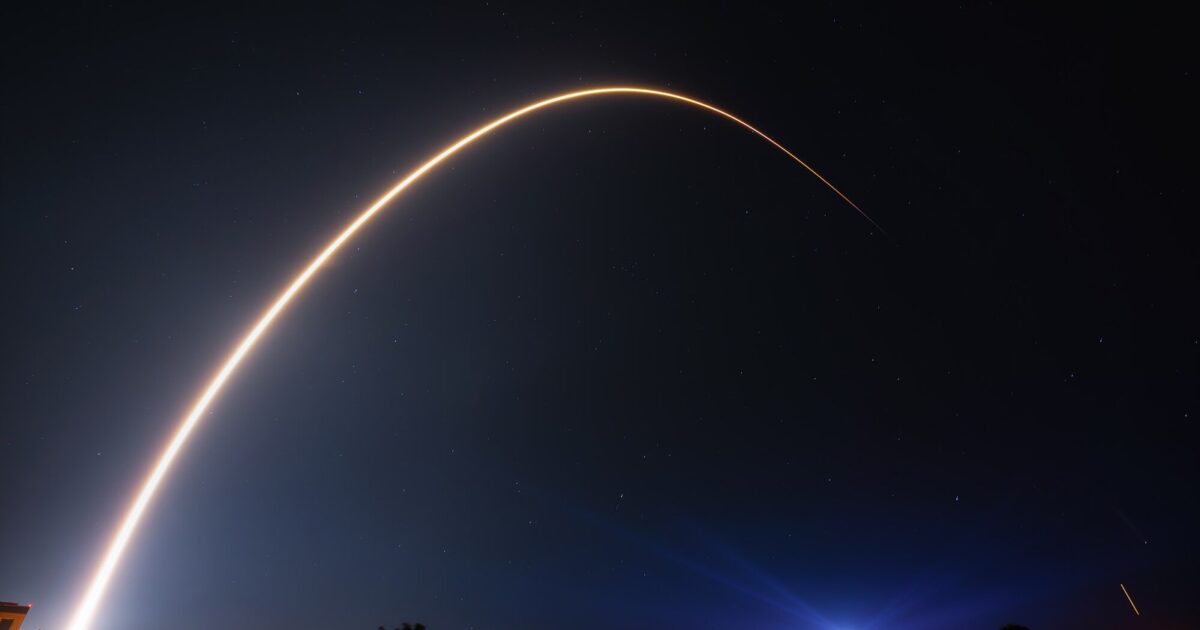
A spent Falcon 9 upper stage is on course to slam into the Moon early Wednesday morning, turning a disposal mistake into one of the most unusual observation opportunities astronomers have had in years.
The impact is expected near Einstein Crater at roughly 1:34 a.m. Central on August 5. The stage will be moving about 5,400 mph.
SpaceX did not plan this collision as a test or landing attempt. The stage is leftover hardware from the January 2025 mission that launched Firefly Aerospace’s Blue Ghost and ispace’s Resilience lunar landers.
Scientists do not expect a lunar emergency. They do expect a new crater, a potentially visible plume, and a rare chance to watch a known object hit at a known time.
The collision-course report is now moving from a forecast into a countdown.
A drifting SpaceX rocket is on a collision course with the moon after launching a pair of lunar landers more than a year ago. https://t.co/FFXkAOSexI pic.twitter.com/MjE9ywfMzi
— ABC7 Eyewitness News (@ABC7) August 1, 2026
The Associated Press reports that orbital analyst Bill Gray expects the impact at about 5,400 mph—roughly seven times the speed of sound—on the Moon’s sunlit limb near Einstein Crater.
The abandoned stage is about 40 feet long and weighs roughly 10,000 pounds. AP says the impact could carve a crater close to 90 feet across and 16 feet deep while throwing dust and broken lunar material high above the surface.
The flash itself may be too faint and too brief to catch. The debris plume is the better target: it could rise for miles and remain visible through sufficiently capable telescopes for tens of minutes.
NASA’s Lunar Reconnaissance Orbiter and South Korea’s Danuri lunar orbiter are expected to collect before-and-after images. Danuri may pass within a mile or two of the stage just two minutes before impact, giving scientists an unusually close piece of the observation campaign.
The latest models make the plume sound almost cinematic, but the numbers are predictions—not a promise of a naked-eye show.
A July 27 ejecta-dynamics study models the upper stage at about 3,900 kilograms and 2.43 kilometers per second. Its simulation puts the main ejecta curtain at roughly 15 to 20 kilometers high, with a central spike potentially reaching 75 to 100 kilometers.
The same model projects material spreading as far as 183 kilometers across the lunar surface. For the first few minutes, dust above the Moon’s edge could stand out sharply against the dark sky behind it.
Sunlit terrain makes the actual impact flash much harder to detect. Telescope size, atmospheric conditions and the precise geometry will decide whether observers see a dramatic plume, a faint streak—or nothing at all.
The crater forecast has given the story a second life far beyond the scientific planning papers.
Current coverage is also focusing on the astronomers preparing to observe the new scar form.
SpaceX rocket stage to crash into moon, creating new crater https://t.co/rRNLNhIkUP
— Just the News (@JustTheNews) August 1, 2026
The rocket stage began this strange trip before dawn at Kennedy Space Center on January 15, 2025.
NASA says Falcon 9 lifted off at 1:11 a.m. Eastern carrying Blue Ghost and 10 agency science and technology instruments. The lander was built to study the lunar environment and test systems meant to help future Artemis crews operate safely.
Blue Ghost went on to complete the first fully successful private lunar landing. The upper stage that helped send it toward the Moon remained in a chaotic Earth-Moon orbit after the payloads separated.
SpaceX did not intend to hit the Moon. A different disposal maneuver could have sent the stage into orbit around the Sun, but gravity and repeated lunar encounters eventually bent this hardware onto a collision course.
The scientific value comes from knowing what is arriving and almost exactly when.
The observational-planning paper brings together researchers from lunar science, impact modeling and professional observatories. It encourages amateur astronomers to join the attempt because a coordinated network can test how well observers locate flashes and plumes on the Moon.
The team also wants to learn how dust moves in the Moon’s low gravity, improve crater-formation models and rehearse methods for future lunar seismic work.
The researchers stress that the event’s visual brightness remains uncertain. A successful detection would help calibrate future instruments, while a non-detection would still narrow the limits of what current telescopes can catch on sunlit lunar terrain.
Natural meteoroids rarely provide advance notice. This impact comes with a known projectile and a tight clock.
There is a longer-term warning in the spectacle. One empty stage hitting an unoccupied patch of lunar terrain carries little risk today.
Traffic around the Moon is growing fast. As landers, orbiters and eventually permanent crews crowd the same region of space, leaving large rocket stages in unpredictable paths will become harder to shrug off.
For now, the accident belongs to the astronomers. Just after 1:30 a.m. Central on Wednesday, telescopes will be trained on the Moon to see whether a discarded Falcon 9 can turn one last burst of energy into useful science.
Join the conversation!
Please share your thoughts about this article below. We value your opinions, and would love to see you add to the discussion!