

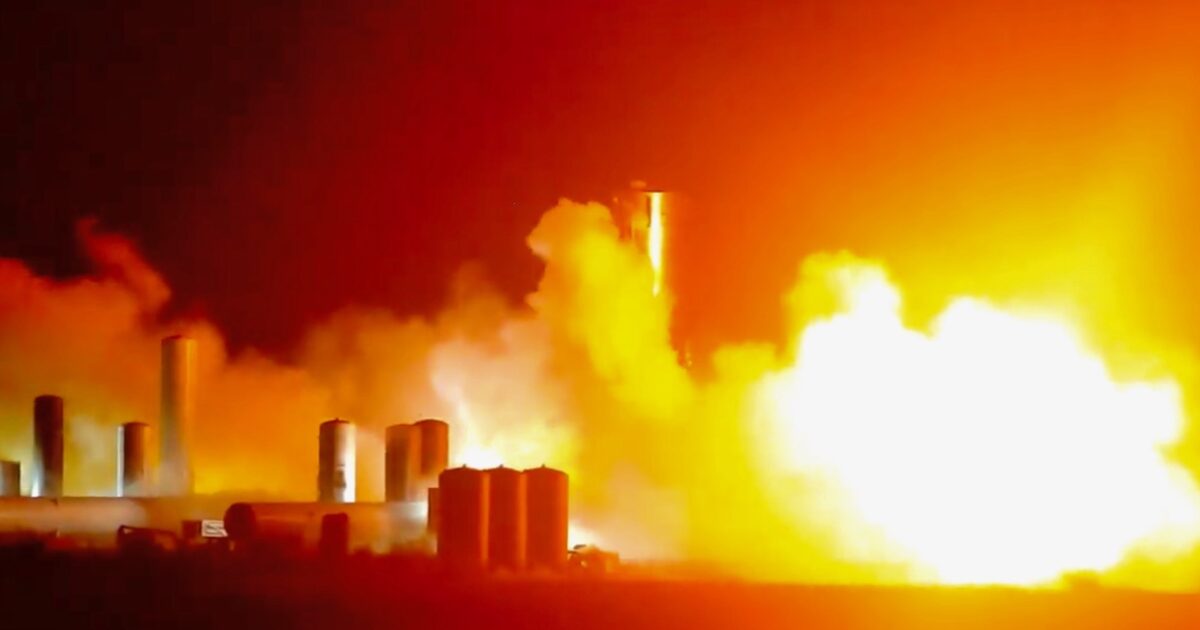
SpaceX just held Ship 41 on the ground and ran all six of its Raptor engines for a full minute.
The company confirmed Friday night that the Starship upper stage being prepared for Flight 14 completed a full-duration, 60-second static fire. It is the biggest engine test Ship 41 has completed in its preflight campaign.
SpaceX released video from several angles:
The Starship preparing for our fourteenth flight test completed a full-duration, 60-second static fire with all six Raptor engines pic.twitter.com/DY11p3KVxU
— SpaceX (@SpaceX) August 21, 2026
A static fire does not send the vehicle anywhere. Ship 41 is loaded with propellant, restrained on the stand and fired while engineers watch the engines, plumbing, tanks, controls and ground equipment behave under flight-like stress.
The length separates this test from the shorter single-engine firing earlier in the week. That earlier burn demonstrated the kind of maneuver Starship will need to leave orbit.
Friday’s test put the entire six-engine set through a sustained run.
The independent live view showed how long 60 seconds feels when six Raptors are turning night into day at Massey:
STATIC FIRE! Ship 41 fires up all six engines as its final big test ahead of Starship Flight 14.
Live on X and YT:https://t.co/5MorOWpjXq pic.twitter.com/tONZ2Cw0OQ
— NSF – NASASpaceflight.com (@NASASpaceflight) August 21, 2026
Ship 41 has now cleared one of the most visible hurdles in front of Flight 14. The rest of the rocket is not there yet.
Next Spaceflight’s Starship tracker identifies Ship 41 as the Version 3 upper stage expected to fly with Super Heavy Booster 21. It marks Ship 41’s proof and static-fire campaigns complete.
The same tracker still shows Booster 21’s engine installation and static-fire campaign unfinished. The booster and ship have not reached the launch site, the full vehicle has not been stacked, and SpaceX has not formally confirmed a launch date.
The public readiness list also leaves the FAA operations advisory, airspace notices, maritime notices, temporary flight restriction and road closure open. Those are the public trail that usually appears as an actual launch attempt comes into focus.
The current mission listing now says no earlier than September 2026, not late August. That date can move again, and SpaceX has not announced a day or launch window.
Next Spaceflight’s Ship 41 record separates the two tests at Massey Outpost. It lists the single-engine deorbit-burn demonstration on August 19 and the six-engine firing on August 20 in local test-site time.
Together, the tests cover two different jobs. Starship needs all six Raptors during ascent, but it also needs reliable single-engine operation for maneuvers that cannot be proven merely by reaching space.
The hardware record also traces two cryogenic proof tests from June, when Ship 41’s tanks were loaded to verify their structural integrity. That sequence puts Friday’s full-duration firing at the end of a campaign that progressed from tank proofing to engine installation, a single-engine maneuver test and finally all six engines together.
Flight 14 is expected to push Starship into a new phase.
The current mission tracker describes it as the program’s first orbital flight. That raises the stakes beyond another long suborbital arc and controlled splashdown.
The most spectacular goal, however, has moved off the immediate schedule.
Space.com reported that Elon Musk now expects the first attempt to catch the Ship upper stage with the launch tower in a few months. Earlier this month, Musk had tentatively pointed to Flight 14 for that attempt, pending regulatory approval.
SpaceX has already caught Super Heavy three times, but Ship returns from much higher and faster. The upper stage has to survive orbital-energy reentry, steer back toward Starbase and arrive at the tower with enough precision for the mechanical arms to take it.
Removing that catch from Flight 14 does not make the mission ordinary. An orbital flight would give SpaceX longer-duration operations, payload work and deorbit performance to prove before it risks bringing Ship back over the launch site.
SpaceX’s Starship page describes a 124.4-meter two-stage vehicle built around full and rapid reuse. The Ship upper stage carries six Raptors, while Super Heavy supplies the 33-engine push off the pad.
Those ambitions depend on the sequence now unfolding at Starbase: proof tests, engine installation, static fires, transport, stacking, countdown rehearsals and regulatory clearance.
SpaceX lists the rocket at nine meters in diameter and says its payload compartment is larger than any fairing now operating or in development. The company intends the system to carry satellites, large space telescopes and cargo to Earth orbit, the Moon and Mars.
Development, manufacturing, testing and launch all converge at Starbase. The hardware may be designed for distant destinations, but Flight 14 first has to clear the remaining work in South Texas.
Ship 41 has done its loudest work on the ground. Booster 21, the launch site and the paperwork now have to catch up.
Sixty seconds of fire is a serious milestone. It is not a launch date.
Join the conversation!
Please share your thoughts about this article below. We value your opinions, and would love to see you add to the discussion!