

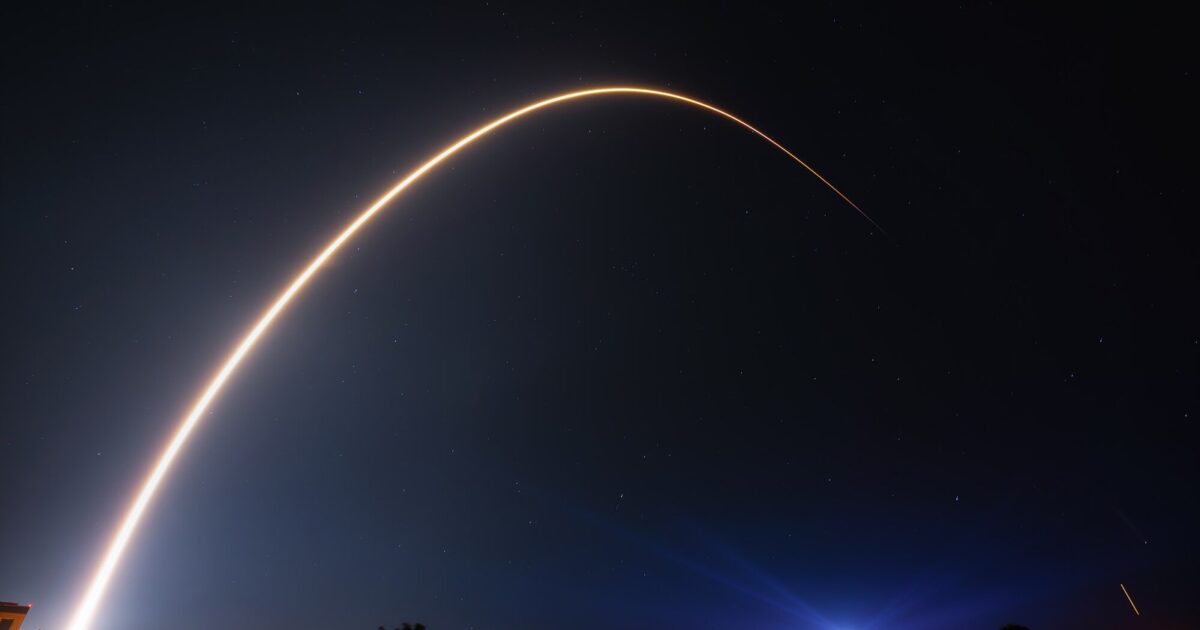
One of SpaceX’s busiest launch chapters has ended with a record.
Starlink 10-49 lifted off from Cape Canaveral early Tuesday carrying 29 satellites. It was the last planned Falcon 9 Starlink mission from Florida, according to the SpaceX executive responsible for launch operations.
The first stage made the moment even bigger. Booster B1067 flew for the 37th time, landed on a droneship and set a new Falcon 9 reuse record.
Florida is not losing Falcon 9 altogether. SpaceX still has customer, crew and cargo missions on the schedule from the Space Coast.
The change is narrower and more consequential: the relentless stream of Falcon-launched Starlink batches from Florida is over. SpaceX says the next Starlink missions from that coast will wait for Starship.
Kiko Dontchev, SpaceX’s vice president of launch, laid out the transition after the mission. Falcon 9 Starlink flights will continue from Vandenberg in California, while Florida shifts that work to Starship.
This morning’s @SpaceX mission from pad 40 was the last planned Falcon 9 Starlink launch from Florida (and it launched on the fleet leading booster!!), marking the end of an era for these launches on the East Coast. From here on, Starlink missions out of Florida will fly on… pic.twitter.com/VG9rTdLg0G
— Kiko Dontchev (@TurkeyBeaver) August 25, 2026
SpaceX identifies the flight as Starlink 10-49, launched from Space Launch Complex 40 at Cape Canaveral Space Force Station. The payload was a batch of 29 satellites bound for low Earth orbit.
The company’s mission record confirms that the satellites deployed successfully after the upper stage completed the orbital portion of the flight. That result closed the Falcon 9 chapter in Florida cleanly: another full Starlink batch delivered, not a transition forced by a failed mission.
SpaceX also kept the distinction precise in its own launch record. Starlink 10-49 was a Falcon 9 mission from SLC-40, the Cape pad that handled the bulk of the company’s recent Florida Starlink pace, rather than a Falcon Heavy flight from nearby Launch Complex 39A.
The launch itself also gave SpaceX a fresh demonstration of the hardware economics that built Starlink.
Space.com reports that Falcon 9 left the pad at 5:33 a.m. Eastern and that B1067 returned to the droneship A Shortfall of Gravitas about eight and a half minutes later. The 29 satellites separated from the upper stage roughly 61 and a half minutes after launch.
The outlet counts this as SpaceX’s 100th Falcon 9 flight of 2026 and its 77th Starlink mission of the year. B1067 first flew in June 2021 and had already carried NASA crews, cargo missions and commercial payloads before piling up 25 Starlink flights.
Thirty-seven flights from one first stage would have sounded outlandish when Falcon 9 first reached orbit in 2010. On Tuesday, it became part of a successful pre-dawn deployment—and then the booster came home again.
SpaceX confirmed the payload was in orbit after the mission.
Deployment of 29 @Starlink satellites confirmed
— SpaceX (@SpaceX) August 25, 2026
The final-Florida designation needs one important qualifier. It applies to planned Falcon 9 Starlink missions from Florida, not every Falcon flight from the state and not every Falcon-launched Starlink mission.
Orlando Sentinel reporting says Florida hosted 32 Starlink launches this year before the cutoff. Dontchev put the longer history at roughly 260 Starlink missions from the Cape over seven years.
Vandenberg remains in the picture. SpaceX will continue using Falcon 9 for Starlink missions from California, while Florida’s upcoming Falcon manifest still includes non-Starlink customers, station cargo and crew flights.
Falcon Heavy work at Launch Complex 39A also continues, including high-profile NASA and commercial payloads.
The immediate effect is a quieter Space Coast schedule. Starlink launches drove much of Florida’s record 109-launch year in 2025, and the 32 Starlink missions flown there this year represented more than two-thirds of SpaceX’s 2026 Space Coast launches before this cutoff.
The Sentinel also notes that Florida still has major SpaceX work ahead, including the Roman Space Telescope on Falcon Heavy, Crew-13 and station resupply flights. Ending one high-volume mission family changes the cadence without closing either of SpaceX’s Florida pads.
SpaceX is building Starship capability at Kennedy Space Center and Cape Canaveral, but the company has not turned Tuesday’s handoff into a guaranteed date for the first operational Florida Starlink flight on Starship. Development and launch-site work still have to meet the ambition.
Starlink describes its next generation as a step change built around Starship’s much larger payload capacity. The official progress report says Starship will carry the new satellites and deliver far more network capacity per launch than Falcon 9 can provide with the current generation.
That is the logic behind leaving a system that plainly works. Falcon 9 and B1067 just delivered 29 more satellites and another textbook landing, but SpaceX wants Starship to move larger spacecraft in batches sized for a network that keeps growing.
The report presents that shift as a capacity decision, not a rejection of Falcon 9’s performance. Current-generation satellites can keep flying from California while SpaceX develops the vehicle and launch infrastructure needed to put the larger generation into orbit from Florida.
Until Starship is ready in Florida, the split is clear.
California keeps launching Starlink on Falcon 9. Florida keeps Falcon for other missions.
The Space Coast’s next Starlink launch is supposed to ride a rocket that has not yet inherited Falcon 9’s extraordinary reliability or cadence.
Falcon 9 did not leave the stage quietly. Its final planned Florida Starlink flight set a reuse record, deployed every satellite and landed the booster—an ending that looked exactly like the era it closed.
Join the conversation!
Please share your thoughts about this article below. We value your opinions, and would love to see you add to the discussion!