

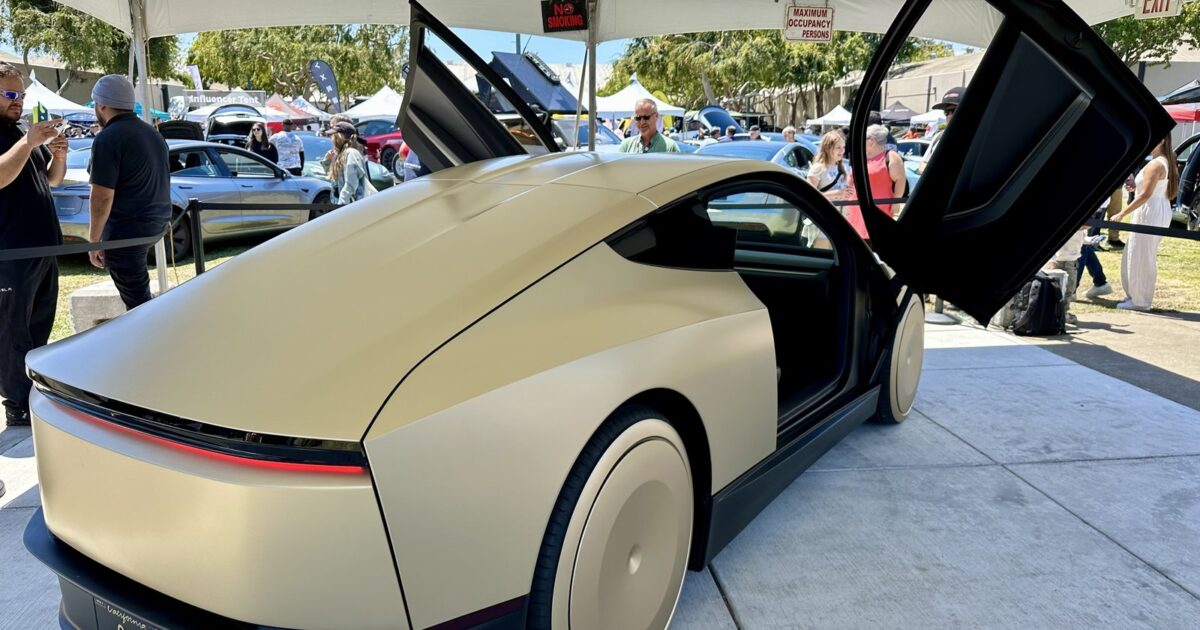
A gold Tesla Cybercab is now driving through Austin with nobody onboard.
New video recorded Friday night shows the purpose-built robotaxi moving with traffic while its two-seat cabin appears completely empty.
No steering wheel. No pedals.
No safety monitor in the passenger seat.
That is a real step beyond the occupied Cybercab test vehicles Austin has been seeing for months.
The street footage captures the empty cabin clearly as the car passes:
FIRST CYBERCAB FULLY AUTONOMOUS DRIVING AROUND WITH NOBODY INSIDE NO STEERING WHEEL NO PEDALS THE FUTURE HAS ARRIVED
Congratulations @elonmusk & the whole @Tesla team! 🖤My brother and I witness a historical moment in time!
🎥 @AdanGuajardo with @artsimage 08.28.2026 Austin, TX pic.twitter.com/wagCJfm07s— Adan Guajardo (@AdanGuajardo) August 29, 2026
The clip shows what it shows: an empty Cybercab traveling on an Austin road.
It does not establish that paid Cybercab rides have begun, that ordinary customers can summon one, or that Tesla has removed remote assistance from the operating system. Tesla has not announced an initial public fleet count or a service map for the car.
The timing still jumps out. Tesla’s Cybercab launch event is only days away.
Tesla describes the Austin gathering as an exclusive event celebrating the launch of its Cybercab robotaxi. The company gave Robotaxi riders one event entry for every completed trip taken August 17 through August 23, while also offering a free mail-in route.
Five winners were scheduled to be selected and notified August 25. Tesla’s terms place the event at 1 Tesla Road in Austin, though the company retains the right to change the date, time, location or format.
The prize is admission to the event and a small package of event items. Winners are responsible for their own transportation, and the invitation cannot be transferred to somebody else.
That page confirms the event and the invitation process. It does not promise that Cybercab passenger service opens to the public the same day.
Tesla put September 3 and Austin on the calendar through its official account:
— Tesla (@Tesla) August 22, 2026
The empty-cabin test is important because Cybercab removes the human fallback built into every Model Y.
A Model Y can still be driven conventionally. Cybercab has no conventional driver controls at all, so its autonomy software, remote-support system, charging operation and emergency procedures have to function as one complete service.
Tesla Investor Relations said in the company’s second-quarter update that Cybercab production had started. Tesla called the two-seat vehicle the purpose-built autonomous EV designed to become the workhorse of its Robotaxi fleet.
The same update showed Tesla moving beyond prototypes and toward fleet deployment. Cybercab is meant to replace Model Ys inside the network over time, giving the company a vehicle built around paid autonomy from the beginning rather than adapted from a retail car.
Tesla’s chart placed cumulative paid Robotaxi mileage at roughly 2.4 million miles by the end of June. The Cybercab program is entering an existing commercial network with real operating history, not waiting for Tesla to create a ride service from scratch.
Friday’s footage fits that progression. A vehicle with no onboard monitor can begin accumulating the street-level operating experience Tesla needs before carrying paying passengers.
Tesla Robotaxi currently describes Cybercab as a purpose-built, fully autonomous vehicle that will bring rides to more areas in the future. The public product page still separates that future from today’s service, which uses Model Ys in the cities Tesla lists.
Those Model Y operations now cover Austin, Dallas and Houston in Texas, plus Miami, Orlando and Tampa in Florida. The company presents Cybercab as the next vehicle for that network rather than a separate ride-hailing product.
Tesla has not yet added a Cybercab launch city, fleet size or September 3 service boundary to that page. The empty Austin vehicle therefore looks like late-stage operating work, not proof that the app has quietly opened Cybercab rides to everyone.
The company is also building procedures for the moments when an empty car needs human help.
Tesla First Responders now carries a dedicated Cybercab interaction plan, emergency response guide and rescue sheet. Tesla says those materials are for situations involving an autonomous Cybercab in Robotaxi service, and it offers direct training to public-safety agencies.
The Cybercab documents sit apart from the Model Y Robotaxi package. That distinction reflects the practical challenge of a car that cannot be moved with a steering wheel or pedals after an incident and may need Tesla support to secure or relocate it.
A public-road test with nobody onboard does not answer every question about Tesla’s rollout. It does show that the car is operating at the stage where those questions have become immediate.
September 3 should reveal whether Tesla is ready to move from empty-cabin testing into a limited passenger launch—and how quickly Austin will see Cybercabs that people can actually request.
Join the conversation!
Please share your thoughts about this article below. We value your opinions, and would love to see you add to the discussion!