
SpaceX’s Falcon Heavy has sent NASA’s newest flagship observatory on its way to deep space—and brought both side boosters home.
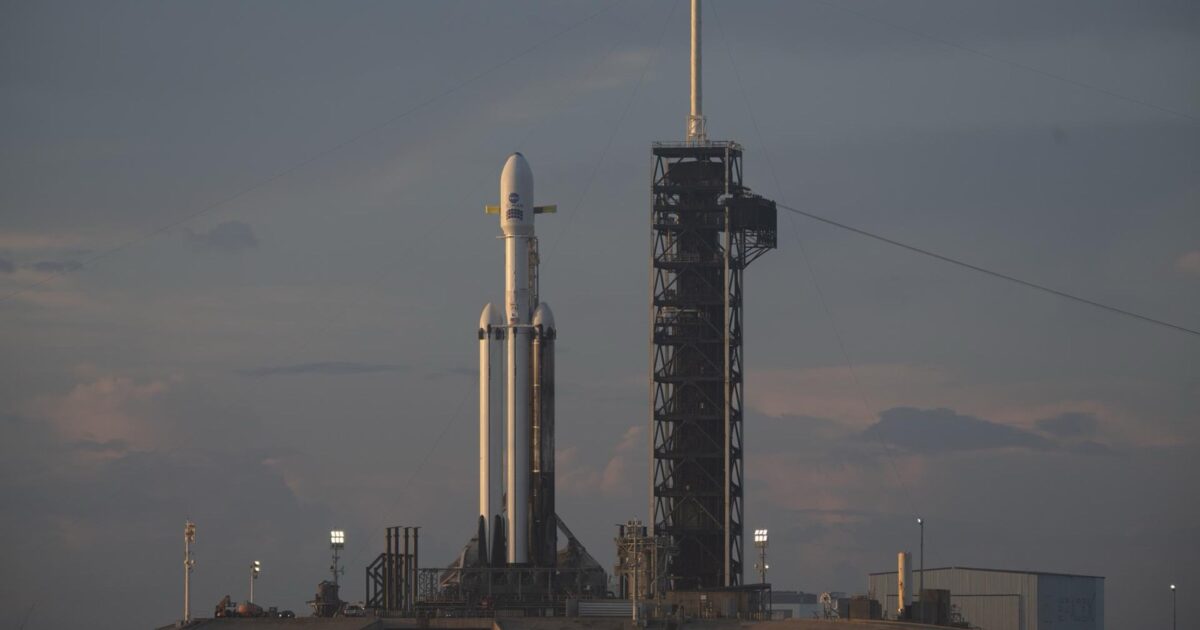
The Nancy Grace Roman Space Telescope lifted off from Kennedy Space Center at 7:26 a.m. EDT Sunday, riding more than five million pounds of thrust away from Launch Complex 39A.
Thirty-one minutes later, Roman separated from Falcon Heavy’s upper stage. NASA then confirmed the telescope was communicating, generating power and beginning its roughly three-month journey to a destination nearly one million miles from Earth.
The launch itself was a reminder of what Falcon Heavy can do:
Falcon Heavy lifts off from pad 39A in Florida for the 13th time! pic.twitter.com/qh63XvOVtV
— SpaceX (@SpaceX) August 30, 2026
The rocket’s 27 Merlin engines powered Roman through the thickest part of the atmosphere. About two and a half minutes after liftoff, the two side boosters shut down, peeled away from the center core and flipped around for the trip back to Florida.
Both completed their return burns and landed near the launch site—one at Landing Zone 2 and the other at Landing Zone 40.
NASA reports that Falcon Heavy performed as expected and released Roman 31 minutes into the flight. Ground controllers at Goddard began receiving telemetry only seven minutes after liftoff, while the rocket’s two side boosters safely returned for refurbishment.
One booster was flying for the first time. The other completed its third mission after previously supporting GOES-U and Viasat-3 F3, giving SpaceX another recovery on a flight that needed the center core’s full performance for the deep-space trajectory.
NASA says Roman’s solar panels and lower instrument sun shade deployed one hour and 23 minutes after launch. That left the observatory power-positive and in communication with the ground as responsibility shifted from the launch vehicle to the spacecraft team.
The agency also put the schedule in unusually favorable terms: Roman was delivered ahead of schedule and on budget. NASA’s Launch Services Program accelerated the launch after the telescope was completed early instead of allowing finished hardware to wait for a later readiness date.
SpaceX built the mission around a short but demanding Falcon Heavy sequence. The side boosters were recovered, but the center core was expended so the upper stage could send the 18,000-pound observatory out of Earth orbit and toward Sun-Earth L2.
The official profile called for side-booster cutoff about two minutes and 24 seconds after launch, separation three seconds later and simultaneous landings at roughly T+7:40. The upper stage then coasted for more than 15 minutes before restarting to place Roman on its departure path.
The two side cores did not have identical flight histories. One was new; the other had already flown the GOES-U weather satellite and Viasat-3 F3 missions.
Their recovery leaves SpaceX with reusable hardware from a launch that still spent the center core to give Roman the energy it needed.
That destination is a gravitationally useful region on the far side of Earth from the Sun. Roman can hold a stable view of the sky there while keeping the Sun, Earth and Moon on the same side of its protective shades.
The last launch-vehicle milestone came with a clean deployment:
Deployment of Roman confirmed pic.twitter.com/QB1NHPmcNk
— SpaceX (@SpaceX) August 30, 2026
Roman is not supposed to replace the Hubble or James Webb space telescopes. It is designed to see a much bigger piece of the sky at once.
NASA Roman Mission lists a 2.4-meter primary mirror, the same diameter as Hubble’s, paired with the Wide Field Instrument and a Coronagraph Instrument technology demonstration. The five-year primary mission has a ten-year goal and will operate around Sun-Earth L2.
The observatory is expected to downlink roughly 1.4 terabytes of data every day. NASA calls that the highest daily data rate yet for one of its astrophysics missions, enough to demand machine learning, artificial intelligence and citizen-science help alongside traditional astronomical analysis.
That flow of data will support studies of dark matter, dark energy, black holes, galaxies and planets outside our solar system. Roman is built to survey vast populations rather than spend most of its time on one narrow target at a time.
NASA Roman Telescope says the observatory’s field of view is at least 100 times larger than Hubble’s while preserving similar sensitivity and infrared resolution. That combination could let Roman survey the universe up to 1,000 times faster and measure light from as many as a billion galaxies over its mission.
Its exoplanet work will use gravitational microlensing to catch distant worlds that are difficult to find by other methods. The coronagraph will also test technologies for blocking a star’s glare so astronomers can directly image much fainter planets and planet-forming disks nearby.
None of those scientific returns arrive simply because the launch went well. Roman still has to travel to L2, deploy and stabilize its systems, cool down, calibrate its instruments and prove that the observatory performs as designed.
NASA expects commissioning to take about three months and is targeting the first public images for early 2027.
Falcon Heavy’s part is complete. Roman is separated, powered and talking to Earth—and a telescope built to survey the universe on a scale NASA has never attempted is finally on its way.
Join the conversation!
Please share your thoughts about this article below. We value your opinions, and would love to see you add to the discussion!