
NASA’s next great space telescope has moved into final launch processing, and a SpaceX Falcon Heavy is waiting at the end of the road.
Technicians at Kennedy Space Center have lifted the Nancy Grace Roman Space Telescope onto a specialized work platform called the Pantheon.
The current target is no earlier than August 30 from Launch Complex 39A in Florida.
Roman is nearly ready for its journey to L2, where it will map billions of galaxies, study exoplanets, and probe dark energy!
— NASA's Kennedy Space Center (@NASAKennedy) July 9, 2026
Preparations here at Kennedy continue, and it is now on its specialized work platform, known as the Pantheon.
Targeting launch no earlier than Aug. 30… pic.twitter.com/1qWZjIGPUI
The Pantheon move changes Roman from a carefully shipped observatory into a spacecraft being prepared for the rocket.
NASA says engineers have already powered up Roman for system checkouts after its arrival in Florida. The next weeks will be filled with methodical work on hardware that has to function about a million miles from Earth.
The team plans to test all six solar array panels, inspect the telescope’s insulation and thermal blankets, and check its propellant tanks.
After those tests, technicians expect to load roughly 290 gallons of hydrazine into the observatory. Roman will then be sealed inside a SpaceX payload fairing, one of the final steps before it meets Falcon Heavy.
NASA describes the August 30 target as about nine months ahead of schedule. That is an extraordinary position for a flagship observatory that spent more than a decade coming together.
The clean-room work is every bit as serious as the rocket waiting outside.
NASA Kennedy upgraded the 40-year-old Payload Hazardous Servicing Facility before Roman arrived. The work included new air showers that blast HEPA-filtered air across people and equipment before they enter the clean room.
Technicians have to suit up before stepping inside because a speck of dust, debris, or even a strand of hair can interfere with sensitive spacecraft instruments.
The facility normally operates at ISO class 8. Roman needs the cleaner ISO class 7 standard, so the team is adding a HEPA filtration wall along with upgraded climate-control and compressed-air systems.
That compressed air can help slide heavy hardware across the floor on a cushion of air, like an industrial-scale air hockey table. The process is built to move a massive observatory without trading precision for speed.
It is a small detail with a huge job: keep the telescope clean enough to trust every photon it collects.
All of that care is protecting a telescope with a huge assignment.
NASA Science says Roman will have a field of view at least 100 times larger than Hubble’s while retaining the sharp infrared vision needed to survey enormous sections of the sky.
The observatory could measure light from a billion galaxies during its lifetime. It will map the structure of the universe, study dark matter and dark energy, find new exoplanets, examine black holes, and give astronomers a flood of public data to explore.
Roman also carries a coronagraph designed to block the glare of distant stars so nearby planets and planet-forming disks can be seen directly.
Its destination is the Sun-Earth Lagrange point 2, or L2, about one million miles from Earth. The balanced gravitational environment there gives the telescope a stable, largely unobstructed view of deep space.
SpaceX has been attached to this mission for years.
The launch provider has now publicly joined the countdown.
Looking forward to Falcon Heavy launching @NASA's next flagship telescope https://t.co/rBUo7XTe3R
— SpaceX (@SpaceX) July 9, 2026
NASA awarded the launch service to SpaceX in 2022 under a package valued at approximately $255 million, including mission-related costs.
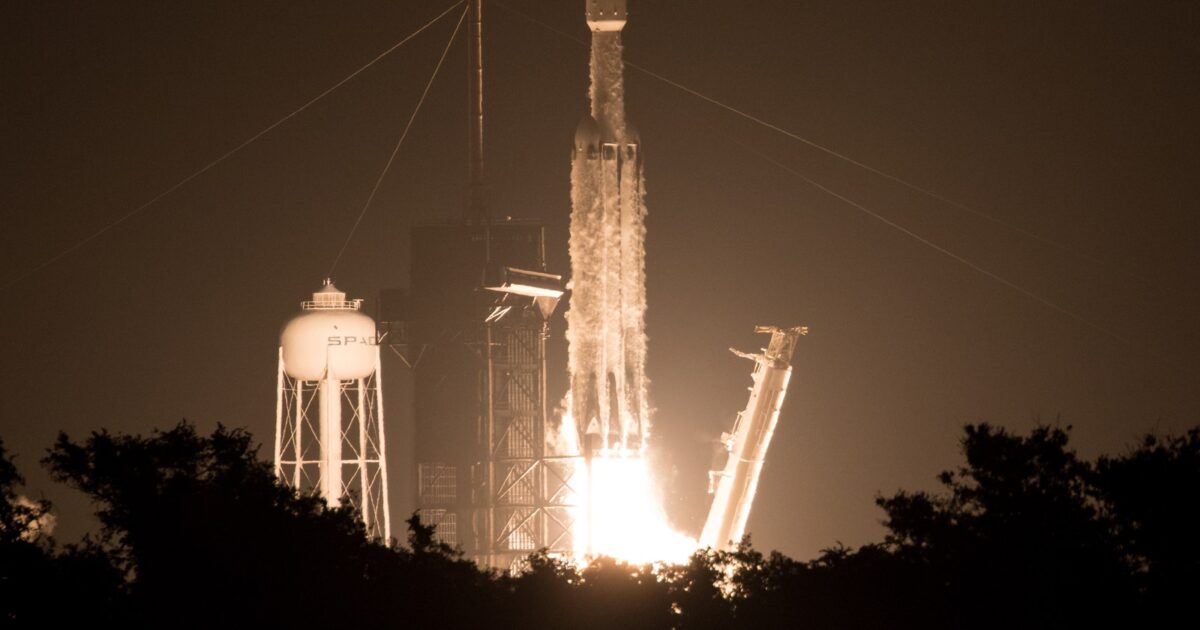
The contract called for Falcon Heavy to fly from LC-39A, the same Kennedy pad now sitting only a few processing milestones away from Roman. From there, the telescope will leave Earth’s neighborhood and begin its trip toward L2.
At the time, NASA described Roman as the top-priority large space mission recommended by the 2010 astronomy and astrophysics decadal survey. Its science program was built around cosmology and exoplanet exploration, with room for researchers to pursue a much wider range of astrophysics questions.
The contract announcement listed October 2026 as its target. Roman’s current no-earlier-than August 30 plan has pulled that Falcon Heavy mission forward.
NASA’s Launch Services Program manages the launch vehicle side at Kennedy, while Goddard Space Flight Center manages the telescope project. The current schedule has moved well ahead of the timeline NASA carried when the launch contract was first announced.
A Falcon Heavy launch is always a spectacle. This one will carry a machine built to scan the universe on a scale Hubble could never attempt.
Roman still has solar arrays to test, tanks to check, fuel to load, and a SpaceX fairing to close around it.
But the telescope is upright, powered on, and sitting on the Pantheon. The countdown now belongs to the hardware.
Join the conversation!
Please share your thoughts about this article below. We value your opinions, and would love to see you add to the discussion!