

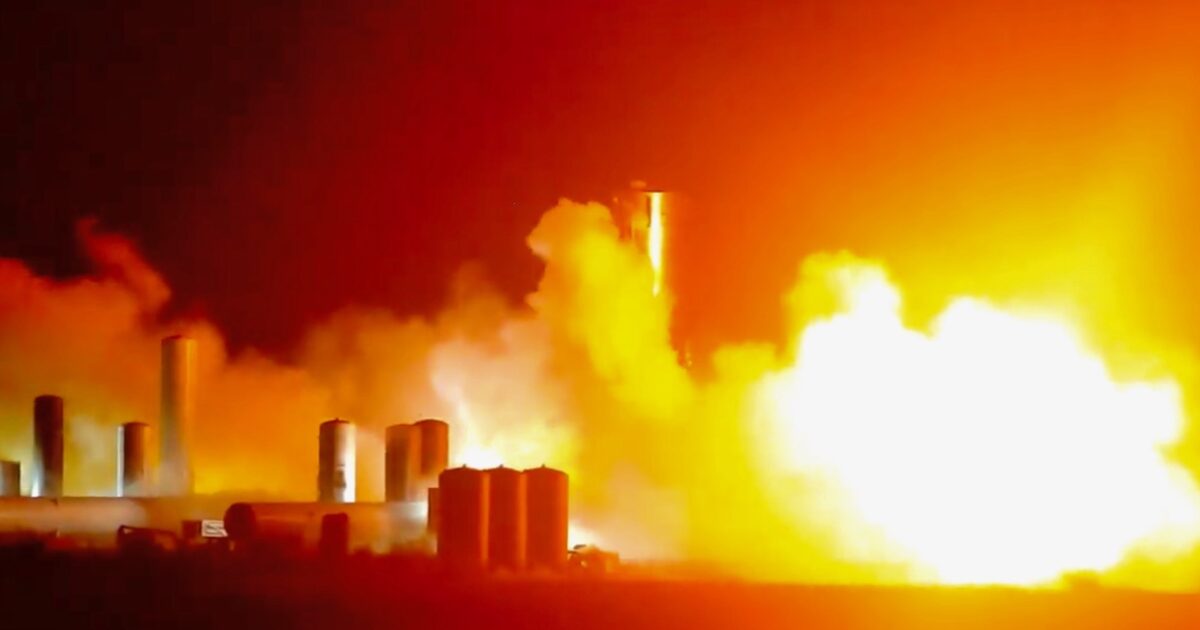
Starship’s next flight is no longer a short hop dressed up as an orbital test.
SpaceX released the complete Flight 14 mission plan today, targeting Tuesday, September 22, for the first attempt to send Starship into orbit around Earth.
If the flight proceeds, Ship 41 will spend nearly ten hours aloft, complete about six orbits, deploy 26 production Starlink V3 satellites and then deliberately leave orbit for a controlled splashdown in the Pacific.
That is a sharp break from every Starship flight so far.
Previous vehicles followed passively safe suborbital trajectories. Flight 14 is designed to cross the line into a real orbital mission, but SpaceX built a decision gate into the flight before Ship 41 commits.
SpaceX announced the September 22 target with footage of the vehicle and a reminder that regulatory approval is still pending:
Starship is preparing to go to orbit. Flight 14 is targeting to launch as early as Tuesday, September 22, pending regulatory approval → https://t.co/LwJ4g6dg9v pic.twitter.com/Ds0aGWpT9V
— SpaceX (@SpaceX) September 15, 2026
A six-orbit mission with an exit plan
SpaceX Flight 14 lays out a 75-minute launch window opening at 7:15 a.m. Central on September 22. The company expects Starship to fly at roughly 275 kilometers above Earth, circle the planet about six times and remain in flight for close to ten hours.
Ship 41 will not enter orbit automatically after ascent. The flight-control team first has to confirm that the hardware needed for a later deorbit burn still has enough redundancy to complete that job safely.
Only then will Starship perform its first orbital insertion maneuver.
After satellite deployment, the plan calls for a single Raptor engine to fire in space and pull the ship out of orbit. Starship would then reenter and descend toward a Pacific splashdown zone west of Chile.
That sequence turns the mission into much more than another launch-and-splashdown test. SpaceX has to prove it can enter orbit, operate there for hours, deploy working payloads and reliably bring the ship back onto a controlled reentry path.
SpaceX Updates explains why the orbit decision is tied so closely to the deorbit system. Earlier test flights were deliberately aimed along trajectories that would naturally return the vehicle to Earth even if propulsion or flight control failed after launch.
An orbital mission removes that passive safeguard. Flight 14 therefore has to preserve a working way home before the final insertion burn is allowed to happen.
The planned webcast is scheduled to begin about 30 minutes before liftoff and continue through splashdown. If the timeline holds, viewers could receive live Starship video for hours rather than minutes.
SpaceX is also treating the schedule as dynamic. The September 22 attempt still depends on regulatory approval, and the company has a 75-minute window rather than a single fixed launch second.
Twenty-six production satellites are riding inside
The payload is operational, not a rack of mass simulators.
SpaceX says Flight 14 will carry 26 production Starlink V3 satellites. Each is designed to add one terabit per second of capacity, putting the planned load at 26 terabits per second in total.
According to the company, that is about ten times the capacity delivered by a single Falcon 9 mission carrying V2 Mini satellites.
After deployment, the satellites are expected to unfold their antennas and solar arrays, establish radio and laser links, and begin raising their own orbits. SpaceX says they could start serving customers within weeks after completing on-orbit checks.
Three of the satellites have another assignment. They carry cameras intended to scan Starship’s heat shield from orbit and send that imagery back to operators.
Elon Musk put the first V3 deployment into the larger network picture:
Starlink V3 constellation starts being deployed this month.
Ultimately, it will deliver more than 100 times the bandwidth of our current 11,000 satellite constellation. https://t.co/oB8LVm8bgp
— Elon Musk (@elonmusk) September 15, 2026
SpaceX prospectus gives the longer-term scale behind that statement. The company says a mature Starship mission could eventually carry as many as 60 V3 satellites, with each spacecraft designed for one terabit per second of downlink capacity.
Flight 14’s load of 26 is well below that eventual target, but it is the first time Starship is scheduled to place production satellites into stable low-Earth orbit. The mission connects the rocket program directly to the next expansion of the Starlink business.
The filing says Falcon 9 currently deploys the smaller V2 Mini design because it fits the rocket’s payload limits. Starship is the vehicle SpaceX expects to use for the larger V3 generation, with a full load projected to put roughly twenty times as much downlink capacity into orbit as one Falcon 9 mission.
Flight 13 data is already changing Flight 14
The booster will not attempt a tower catch on this flight.
Booster 21 is expected to launch, separate, perform its boostback maneuver and attempt a landing burn toward an offshore point in the Gulf.
Ars Technica reports that the booster carries hardware and software changes aimed at the trouble seen late in Flight 13. Three center engines showed signs of ice clogging during the terminal phase of the boostback burn, ending that maneuver early, and only eight of 13 planned engines reignited for the landing burn before the booster hit the water hard.
SpaceX says Booster 21 now has improved engine filtering and updated relight software.
The upper stage is changing too. Engineers added retention hardware in areas where heat-shield tiles faced the highest risk of coming loose during ascent.
They also addressed newly identified paths that could let plasma flow behind tiles during reentry and added curved-tile experiments intended to reduce heating in the gaps.
Two tiles recovered from Ship 40 after Flight 13 are scheduled to fly again on Ship 41. That would mark the first reuse of Starship heat-shield tiles.
None of this makes September 22 certain. Regulatory approval is still pending, weather can move the window and developmental vehicles can change schedules quickly.
But the mission itself is now defined.
Flight 14 is SpaceX’s first attempt to make Starship behave like an orbital transportation system: reach orbit, deliver production hardware, stay there for hours, execute a deorbit burn and return on command.
If Ship 41 clears that sequence, Starship will have crossed its biggest operational line yet.
Join the conversation!
Please share your thoughts about this article below. We value your opinions, and would love to see you add to the discussion!