
The U.S. Space Force has reportedly shifted six near-term national-security launches from United Launch Alliance to SpaceX while ULA’s Vulcan rocket remains grounded.
This goes well beyond a routine shuffle of dates on a manifest. Six sensitive government missions are moving toward Falcon 9 or Falcon Heavy because the military still has no firm date for Vulcan’s return to national-security flight.
SpaceX was already the dominant launch provider in the United States. This move makes the government’s near-term dependence on Elon Musk’s rocket company even harder to miss.
SatNews reports that Space Systems Command chief Lieutenant General Philip Garrant disclosed the six transfers during an industry briefing.
The report says the Space Force remains confident that Vulcan will return. The investigation into a solid-rocket-booster nozzle failure, however, has not produced an official date for renewed military launches.
Vulcan reached orbit on the February 12 USSF-87 mission, yet one of its Northrop Grumman-built GEM 63XL boosters suffered a visible nozzle problem shortly after liftoff. It was the second nozzle-related irregularity in Vulcan’s first four flights, following a separate issue during the Cert-2 mission in October 2024.
The six payloads were not identified publicly in the report. What is clear is the direction of travel: time-sensitive missions are going to SpaceX now, while ULA is expected to receive other missions later if Vulcan clears the investigation and returns to the national-security roster.
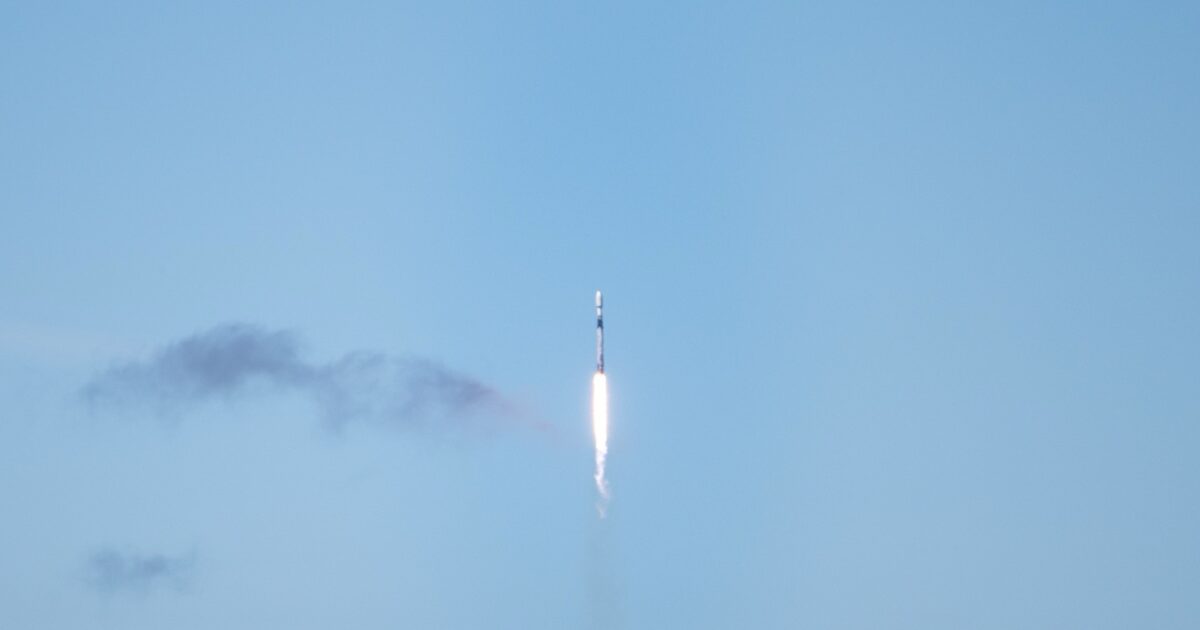
SpaceX’s October 15 USSF-481 flight offered a recent look at the launch system receiving that work:
Liftoff! pic.twitter.com/yjEQXS2RKu
— SpaceX (@SpaceX) October 16, 2026
That post is not an announcement of the six-mission transfer. It documents the operational reality behind the decision: Falcon 9 is flying classified Space Force payloads now, from an established pad, with a deeply reused booster fleet.
Space Systems Command used the same mission-trade playbook in March. The service moved GPS III-8, the final GPS III satellite, from Vulcan to a SpaceX Falcon 9 so the advanced positioning spacecraft would not sit in storage while the booster investigation continued for months.
That exchange kept a ULA contract on the board. The Space Force moved USSF-70, a mission previously assigned to SpaceX, onto Vulcan with a target no earlier than summer 2028.
The arrangement preserved the two-provider contract balance while putting the urgent GPS launch on a rocket that could fly sooner. Space Systems Command described the move as a way to deliver upgraded military and civilian GPS capability without waiting for Vulcan’s investigation to finish.
The new six-mission shift appears to scale that logic dramatically. SpaceX gets the near-term work.
ULA keeps a path to later missions, but only after Vulcan satisfies the military’s return-to-flight requirements.
The March exchange also showed why these trades are possible on short notice. GPS III spacecraft were designed to ride more than one certified launch vehicle, giving the service room to change providers without redesigning the satellite from scratch.
Space Systems Command’s Phase 3 mission assignments show how much was already riding on SpaceX before this change. The fiscal 2026 Lane 2 order assigned the company five missions: USSF-206/WGS-12, USSF-155, NROL-86, USSF-149 and USSF-63.
Lane 2 covers the government’s most demanding national-security payloads, including missions that require higher performance, complex integration and access to difficult orbits. ULA also holds Lane 2 work, and Blue Origin joined the provider pool, but new certification and schedule problems do not disappear because a contract has three names on it.
Moving another six launches to SpaceX solves one immediate problem while sharpening another. The Space Force needs assured access to orbit through more than one dependable rocket family.
For the moment, its fastest answer to a Vulcan delay is more Falcon.
SpaceX’s launch archive shows the cadence behind that choice. In the weeks before this reported transfer, Falcon vehicles launched the Space Development Agency’s fourth Tranche 1 mission, the classified USSF-481 mission and the NROL-97 mission on Falcon Heavy, alongside commercial and Starlink flights.
That mixed manifest is Falcon’s biggest advantage. SpaceX does not have to restart a dormant line or prove a new vehicle for each customer.
The same launch system moves internet satellites, science spacecraft, crew vehicles and some of the country’s most sensitive payloads.
USSF-481 flew from Vandenberg on a first stage making its 28th flight, then landed that booster at sea. NROL-97 used Falcon Heavy, giving the government both a high-cadence medium-lift option and a heavier configuration inside the same launch family.
Capacity is not unlimited. SpaceX is building Starship as Falcon’s successor and has discussed winding down Falcon production once Starship flies reliably at high cadence.
Government planners now have to reconcile that long-term transition with a near-term reality in which Falcon is absorbing work from another grounded rocket.
The reported swaps do not mean ULA has lost six missions forever. The mission-trade mechanism protects urgent launch dates without stripping ULA of the later work it was awarded.
But schedules are strategy in the launch business.
A rocket that can fly today gets the payloads that cannot wait. A rocket still under investigation gets promises about tomorrow.
Vulcan may return and restore the competition the Space Force built into its launch program. Until then, six more national-security missions are reportedly headed toward the company that keeps answering the same question with a Falcon on the pad.
Join the conversation!
Please share your thoughts about this article below. We value your opinions, and would love to see you add to the discussion!