

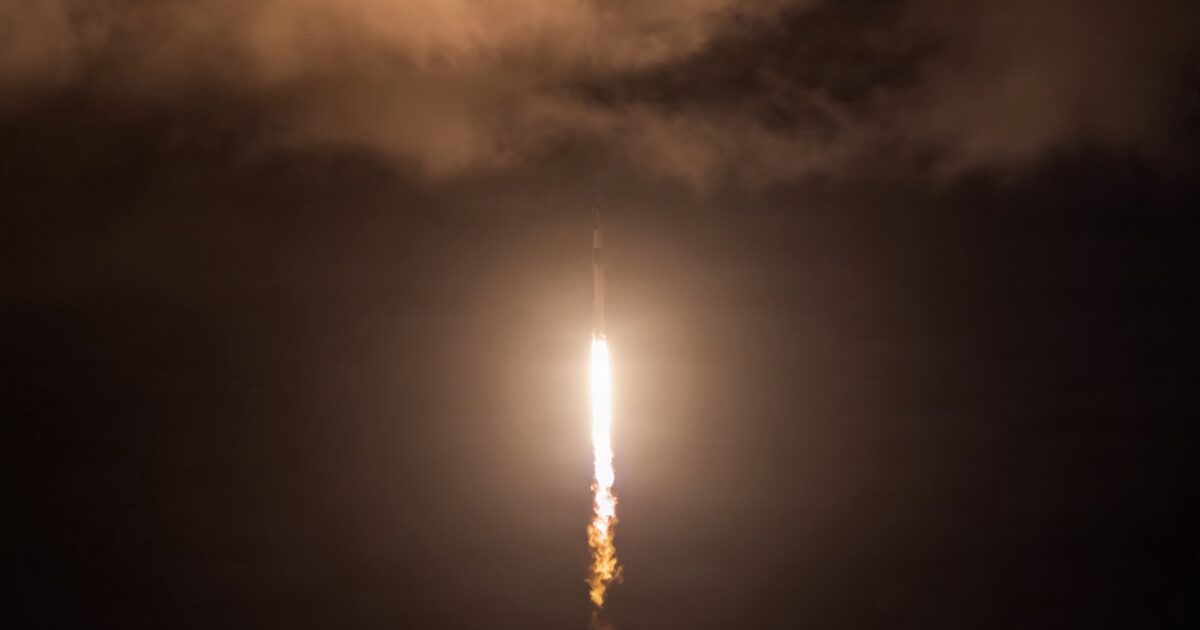
SpaceX launched its Starlink 10-50 mission from Space Launch Complex 40 at Cape Canaveral Space Force Station in Florida early Sunday, July 5, 2026.
Liftoff came at 10:50 UTC, which is 5:50 AM Central. The Falcon 9 carried 29 Starlink satellites to low Earth orbit.
The extra twist was riding on the first stage.
Bolted to the booster were two Besxar Fabships, small semiconductor-manufacturing pods built for a quick flight test to the edge of space and back.
This morning, SpaceX is set to launch the Starlink 10-50 mission from Cape Canaveral Space Force Station at 6:50 a.m. EDT (1050 UTC). Along for the ride on the Falcon 9 booster is a payload from Besxar, a semiconductor manufacturing company.
Watch live: https://t.co/wqPfHycHrx
— Spaceflight Now (@SpaceflightNow) July 5, 2026
A Falcon 9 booster already has to fly uphill, separate, reenter, and land. SpaceX just used that same return trip as a short-duration test lane for space-based manufacturing.
The booster was making its 13th flight, and the recovery profile sent it back to the A Shortfall of Gravitas droneship in the Atlantic.
SpaceX’s official SpaceX mission record identifies Starlink 10-50 as a 29-satellite flight from SLC-40 at Cape Canaveral, lists the first-stage booster as flying for the 13th time after Crew-10, Bandwagon-3, CRS-33, SES O3b mPOWER-E, mPOWER-D, and seven Starlink missions, and says that stage was assigned to the A Shortfall of Gravitas droneship in the Atlantic. The same record separately confirms Besxar’s two pilot Fabship manufacturing pods were integrated onto the Falcon 9 first-stage booster to begin a series of development flight tests, which is the key story turn because the returning booster became useful payload real estate instead of simply carrying itself home.
That is the business model hiding inside the launch cadence. The same hardware that hauls Starlink to orbit can sell useful test time on the way home.
Spaceflight Now explained why the Besxar ride made this more than a routine Starlink batch, reporting that the two Besxar Space Industries pods were attached to the Falcon 9 first stage for an eight-minute, 19-second trip to space and back while the second stage carried the 29 Starlink v2 Mini satellites toward deployment. The report said Besxar booked 12 Falcon 9 flights for its Fabship test campaign, wants to use near-space vacuum conditions to explore ultra-pure semiconductor substrates and precursor materials, and sees the booster profile as valuable because the first stage keeps coasting upward after separation before returning for a droneship landing, giving experiments a fast exposure cycle without waiting on a traditional orbital spacecraft return.
The physics behind the pitch is simple enough. A returning Falcon 9 first stage can become a repeatable near-space test stand.
That does not mean orbital chip factories are suddenly here. It means Besxar gets to test whether its pods, wafers, and materials can survive launch, near-space exposure, reentry, and recovery.
SpaceX Launches Falcon 9 with Starlink 10-50 https://t.co/4AB6NHJHnV
— NSF – NASASpaceflight.com (@NASASpaceflight) July 5, 2026
Tom’s Hardware reported the original 12-launch Besxar-SpaceX agreement in November 2025 and described the Fabships as small reusable pods attached to Falcon 9 boosters for short exposure to the launch, near-space, reentry, and recovery environment, with the larger goal of testing space-based semiconductor substrate manufacturing outside the limits of earthbound fabrication equipment. The report said the units are roughly microwave-sized, tied the work to Besxar’s reusable Clipper Class pod concept, noted SpaceX as one of Besxar’s listed investors, connected the effort to demand for ultra-pure substrates and precursor materials, placed the first Fabship campaign on Falcon 9 rather than a separate orbital spacecraft, and explained that Besxar’s early problem is practical before it is commercial: the company needs to learn whether wafers and related materials can make the round trip without cracking, heat damage, contamination, or recovery problems, then repeat that loop across additional launches quickly enough to refine the pod design and manufacturing process, making Sunday’s flight an early durability and process test before any larger manufacturing claim can be taken seriously in a sector where consistency, cleanliness, and material survival matter as much as the launch itself.
That is why the Sunday flight works as a hardware shakedown before any space-factory claim.
Survive, recover, inspect, repeat: that is the path Besxar appears to be testing on Falcon 9.
By 6:56 AM Central, Next Spaceflight‘s refreshed Starlink Group 10-50 page listed the mission as a Falcon 9 launch from Cape Canaveral at 10:50 UTC, identified Besxar’s Fabships as two suborbital payloads integrated onto the first-stage booster, and showed the stage-one landing sequence complete. Its timeline also showed the Starlink deploy event complete at T+1 hour, 3 minutes, and 31 seconds, while the booster recovery data marked the A Shortfall of Gravitas landing as successful, turning the story from a prelaunch setup into a completed-mission recap.
Reuse is what makes this possible. Once you stop throwing rockets away, a returning booster stops being wasted mass and starts being a platform.
Starlink still gets to orbit, the stage still comes home to fly again, and a chip startup gets a repeatable ride to the edge of space in the same eight minutes.
That is the quiet power of SpaceX’s cadence. The second lane it opens up may end up mattering as much as the satellites in the fairing.
Join the conversation!
Please share your thoughts about this article below. We value your opinions, and would love to see you add to the discussion!