

SpaceX just turned one Falcon 9 into an orbital moving truck.
The company launched its 17th Transporter rideshare mission on July 7, 2026, delivering 81 payloads to orbit in a single flight.
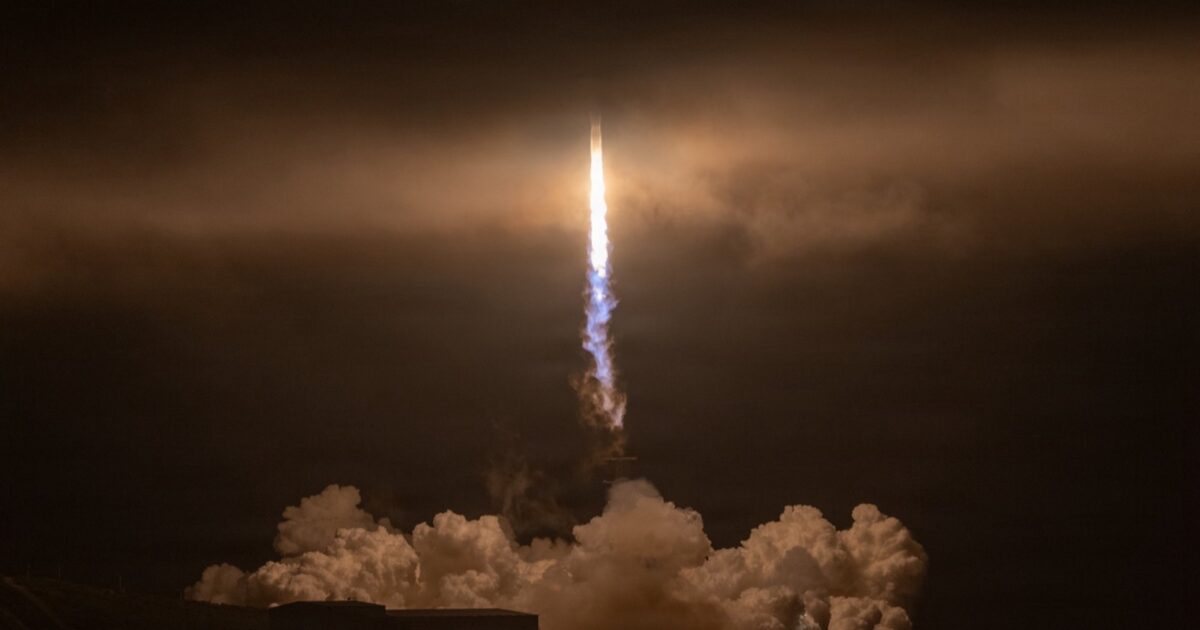
The rocket lifted off in the middle of the night from Vandenberg Space Force Base in California, and the official result was simple: the payloads made it to orbit.
The headline number came straight from SpaceX after the flight.
Falcon 9 launches the 17th Transporter rideshare mission and delivers 81 payloads to orbit pic.twitter.com/ApixoSmFHv
— SpaceX (@SpaceX) July 7, 2026
Transporter is SpaceX’s rideshare program, where dozens of smaller customers split a ride to space instead of each buying a whole rocket. Think carpool, but for satellites.
That model has quietly become one of the most important things SpaceX does. It gives startups, universities, and government teams a cheap, regular path to orbit they never had before.
SpaceX lists Transporter-17 as a Falcon 9 mission from Space Launch Complex 4E at Vandenberg Space Force Base.
The mission page and official SpaceX posts put the timeline in plain terms: a July 7 launch at 12:12 a.m. Pacific time, a dedicated rideshare flight, and 81 payloads delivered to orbit.
That is the business model in one sentence. A long list of small spacecraft, built by different teams for different missions, can now share one SpaceX launch and reach orbit on a schedule.
The official source matters here because it keeps the article centered on the completed mission result instead of prelaunch chatter. Transporter-17 moved past the launch-window stage when SpaceX confirmed the payload count and orbital delivery after the flight.
Space.com reports that the mission lifted off at 12:12 a.m. Pacific time, or 3:12 a.m. Eastern, with cubesats, microsats, hosted payloads, and orbital transfer vehicles on board.
The report also points out how big the rideshare machine has become. Before this flight, SpaceX’s Transporter and Bandwagon missions had already sent more than 1,800 payloads to Earth orbit.
One of the biggest payloads on this flight was South Korea’s CAS500-4 Earth-observation satellite, a roughly 500-kilogram spacecraft meant to help monitor crops and forests.
Space.com also notes that the first stage landed on the droneship Of Course I Still Love You about eight and a half minutes after liftoff, while the upper stage began payload deployments roughly 50 minutes into the mission.
The launch itself had the classic Vandenberg night-flight look: dark pad, bright plume, and a Falcon 9 disappearing into the marine layer.
Liftoff of Transporter-17! pic.twitter.com/sUZ9BuP9Eb
— SpaceX (@SpaceX) July 7, 2026
Via Satellite makes the payload list more interesting than a simple count.
The manifest included the first Nova satellite from Apex Space, Planet’s Pelican-11 technology demonstration satellite, and the first operational FireSat satellites from Earth Fire Alliance, built by Muon Space to help identify early wildfire ignitions and track active fires.
There were also radio-frequency detection satellites from Unseenlabs, the BOHR nuclear-power cubesat from City Labs, SPEAR-1 national-security satellites from NearSpace Launch, and multiple Open Cosmos, Spire, Iceye, Exolaunch, and SEOPS customer payloads.
That spread is exactly why rideshare launches matter. One Falcon 9 can carry commercial Earth-imaging hardware, fire-monitoring tools, defense demonstrations, communications experiments, and small constellation pieces in the same mission, giving very different operators one shared route to low Earth orbit.
For small satellite teams, that kind of access changes the math.
That is the fun part of Transporter-17. One customer did not buy the whole rocket.
It was a flying stack of space startups, national-security hardware, Earth-observation tools, wildfire tech, and commercial constellation pieces.
Spaceflight Now reported that SpaceX confirmed deployment of all payloads by 6:08 a.m. Eastern on July 7.
Its mission report identified the booster as B1097, flying for the 11th time after missions including Twilight, NROL-172, Sentinel-6B, and seven Starlink flights.
Spaceflight Now also tracked the landing math: B1097 touched down on Of Course I Still Love You for that droneship’s 208th booster landing, and SpaceX’s 634th booster landing overall.
The deployment sequence was more involved than one door opening and everything floating away. The report says Osiris-A began the first deployment sequence after a trajectory correction burn, and CAS500-4 was released after two more upper-stage burns roughly two and a half hours after liftoff.
Eighty-one payloads on one rocket, sent up in the dark, and it barely made national news. That is what happens when the impossible becomes the schedule.
Join the conversation!
Please share your thoughts about this article below. We value your opinions, and would love to see you add to the discussion!