

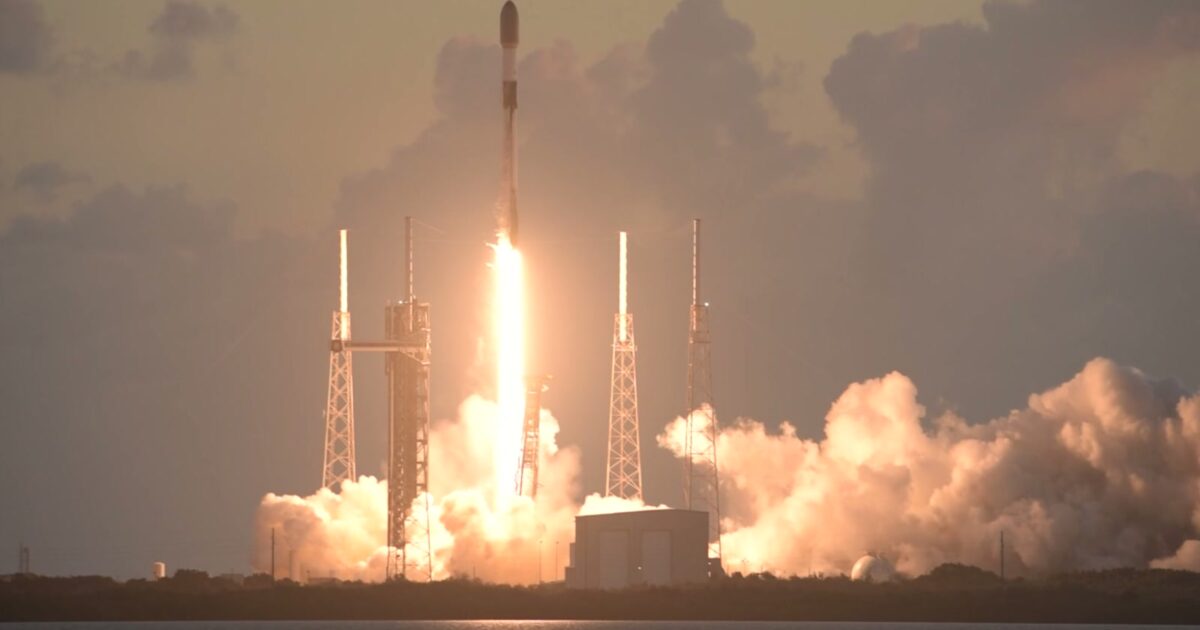
SpaceX set another rocket-reuse record Thursday morning.
The company flew B1067, its most-traveled Falcon 9 first stage, for the 36th time on the Starlink 10-42 mission.
Liftoff came at 5:25 a.m. EDT, which is 4:25 a.m. Central and 09:25 UTC, from Space Launch Complex 40 at Cape Canaveral Space Force Station.
The mission carried 29 Starlink broadband satellites to low Earth orbit.
Thursday morning, SpaceX aims to launch its most flown Falcon 9 rocket booster, B1067, on a record-breaking 36th flight. Liftoff of the Starlink 10-42 mission from Cape Canaveral Space Force Station is scheduled for 5:25 a.m. EDT (0925 UTC).
— Spaceflight Now (@SpaceflightNow) July 9, 2026
Read more: https://t.co/lJJa6bP5Rz
Think about that number for a second. One booster, thirty-six flights.
Not thirty-six rockets. The same hardware, cleaned up and sent back to the pad again and again.
Spaceflight Now put the milestone in plain mission terms: B1067 first flew in June 2021 on SpaceX’s CRS-22 Dragon cargo run for NASA, then kept returning to the manifest instead of retiring into a museum.
The same booster later supported Crew-3 and Crew-4, then became one of the workhorses behind Starlink’s buildout with roughly two dozen Starlink batches on its resume.
That history matters because this was not a ceremonial record attempt. It was an operational launch carrying real network hardware, and SpaceX still asked the oldest star of the fleet to do the job.
A little more than eight minutes after liftoff, B1067 came home again and landed on the droneship A Shortfall of Gravitas in the Atlantic Ocean.
Spaceflight Now listed that touchdown as the 160th landing for A Shortfall of Gravitas and the 635th booster landing overall for SpaceX.
Those are the kinds of totals that used to sound like science fiction. Now they read like a status update.
The mission details line up cleanly across the trackers, too.
Next Spaceflight logged Starlink Group 10-42 as a successful Falcon 9 Block 5 mission from SLC-40 at Cape Canaveral Space Force Station after Thursday morning’s successful liftoff.
The launch database listed 29 payloads, B1067 on Flight #36, A Shortfall of Gravitas as the recovery ship, and a 31-day turnaround since the booster’s previous flight.
It also marked the trajectory northeast and identified the batch as part of the Starlink v2-mini constellation, the lower-orbit broadband network SpaceX keeps feeding with these repeated Falcon 9 flights from Florida.
The same page put the flight into the wider Falcon 9 cadence, listing it as the 80th Falcon 9 mission of 2026 and the 663rd Falcon 9 mission overall.
For SpaceX as a company, the tracker showed the mission as the 82nd launch of 2026 and the 692nd mission overall.
The recovery numbers were just as loud: Next Spaceflight listed this as SpaceX’s 652nd Falcon recovery attempt, 637th successful recovery, 220th consecutive successful recovery, and 294th consecutive successful landing.
A 31-day turnaround is the quiet star of this story. That is barely a month between launches for the same first stage.
For a reusable rocket fleet, that number is almost as important as the flight count. B1067 survived 36 missions and still moved quickly enough to matter.
SpaceX now targeting 5.25 a.m. EDT on Thursday, July 9 for a Falcon 9 launch of 29 Starlink (Group 10-42) satellites from Cape Canaveral SFS, FL https://t.co/WcrmAoOJ9E
— Brian Basson (@BassonBrain) July 8, 2026
The bigger picture here is cadence.
Every one of these 29 satellites adds capacity to a network that already serves customers across remote areas, ships, planes, and disaster zones.
Cheap, repeatable launches are what make that expansion possible. A booster that flies 36 times spreads its cost across 36 missions instead of one.
That is the whole thesis of reusable rockets, and B1067 is the clearest proof of it flying today.
None of this was billed as a headline event. It was a Starlink batch on a Thursday morning.
And that might be the most impressive part. Flying the same rocket for a 36th time has become routine enough that SpaceX treats it as just another day at the Cape.
Join the conversation!
Please share your thoughts about this article below. We value your opinions, and would love to see you add to the discussion!