

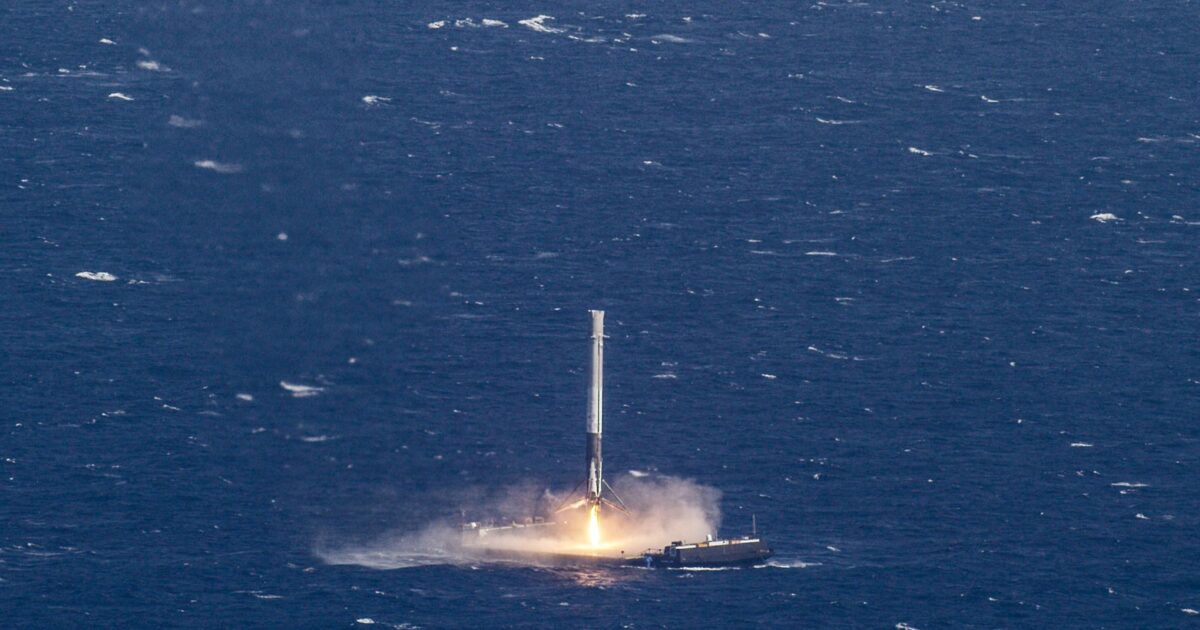
SpaceX closed out Sunday morning with another Falcon 9 on the drone ship and 27 more Starlink satellites in orbit.
Starlink 15-24 lifted off from Vandenberg Space Force Base at 9:26 a.m. Central on September 6. The flight became SpaceX’s 103rd Falcon 9 mission of 2026.
The first stage, booster B1088, came back to the Pacific about eight and a half minutes later. Its landing on Of Course I Still Love You completed the booster’s 19th flight.
SpaceX shared photographs of the climb from California after the rocket cleared the coast.
Falcon 9 launches 27 @Starlink satellites from California pic.twitter.com/bjesgK0h7R
— SpaceX (@SpaceX) September 6, 2026
The mission was not built around a new payload record or a first-of-its-kind maneuver. Its significance is the opposite: launches that once demanded a special moment have become a production rhythm.
Space.com reports that Falcon 9 carried the 27 satellites from Space Launch Complex 4 East at 14:26 UTC, then put B1088 down on the droneship as planned. The upper stage continued with the payload while the booster finished its work in the Pacific.
The same report identifies this as B1088’s 19th mission. Its earlier work includes NROL-126, Transporter-12, NASA’s SPHEREx observatory, NROL-57 and 13 previous Starlink flights.
That history gives the number more substance than a simple landing tally. One first stage has now carried national-security payloads, a NASA science mission, a rideshare and repeated batches for SpaceX’s own constellation.
The outlet counted Starlink 15-24 as Falcon 9’s 103rd mission of the year and the 80th devoted to Starlink. It also reported that deployment came on schedule 62 minutes after launch, completing the mission after the first stage had already returned to sea.
Next Spaceflight independently records Starlink 15-24 as a completed September 6 mission from Vandenberg’s SLC-4E, with B1088 flying for the 19th time and recovery assigned to Of Course I Still Love You.
The launch record also fixes the timing after several target changes. Liftoff ultimately came at 14:26:54 UTC, sending the batch south from California into low Earth orbit.
Its entry separates the three milestones that can be blurred together in a fast launch recap: liftoff from SLC-4E, recovery of the first stage on the Pacific droneship, and orbital delivery of the 27-spacecraft payload. Each is recorded as a completed mission event rather than a target.
Roughly 62 minutes after liftoff, SpaceX confirmed that all 27 spacecraft had separated from the upper stage.
Deployment of 27 @Starlink satellites confirmed
— SpaceX (@SpaceX) September 6, 2026
Deployment is the final mission result that matters for the satellites. A clean liftoff and booster landing do not finish the job if the payload remains attached or enters the wrong orbit.
SpaceX’s confirmation closed that loop: the rocket flew, the first stage survived, and the full batch separated in orbit.
The cadence behind those three events is becoming difficult to overstate.
Space.com counted this as the 80th Falcon 9 mission devoted to Starlink in 2026. That means more than three-quarters of the rocket’s missions this year have been used to build and replenish SpaceX’s own broadband network.
The concentration also explains why booster reuse matters so much. A constellation that requires frequent launches cannot be sustained by treating every first stage as disposable hardware.
SpaceX’s Falcon 9 overview describes the vehicle as a reusable, two-stage rocket designed for missions to Earth orbit and beyond. The company says recovery allows it to refly the most expensive portion of the rocket instead of discarding that hardware after one ascent.
Falcon 9’s first stage uses nine Merlin engines and carries the landing legs, grid fins and guidance hardware needed to return after separation. The upper stage continues with the payload while the booster turns a launch into the beginning of another processing cycle.
B1088 is still well short of SpaceX’s fleet record. B1067 reached 37 flights in August, nearly twice B1088’s present count.
But the comparison shows how quickly the definition of a veteran booster has changed. Nineteen launches would once have looked like an extreme reuse experiment.
Now it lands in the middle of an operating fleet with several stages far ahead of it.
The mission also reinforces Vandenberg’s current role in Starlink deployment. California launches serve the higher-inclination orbital paths that send satellites toward the planet’s northern and southern regions.
Starlink 15-24 was a straightforward mission by SpaceX’s 2026 standards. That is exactly what made it revealing.
Twenty-seven satellites reached orbit, a 19-flight booster landed at sea, and Falcon 9 pushed its annual count to 103—all before most of California finished breakfast.
Join the conversation!
Please share your thoughts about this article below. We value your opinions, and would love to see you add to the discussion!