
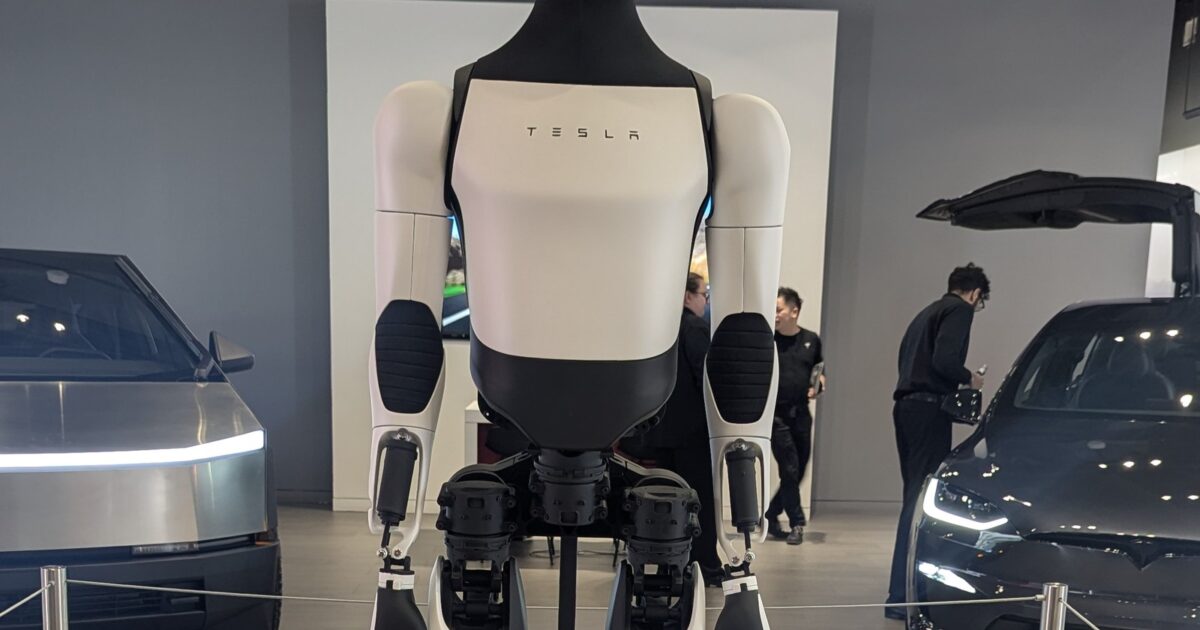
Piper Sandler published one of the more interesting Tesla valuation frameworks Wall Street has produced in a while, and the headline number is hard to ignore: at recent share prices around $400 to $420, the firm argues investors are effectively paying nothing for Optimus.
Analyst Alexander Potter updated his Tesla model with a 17-product-line breakdown that covers electric vehicles, Full Self-Driving software, robotaxi operations, the Supercharging network, energy storage, in-house insurance, and more. All of those businesses together come out to roughly $400 per share. Optimus is not included in that number.
Piper maintained its Overweight rating and $500 price target. The gap between the $400 base valuation and that $500 target is where the robot lives.
$TSLA – TESLA INVESTORS GET OPTIMUS FOR FREE
Piper Sandler says Tesla stock already reflects the value of its core business, meaning investors are effectively getting Optimus for free.
Analyst Alexander Potter values Tesla at about $400 per share without Optimus and kept a $500…
— *Walter Bloomberg (@DeItaone) May 11, 2026
This is a meaningful shift in how at least one major Wall Street firm talks about Tesla. Instead of treating robotics as a footnote bolted onto an automaker’s earnings, Potter is explicitly separating the humanoid robot and inference-as-a-service opportunities into their own category of upside.
Teslarati broke down the updated framework in detail.
Piper Sandler analyst Alexander Potter updated the firm’s Tesla valuation framework and concluded that, at recent share prices around $400 to $420, investors may effectively be getting Optimus at no added cost. Potter’s latest framework breaks Tesla into 17 separate product lines and values the company’s existing businesses at roughly $400 per share before assigning any value to Optimus.
Those product lines include electric vehicles, energy storage, Full Self-Driving software, in-house insurance, the Supercharging network, and a standalone robotaxi operation. Piper maintained an Overweight rating and $500 price target, with the gap implying a separate value layer for Optimus and related inference services.
The key investor takeaway is that Optimus has not yet proven commercial scale, but Piper is now modeling Tesla in a way that separates the robot from the car business. That gives the humanoid robot program its own lane in the valuation discussion rather than treating robotics as a small side note attached to vehicle deliveries. The framework also makes clear how much Tesla’s investor story has widened beyond quarterly auto shipments alone.
What makes this framework different from the usual bull-versus-bear Tesla debate is the granularity. Potter is assigning individual value to 17 distinct business lines, and the auto business is only one of them. FSD subscribers, robotaxi ride volume, and energy deployment all get their own weight on the scoreboard.
Investing.com added further context on where Potter sees the ceiling.
Piper Sandler’s updated Tesla framework argues current share prices leave Optimus effectively unpriced. Potter’s model covers 17 product lines and produces a value of about $400 per share without including the humanoid robot business. Piper maintained its Overweight rating and $500 target, while also acknowledging that some near-term 2026 and 2027 estimates sit below consensus because older delivery and regulatory-credit drivers are less central to the thesis.
The important shift is in what the analyst considers the future scoreboard. FSD subscribers, robotaxi metrics, and other platform businesses begin to matter more than traditional auto-only comparisons. That framing moves Tesla away from a simple vehicle-delivery multiple and toward a broader technology-platform model.
On Optimus specifically, Potter has not yet built a formal forecast, but believes the humanoid robot and inference-as-a-service opportunities could ultimately be worth more than Tesla’s other businesses combined. That is a bold analyst view, and it explains why the $500 target leaves room for robotics beyond the $400 base-case framework.
That last part is worth sitting with. Potter is saying, on the record, that he believes Optimus and inference could eventually be larger than everything else Tesla does today. He has not modeled it formally yet, which is an honest acknowledgment that the timeline and revenue path are still taking shape. But the fact that a major sell-side firm is even framing the conversation this way tells you something about where institutional thinking is headed.
NEWS: Piper Sandler says Tesla investors get Optimus robots “for free” at $400 per share.
The investment firm’s updated analysis shows Tesla’s 17 current product lines already justify today’s stock price without counting the humanoid robot business.
This means Optimus… pic.twitter.com/K4Y2ebBrOS
— Muskonomy (@muskonomy) May 11, 2026
None of this is financial advice, and an analyst opinion is only one view of the company. The framing still matters. For years, Tesla skeptics argued the stock was overvalued because it traded at a premium to legacy automakers. Potter’s model is a direct rebuttal of that entire lens. If you value 17 product lines individually and the math already gets you to $400 before the robot even shows up, then the old “overpriced car company” narrative has a serious structural problem.
Tesla investors have been saying this for a long time. Now Wall Street is starting to put numbers behind it.
Join the conversation!
Please share your thoughts about this article below. We value your opinions, and would love to see you add to the discussion!