
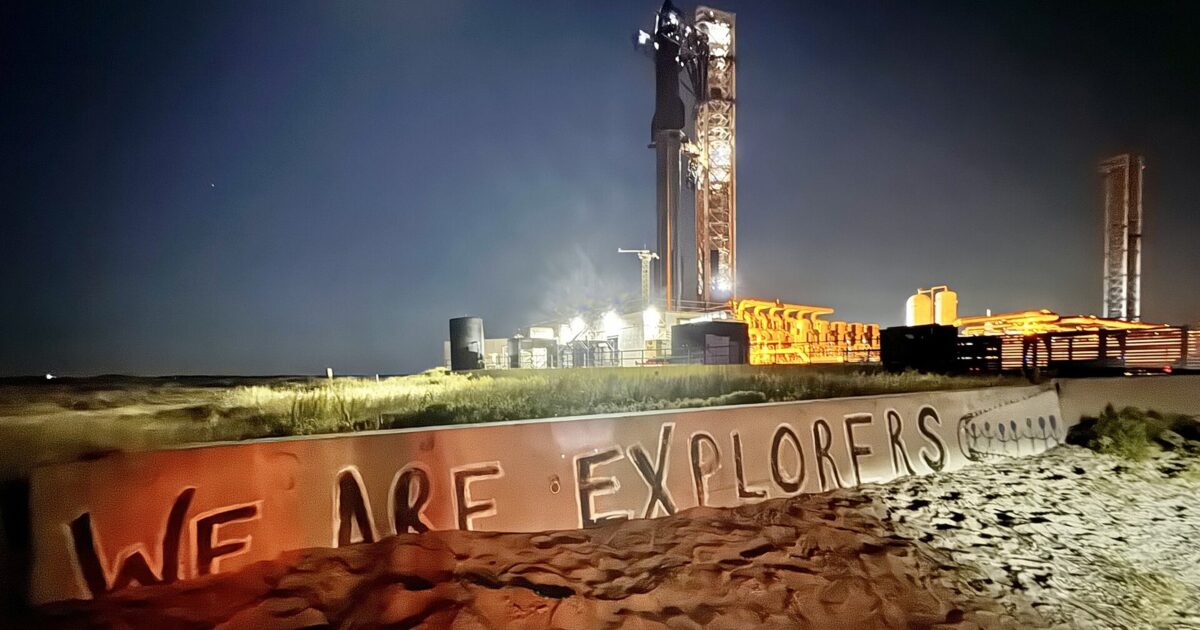
SpaceX is preparing to launch Starship Flight 12 as early as Tuesday, May 19, with a launch window opening at 5:30 p.m. Central time from Starbase, Texas. Flight 12 rolls several firsts into one mission: SpaceX’s first next-generation V3 Starship and Super Heavy vehicles, the first flight powered by Raptor 3 engines, and the first launch from the newly designed Pad 2.
The vehicle stack consists of Ship 39 and Booster 19, both first-flight hardware in the V3 generation. SpaceX completed a full flight-like launch rehearsal before announcing the date, loading more than 5,000 metric tonnes of propellant into the fully stacked vehicles.
That is over 11 million pounds of fuel and oxidizer running through brand new plumbing on a brand new pad. If that does not get your attention, nothing will.
Starship’s twelfth flight test will debut the next generation Starship and Super Heavy vehicles, powered by the next evolution of the Raptor engine and launching from a newly designed pad at Starbase. The launch is targeted as early as Tuesday, May 19 → https://t.co/2gZQUxS6mm pic.twitter.com/JxmpL2WE4w
— SpaceX (@SpaceX) May 12, 2026
SpaceX laid out the full scope of the mission on its Flight 12 page:
SpaceX’s Flight 12 mission page frames this as a major step in the Starship program. The company is preparing to launch the twelfth flight test as soon as Tuesday, May 19, with a launch window opening at 5:30 p.m. Central time from Starbase. The test is described as the debut of next-generation Starship and Super Heavy vehicles, a new Raptor engine evolution, and a newly designed launch pad. SpaceX says the flight objective is to put these redesigned elements into the flight environment for the first time and keep learning toward full and rapid reuse.
The upper stage mission includes deploying 22 Starlink simulators, an in-space Raptor relight, heat-shield experiments, white-painted tiles to simulate missing tiles, and reentry maneuvers meant to inform future return-to-Starbase profiles. The last two Starlink simulators are intended to scan the heat shield and send imagery back to operators, giving SpaceX another data stream for future vehicle recovery work. The company also cautions that developmental test schedules are dynamic and may change, with a live webcast planned about 30 minutes before liftoff when the attempt is ready.
The mission objectives list is stacked. SpaceX plans to deploy 22 Starlink simulator satellites from the upper stage. Two of those simulators are designed to scan the heat shield during flight and transmit imagery back, giving engineers a real-time look at thermal protection performance under actual reentry conditions. SpaceX is also intentionally removing one heat-shield tile to gather aerodynamic-load data on exposed surfaces.
On top of that, Flight 12 will attempt an in-space relight of a single Raptor engine, stress the rear flaps under load, and perform a banking maneuver that mimics the trajectory SpaceX would need to bring a Starship back to Starbase on future flights.
Because so many elements are new, SpaceX is not attempting a catch on either stage. Booster 19 is expected to perform a controlled splashdown in the Gulf of Mexico roughly seven minutes after liftoff, and Ship 39 is aimed at an Indian Ocean splashdown after a flight lasting a little more than an hour.
Spaceflight Now provided detailed technical framing around the V3 hardware changes and why this flight matters beyond the headline date:
Flight 12 is targeted no earlier than May 19 and will be the debut of the third major Starship and Super Heavy iteration, the first Starship launch from Pad 2, and the first flight with Raptor 3 engines. Because so many pieces are new, SpaceX is not trying to catch Ship 39 or Booster 19. Booster 19 is expected to perform a controlled splashdown in the Gulf roughly seven minutes after liftoff, while Ship 39 is aimed at an Indian Ocean splashdown after a flight lasting a little more than an hour.
The article also highlights integrated hot-stage changes, the 22 Starlink simulators, the heat-shield imaging plan, the intentionally missing tile, and the Raptor 3 upgrades. Those include 250 tonnes-force of sea-level thrust, up from 230 tf, and 275 tf of vacuum thrust, up from 258 tf, while reducing sea-level engine mass from 1,630 kg to 1,525 kg. Raptor 3 also features internalized sensors and controllers and a redesigned ignition system. Spaceflight Now connects the V3 work to NASA’s lunar Starship needs and future propellant transfer architecture.
The Raptor 3 numbers deserve a moment. Each engine now produces roughly 9% more thrust at sea level while weighing about 6.5% less. That is a meaningful gain across 33 booster engines and 6 ship engines. More thrust from lighter hardware translates directly into payload capacity, which is exactly what SpaceX needs for operational Starlink deployment, NASA’s Human Landing System for Artemis, and eventually Mars.
Starship Flight 12: Navigational warnings indicate SpaceX is now targeting NET May 19 for launch.
(Source: NGA. Graphics @NeedPizza42) pic.twitter.com/Yc49iLkrCe
— NSF – NASASpaceflight.com (@NASASpaceflight) May 12, 2026
Tesla Oracle provided additional preflight context on the preparation timeline and why V3 required a longer buildup between flights:
Tesla Oracle framed the May 19 target as the most anticipated Starship launch of the year because of the scope of design and engineering changes in the V3 Starship spacecraft and Super Heavy booster. The article gives the window as 5:30 p.m. Central, 6:30 p.m. Eastern, and notes that weather or technical issues can still change the first-day target.
SpaceX stacked Ship 39 on Booster 19 at Starbase and loaded more than 5,000 tonnes, over 11 million pounds, of propellant during the final rehearsal. Booster 19 had already completed a full-duration, full-thrust 33-engine static fire the prior week, and Ship 39 had gone through a six-engine static fire in April. The article also points back through months of ground testing, including earlier Booster 19 static-fire work and Ship 39 pressure and engine checks.
That longer preparation stretch makes sense for a first V3-generation launch. The V2 era ended with Flight 11, while Flight 12 is carrying a new ship, a new booster, new engines, and a new pad into the same test campaign. The buildup is part of the story because SpaceX is trying to fly a cleaner, more capable stack while collecting data for the next phase of Starship operations.
Drive Tesla Canada detailed some of the physical hardware changes on the V3 stack beyond the engines:
Flight 12 marks the first test of SpaceX’s next-generation Starship and Super Heavy design, with changes that go well beyond Raptor 3. The Super Heavy booster features three larger and stronger grid fins, a redesigned fuel transfer tube, simpler aft thermal protection, and the removal of some engine shrouds. Those changes are meant to simplify the booster, improve control authority during descent, and move the design closer to the hardware SpaceX wants to reuse rapidly.
The Starship upper stage includes new systems for future in-space refueling, docking hardware, and ship-to-ship transfer connections. The Raptor 3 section repeats the thrust and mass improvements and notes that the engine redesign reduces external plumbing and hardware. Mission objectives listed include 22 Starlink simulators, a Raptor relight in space, heat-shield and flap tests, no booster catch, a controlled Gulf splashdown for the booster, and the first launch from Pad 2.
The hardware list shows why this flight carries more weight than a normal launch-date update. Bigger fins, cleaner thermal protection, refueling-related hardware, a redesigned pad, and a lighter, stronger engine package all point toward the same goal: a Starship system that can launch often, survive reentry, transfer propellant in orbit, and eventually support missions far beyond low Earth orbit.
The bigger grid fins, the docking hardware, the refueling plumbing. None of those details are accidental. SpaceX is building the architecture it needs to refuel Starship in orbit, land crew on the Moon for NASA, and eventually turn the vehicle around fast enough to make the economics of fully reusable super-heavy-lift flight actually work.
Flight 12 is targeted for May 19, but SpaceX has been clear that developmental test schedules are dynamic. Weather, technical readiness, or range conditions could shift the date. When the window does open, SpaceX says it will webcast the launch live.
This is the most ambitious single test flight SpaceX has ever loaded onto one mission. New vehicle generation, new engines, new pad, satellite deployment, in-space relight, intentional tile removal, heat-shield scanning, flap stress tests, and a banking maneuver to rehearse future landing profiles. Every one of those objectives feeds directly into the next phase of Starship development. Tuesday could be a very big day at Starbase.
Join the conversation!
Please share your thoughts about this article below. We value your opinions, and would love to see you add to the discussion!