

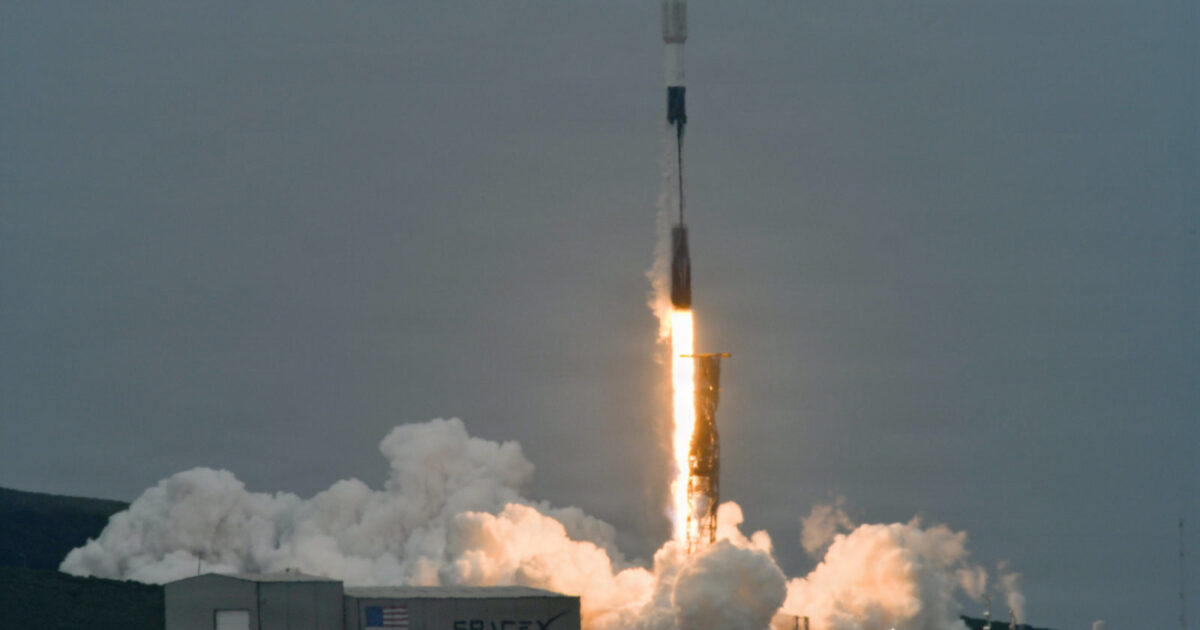
SpaceX has a Falcon 9 standing by at Vandenberg Space Force Base in California for a Starlink mission this evening.
The flight is Starlink 17-46, lifting off from Space Launch Complex 4 East with another batch of Starlink internet satellites headed for low Earth orbit.
Liftoff is targeted for 7:57 PM PDT on Wednesday, July 1, 2026.
That launch window is the interesting part. A rocket climbing at dusk, with the sun still catching its exhaust while the ground below sits in darkness, is exactly the recipe for one of the prettiest sights in modern spaceflight.
Skywatchers already have their eyes on it.
Here is the alert making the rounds ahead of the window:
Space jellyfish alert!
Starlink 17-46 from SLC-4E in California on July 1, 2026 at 7:57 PM PDT could produce a space jellyfish. This occurs when a rocket and its expanding exhaust plumes are illuminated by the sun and observers are in local darkness.
The rocket will enter… pic.twitter.com/apSs1vuTkC
— Space Jellyfish Alerts (@spacejellyalert) July 1, 2026
The effect people are hoping for is the so-called space jellyfish. It happens when the rocket enters sunlight at high altitude and its expanding plume fans out into a glowing shape while observers below are in local twilight or dark.
Nothing about it is guaranteed. It depends on the exact lighting angle, the launch time holding, and where you are standing.
But an evening launch like this gives Southern California a real chance to see it.
SpaceX lists Starlink 17-46 as a Falcon 9 mission from SLC-4E in California with a droneship recovery profile.
The official launch listing keeps the details simple: Falcon 9, Starlink payload, Vandenberg launch site, and a sea landing downrange in the Pacific. It is the clean source for the mission family, the pad, and the recovery setup before the countdown begins.
SpaceX’s broader public launch page also shows another Starlink Falcon 9 from SLC-40 in Florida on July 3. That gives the story its same-week cadence: California tonight, Florida next on the board, and both flights feeding the same Starlink buildout.
For readers, that separates the hard schedule facts from the skywatching excitement. The official source says what is supposed to fly and from where; the viewing conditions explain why this particular window could be more dramatic than an ordinary launch listing.
Supercluster logs the mission as Starlink 17-46 and puts the target at 2:57 AM UTC on July 2, which is 7:57 PM Pacific and 9:57 PM Central on July 1.
The tracker says SpaceX plans to send 24 Starlink high-speed internet satellites into low Earth orbit. It also identifies SLC-4E at Vandenberg as the launch site and Of Course I Still Love You as the recovery ship.
Supercluster adds the broader Starlink frame, listing more than 10,700 active satellites in the constellation. It describes Starlink as a low-Earth-orbit broadband network built for lower-latency service, including remote and underserved areas that traditional wired internet struggles to reach.
The tracker also gives useful Falcon 9 context: a reusable two-stage rocket, regular Starlink batches from both Florida and California, and frequent ocean landings for the first stage. That is why a one-line launch listing actually points to a much bigger operating machine.
Spaceflight Now gives the recent cadence context from the same pad.
Its June 28 Vandenberg report covered Starlink 17-40, another 24-satellite Falcon 9 mission from SLC-4E. That flight used booster B1088 on its 17th mission and landed the first stage on Of Course I Still Love You a little more than eight minutes after liftoff.
The bigger number is even louder. Spaceflight Now reported SpaceX had flown 75 Falcon 9 missions in the first half of 2026, with 59 of them supporting Starlink.
June alone had 10 Starlink launches out of 13 Falcon 9 missions after Starlink 17-40. That makes tonight’s Starlink 17-46 attempt feel less like a random schedule entry and more like the next beat in a launch cadence SpaceX has been tightening all year.
DVIDS and Space Launch Delta 30 add the local Vandenberg angle.
The DVIDS record says Guardians and Airmen at Vandenberg supported the June 28 Starlink 17-40 launch from SLC-4E, and that mission marked the 44th launch of 2026 from the U.S. Space Force’s West Coast Spaceport and Test Range.
The record also places the work at Vandenberg Space Force Base in California and identifies the image as a public-domain U.S. Space Force photo by Christopher Okula. It is a useful local source because it shows the range, the people supporting the launches, and the official count from the base itself.
That matters for tonight because Starlink 17-46 is using the same launch base and same core rhythm only a few days later. Vandenberg has become one of the workhorse gateways for the Starlink buildout, not a once-in-a-while backdrop.
None of that takes the shine off tonight.
If the weather cooperates and the countdown holds, people across California could look up around 8 PM Pacific and catch a rocket painting the sky.
Check the local horizon to the northwest after liftoff. The best show is usually a few minutes into flight, once the vehicle is high enough to catch the last of the sun.
Whether or not the jellyfish appears, another Falcon 9 is about to add to a network that keeps growing. That is the part you can count on.
Join the conversation!
Please share your thoughts about this article below. We value your opinions, and would love to see you add to the discussion!