

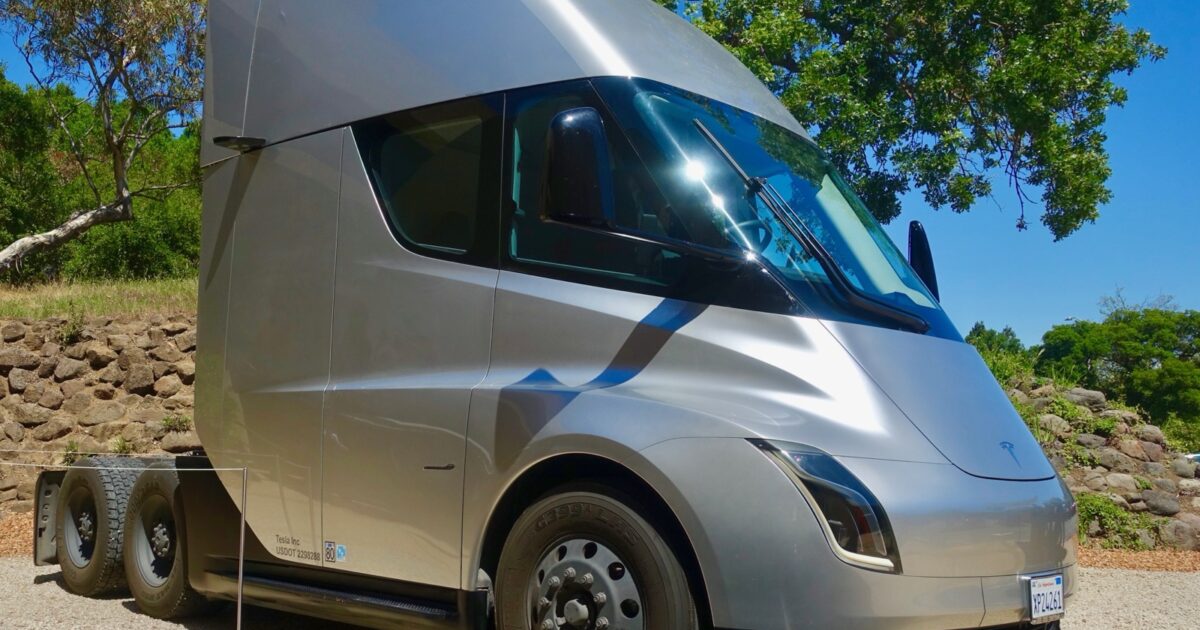
Tesla just gave the Semi a serious public charging address in Southern California.
The new Bloomington hub has six Megacharger stalls, and every one is rated for up to 1.2 megawatts. It puts multiple truck-scale charging positions at one public address.
This is the kind of buildout that turns the Semi from an impressive truck into a practical freight system.
New Tesla Megacharger: Bloomington, CA (6 stalls) https://t.co/nAWzgnNovx pic.twitter.com/6jxTvIdrwx
— Tesla Charging (@TeslaCharging) July 17, 2026
Drive Tesla reports that the station sits at 18434 Valley Blvd in Bloomington, California. Its six charging stalls can each deliver up to 1.2 MW to a Tesla Semi, putting several truck-scale charging positions behind one public address.
The report traces public Semi charging in the area back to an earlier installation nearby. That older location reportedly offered only two 750 kW stalls and used Tesla’s first-generation MC1 connector, so it had fewer plugs and a lower power ceiling than the new hub.
That first site no longer appears on Tesla’s charging map, according to the outlet. The Bloomington station is built around the newer MC2 hardware intended for the redesigned Semi, scaling the public setup far beyond the older installation.
Drive Tesla also says the network is moving beyond a handful of isolated projects. Its review of Tesla’s map found at least 64 planned Megacharger locations in the United States, with Bloomington now serving as one live piece of that larger buildout in a region filled with warehouses and heavy truck traffic.
That scale is important for fleets that need predictable turnaround times. A public site with several current-generation chargers gives drivers a better chance of finding an open stall and keeps one delayed truck from tying up the entire location.
Bloomington’s placement also makes sense. Southern California’s inland freight corridor is threaded with warehouses, distribution centers, interstate traffic and the daily movement of heavy trucks.
A six-stall station will not transform long-haul trucking by itself. It does answer one of the biggest practical questions around electric semis: where a driver can pull in, charge at truck-scale power and get back on the road without owning the depot.
The power level is the headline here. Passenger-car Superchargers helped make Tesla road trips routine.
Heavy trucks carry much larger battery packs and live on schedules measured in loaded miles, delivery windows and driver hours. They need an entirely different class of charger.
Tesla says its Megacharger can deliver up to 1.2 MW and add as much as 60 percent of a Semi’s range in 30 minutes. The company positions that system for quick stops, where a truck can take on meaningful range during a driver’s break and return to service.
Tesla pairs that road-focused option with a 120 kW Basecharger for depots and overnight parking. The company says Basecharger can add up to 60 percent of range in four hours.
That slower unit is designed for the long dwell time a truck already spends parked at its home base, where lower power can be easier and less expensive to install.
Together, the two products give a fleet more than one charging pattern. Basechargers can handle planned overnight energy, while public Megachargers can support fast turnarounds and routes that run beyond a company’s yard.
Bloomington puts the fast side of that system where fleets and drivers can actually reach it.
There is still a long road between six chargers in Bloomington and a nationwide freight network. Tesla now has a full-size public site with six truck-charging positions, each rated for up to 1.2 MW.
That is real progress. Every station like this gives the Semi a larger working map, gives fleet buyers more confidence in routes outside their own facilities, and gives Tesla another place to learn how megawatt charging behaves beyond a private depot.
Tesla can add the pins from here. Bloomington gives the Semi something more valuable than another promise: six public places to charge.
Join the conversation!
Please share your thoughts about this article below. We value your opinions, and would love to see you add to the discussion!