

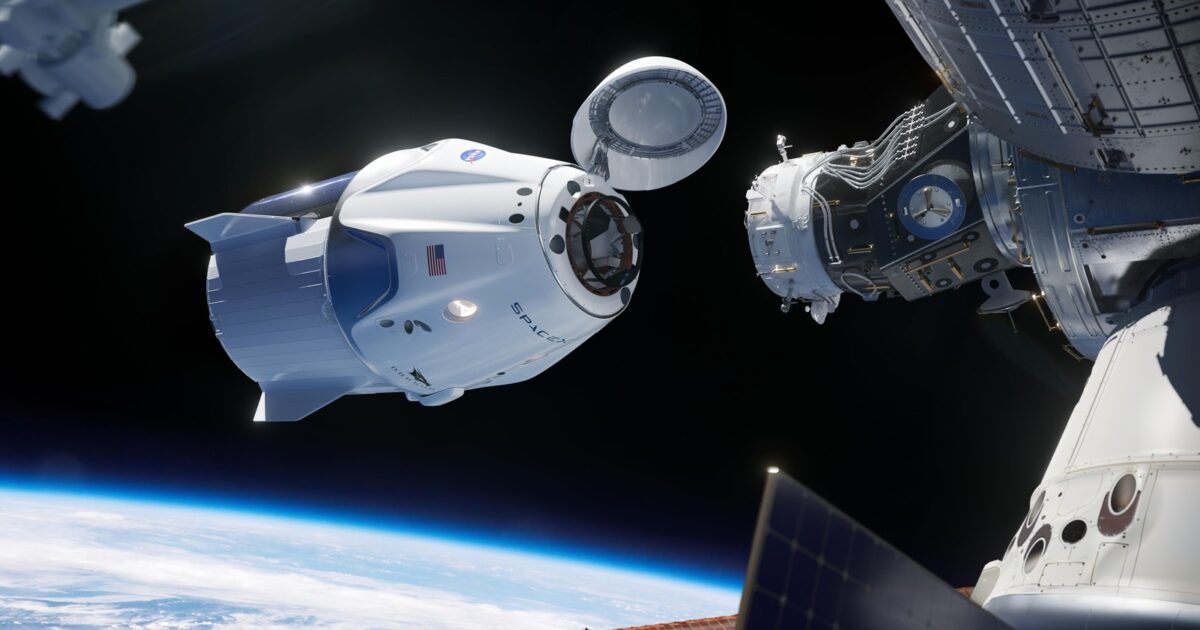
SpaceX sent another Dragon capsule toward the International Space Station on Friday, and at this point the company is making orbital freight runs look about as routine as a FedEx delivery.
The 34th commercial resupply mission under NASA contract lifted off at 6:05 p.m. EDT from Space Launch Complex 40 at Cape Canaveral Space Force Station in Florida, carrying nearly 6,500 pounds of cargo for the Expedition 74 crew.
Dragon separated from Falcon 9’s second stage about nine minutes after launch and began its choreographed series of thruster burns toward the station.
Autonomous docking is scheduled for approximately 7 a.m. EDT on Sunday, May 17, at the forward port of the station’s Harmony module.
Falcon 9 launches the CRS-34 mission to the @Space_Station pic.twitter.com/kXV4C09NHs
— SpaceX (@SpaceX) May 16, 2026
NASA confirmed the launch and outlined the research payloads riding inside Dragon:
The 34th SpaceX commercial resupply mission under contract with NASA is headed to the International Space Station with new scientific experiments after lifting off at 6:05 p.m. EDT Friday on a Falcon 9 rocket from Space Launch Complex 40 at Cape Canaveral Space Force Station in Florida. The SpaceX spacecraft, loaded with nearly 6,500 pounds of cargo for the space station Expedition 74 crew, is scheduled to autonomously dock at about 7 a.m. Sunday, May 17, to the forward port of the station Harmony module.
In addition to cargo for the crew aboard the space station, Dragon will deliver several new experiments, including a project to determine how well Earth-based simulators mimic microgravity conditions, a bone scaffold made from wood that could produce new treatments for fragile bone conditions like osteoporosis, and equipment to help researchers evaluate how red blood cells and the spleen change in space.
The Dragon spacecraft also will carry a new instrument to study charged particles around Earth that can impact power grids and satellites, an investigation that could provide a fundamental understanding of how planets form, and an instrument designed to take highly accurate measurements of sunlight reflected by Earth and the Moon. Dragon is scheduled to remain at the station until mid-June, then return time-sensitive research and cargo before splashing down off the coast of California.
The experiment manifest is wide-ranging. NASA says Dragon is carrying a project to test how well Earth-based simulators mimic actual microgravity conditions, along with a bone scaffold made from wood that could lead to new treatments for fragile bone conditions like osteoporosis.
Equipment for studying how red blood cells and the spleen change in space is also onboard, plus a new instrument designed to measure charged particles around Earth that can affect power grids and satellites.
Two more investigations round out the science cargo: one aimed at understanding how planets form and another built to take highly accurate measurements of sunlight reflected by Earth and the Moon.
Dragon separation confirmed. Autonomous docking with the @Space_Station on Sunday, May 17 at ~7:00 a.m. ET
— SpaceX (@SpaceX) May 15, 2026
The NASA ISS Blog walked through the post-launch sequence:
At 6:05 p.m. EDT, nearly 6,500 pounds of scientific investigations and cargo launched to the International Space Station aboard the SpaceX Dragon spacecraft for the company 34th commercial resupply services mission for NASA. The spacecraft lifted off on a SpaceX Falcon 9 rocket from Space Launch Complex 40 at Cape Canaveral Space Force Station in Florida.
About nine minutes after launch, Dragon will separate from the rocket second stage, open its nosecone, and begin a carefully choreographed series of thruster firings to reach the space station. Dragon will arrive at the orbiting outpost at approximately 7 a.m. Sunday, May 17, and will dock autonomously to the forward port of the station Harmony module.
NASA live rendezvous and docking coverage begins at 5:30 a.m. Sunday on NASA+, Amazon Prime, and the agency YouTube channel for viewers following the final approach.
NASA will carry live rendezvous and docking coverage starting at 5:30 a.m. Sunday on NASA+, Amazon Prime, and YouTube.
Dragon is expected to remain attached to the station until mid-June before departing with time-sensitive research and cargo for a splashdown off the coast of California.
Thirty-four resupply missions.
Reusable rockets, reusable capsules, and a cadence that makes sending three tons of science to orbit feel like clockwork.
That is the commercial space economy SpaceX has built, and it just keeps delivering.
Join the conversation!
Please share your thoughts about this article below. We value your opinions, and would love to see you add to the discussion!