
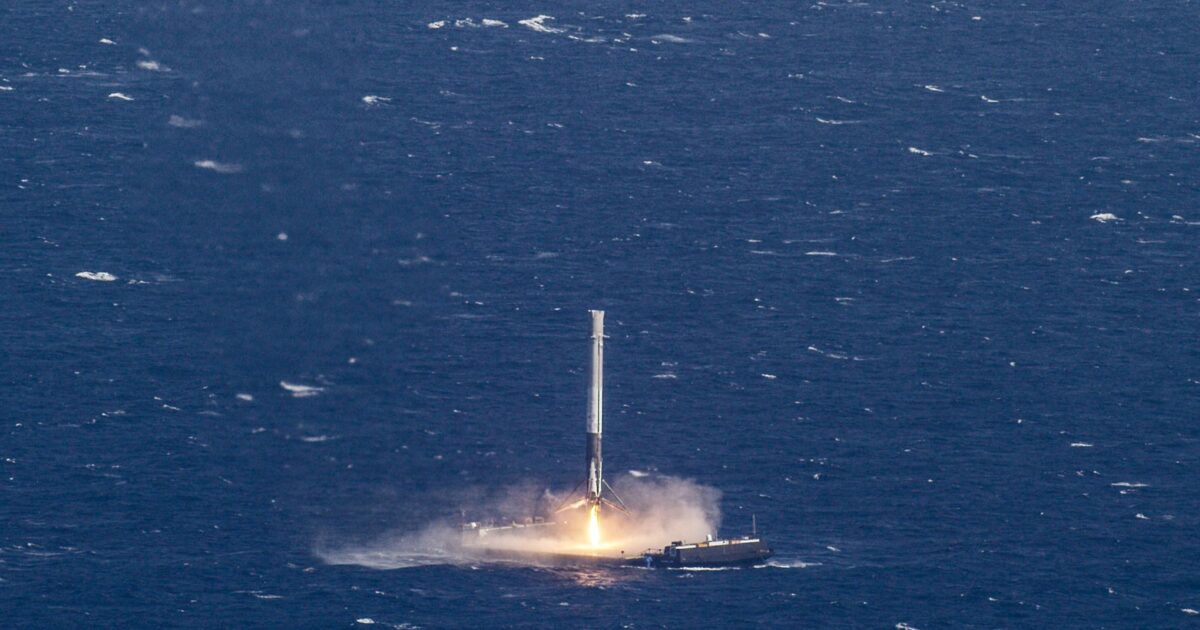
SpaceX put another national-security payload into orbit Monday night.
A Falcon 9 lifted off from Space Launch Complex-4 East at Vandenberg Space Force Base in California at 10:13 p.m. EDT on May 11, carrying the NROL-172 mission for the National Reconnaissance Office.
The NRO confirmed mission success shortly after launch.
Falcon 9 launches NROL-172 to orbit from pad 4E in California pic.twitter.com/obrHZM6kpx
— SpaceX (@SpaceX) May 12, 2026
NROL-172 marks the thirteenth overall launch of the NRO’s multi-phenomenology proliferated architecture and the second proliferated launch of 2026. That cadence is worth paying attention to.
The mission was a partnership between the NRO, U.S. Space Force Space Systems Command’s System Delta 80, Space Launch Delta 30, and SpaceX.
According to the NRO’s official press release:
The National Reconnaissance Office (NRO), in partnership with U.S. Space Force Space Systems Command’s System Delta 80 (SYD 80), Space Launch Delta 30, and SpaceX, successfully launched the NROL-172 mission aboard a SpaceX Falcon 9 rocket from Space Launch Complex-4 East at Vandenberg Space Force Base in California on May 11, 2026, at 10:13 p.m. EDT.
Today’s mission is the thirteenth overall launch of the NRO’s multi-phenomenology proliferated architecture and second proliferated launch of 2026. NROL-172 is also the second mission in partnership with SSC SYD 80 under the National Security Space Launch (NSSL) Phase 3 Lane 1 Launch Service NRO Task Order awarded in October 2024.
NSSL, a government launch acquisition partnership program between SSC and the NRO aimed at ensuring continued assured access to space for national security missions, is overseen and operated by SSC headquartered at Los Angeles Air Force Base in California. NRO’s ability to leverage multiple acquisition approaches demonstrates NRO’s commitment to delivering critical national systems on orbit faster than ever before.
That “assured access to space” language matters. The federal government is betting heavily on SpaceX’s reusable Falcon 9 to keep the national-security launch pipeline moving at a pace no other provider can match right now.
The NRO also laid out the broader mission behind its rapidly growing constellation.
From the same NRO release:
The NRO’s proliferated architecture, in addition to our other ISR systems, supports multiple missions across the intelligence and Department of War (DoW) communities, including the ground moving target indicator mission as part of the DoW’s space-based sensing and targeting architecture.
Through sustained launch activity and accelerated deployment of next-generation systems, NRO fields the most advanced and capable government constellation our nation has ever delivered with hundreds of satellites now on orbit. Building on this momentum, 2026 is poised to be another dynamic year with a robust launch schedule.
Many of these missions will advance the NRO’s proliferated architecture, with additional proliferated launches planned through 2029 to ensure sustained growth and innovation. For more than 60 years, the NRO has successfully met the needs of its U.S. intelligence, military, civil, and allied partners.
It remains the world’s leader in unique intelligence, surveillance, and reconnaissance systems. The NRO’s next-generation systems will help ensure that the right data is delivered to the right user at the right time, faster than ever before.
Hundreds of satellites already on orbit, with more proliferated launches planned through 2029. The NRO is not slowing down.
MISSION SUCCESS: NROL-172 launched today at 10:13 p.m. ET on a @SpaceX Falcon 9 rocket from Vandenberg SFB
NRO & @USSF_SSC launching a proliferated mission with NSSL shows NRO's ability to leverage multiple launch acquisition strategies
Press release: https://t.co/tMeD6mJoqL pic.twitter.com/JM6PoG2Hbm
— NRO (@NRO_gov) May 12, 2026
What makes this story compelling for anyone watching SpaceX is the sheer reliability of Falcon 9 as the workhorse behind America’s most sensitive space missions. Reusability was once dismissed as a pipe dream. Now it is the backbone of the national-security launch manifest.
Expect more NROL missions on Falcon 9 throughout 2026 and beyond. The NRO itself called this year “another dynamic year with a robust launch schedule.”
SpaceX keeps delivering, and the U.S. government keeps coming back for more.
Join the conversation!
Please share your thoughts about this article below. We value your opinions, and would love to see you add to the discussion!