
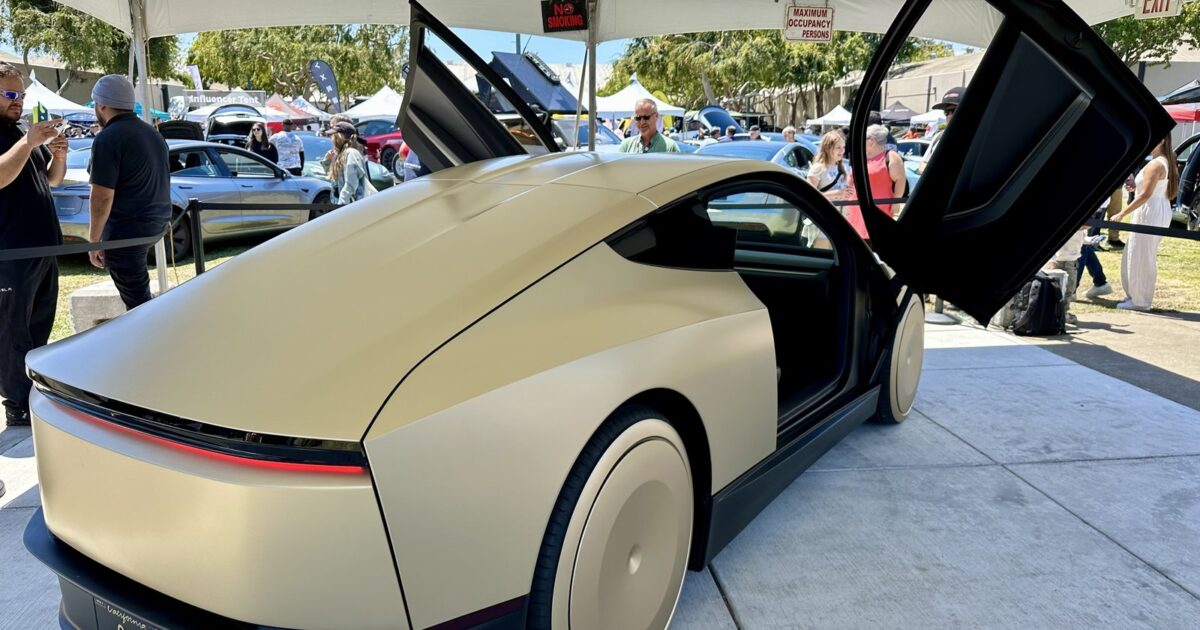
A Tesla Cybercab was photographed on public roads this week with what appears to be a Starlink Mini satellite dish mounted directly to the rear liftgate.
The images were shared on X by Adan Guajardo on May 15 and quickly circulated across the Tesla community.
The hardware has not been officially announced as a Cybercab production feature. What we’re looking at appears to be test equipment on a prototype or development vehicle.
That said, the pairing makes a lot of sense for a vehicle designed to operate without a human driver.
Cybercab + Starlink pic.twitter.com/sI2aRIIeF6
— Adan Guajardo (@AdanGuajardo) May 15, 2026
Not a Tesla App connected the sighting to Tesla’s broader robotaxi connectivity needs:
The May 15 item centers on high-resolution X photos from Adan Guajardo showing a Cybercab on public roads with a portable satellite terminal mounted directly to the rear liftgate. The important distinction is that the photos show apparent hardware on a prototype or development vehicle; Tesla has not announced a production Starlink package for Cybercab.
The connectivity angle is practical. A vehicle designed to operate without a conventional driver still needs dependable links for telemetry, fleet supervision, passenger communication, map and routing data, remote support, and edge-case assistance when the car reaches a situation that needs outside guidance.
The same piece also points back to earlier Project Halo coverage, where modified robotaxi test vehicles carried extra connectivity hardware for more reliable remote-support links. That makes the rear-mounted Cybercab hardware more than a random accessory sighting; it fits a pattern of Tesla testing backup communications before scaling driverless fleet operations.
For readers, the useful takeaway is the gap between what is visible and what remains unconfirmed. The photos show apparent Starlink-style equipment on the car, while the final production plan, fleet configuration, and whether any customer Cybercab receives satellite hardware are still open questions.
The outlet also noted similarities to earlier reporting around Project Halo, where modified Tesla robotaxi test vehicles used secondary connectivity hardware for more reliable links to remote support teams.
New pics of the Tesla Cybercab equipped with a Starlink Mini antenna mounted on the trunk lid. https://t.co/vfX22Fr5N2 pic.twitter.com/QFKCOrl4nS
— The Tesla Newswire (@TeslaNewswire) May 15, 2026
An autonomous vehicle that loses its cellular connection mid-ride is a serious operational problem. Satellite connectivity solves that by providing a redundant link that doesn’t depend on ground-based towers.
The Starlink Mini is a compact piece of hardware built for exactly this kind of use case.
The official Starlink Mini specification sheet shows why the hardware is plausible on a mobile test platform:
The Mini uses an electronic phased-array antenna with a 110-degree field of view and software-assisted manual orienting. The antenna is listed at 1.10 kg by itself, 1.16 kg with the kickstand, and 1.53 kg with the kickstand and 15-meter cable attached.
The environmental rating is IP67 Type 4 when the DC power cable and Starlink plug/cable are installed, with an operating temperature range from -30C to 50C. Average power consumption is listed at 25-40 watts, and the input rating is 12-48V at 60W.
The Wi-Fi side lists Wi-Fi 5, dual-band 3×3 MU-MIMO, WPA2 security, compatibility with Starlink mesh systems, coverage up to 112 square meters, and support for up to 128 connected devices. Those are technical specs rather than a Tesla feature announcement, and they explain why the compact terminal is interesting for vehicle testing in motion.
Those specs are well within what a vehicle platform can accommodate. The Mini’s weight, power draw, and temperature tolerance all fit a rooftop or liftgate mounting scenario.
It also supports Wi-Fi 5 with up to 128 connected devices, though a robotaxi application would likely prioritize the vehicle’s own systems over passenger Wi-Fi.
NEWS: A Tesla Cybercab was spotted with what appears to be a Starlink antenna mounted on the rear.
If that’s really Starlink hardware, it could point toward always-connected autonomous vehicles with direct satellite communication capabilities.
For robotaxis, reliable… pic.twitter.com/ndRquB588t
— Tesla Owners Silicon Valley (@teslaownersSV) May 15, 2026
The timing lines up with where Tesla is in the Cybercab program.
In its Q1 2026 Form 10-Q, Tesla put Cybercab in the manufacturing context:
Tesla described its production growth plans around autonomy, new products, and vehicles using aspects of the next-generation platform. The filing says the next phase of growth depends on advances in autonomy, the introduction of new products, and the ability to manufacture cells with high-volume output, lower capital and production costs, and longer range.
For Cybercab specifically, Tesla said it made significant progress in the first quarter of 2026 because it began pilot production of Cybercab. The company placed that milestone alongside ramps across new battery and material factories, including cathode material and lithium refining in Texas.
The same filing says Tesla is capitalizing on real-world AI data to advance Optimus while preparing and investing for large-scale production. That matters for Cybercab because the vehicle is part of the same autonomy-and-manufacturing push, where the car, the fleet software, the data loop, and the supporting infrastructure all have to mature together.
Tesla’s Q1 2026 update added that the company expected volume production of both Cybercab and Tesla Semi during 2026, while continuing to build supporting infrastructure for Robotaxi expansion.
Unsupervised Robotaxi rides launched in Dallas and Houston in April.
Testing satellite connectivity hardware on a purpose-built autonomous vehicle while you’re simultaneously standing up a robotaxi network is exactly the kind of move you’d expect from a company that controls both the vehicle and the satellite constellation.
Again, there is no official confirmation that Starlink will ship as a standard Cybercab feature. These photos show apparent test hardware on what looks like a development vehicle.
But if Tesla is exploring always-on satellite connectivity for its robotaxi fleet, the implications for reliability, remote support, and operational coverage are significant. This is one to keep watching.
Join the conversation!
Please share your thoughts about this article below. We value your opinions, and would love to see you add to the discussion!