
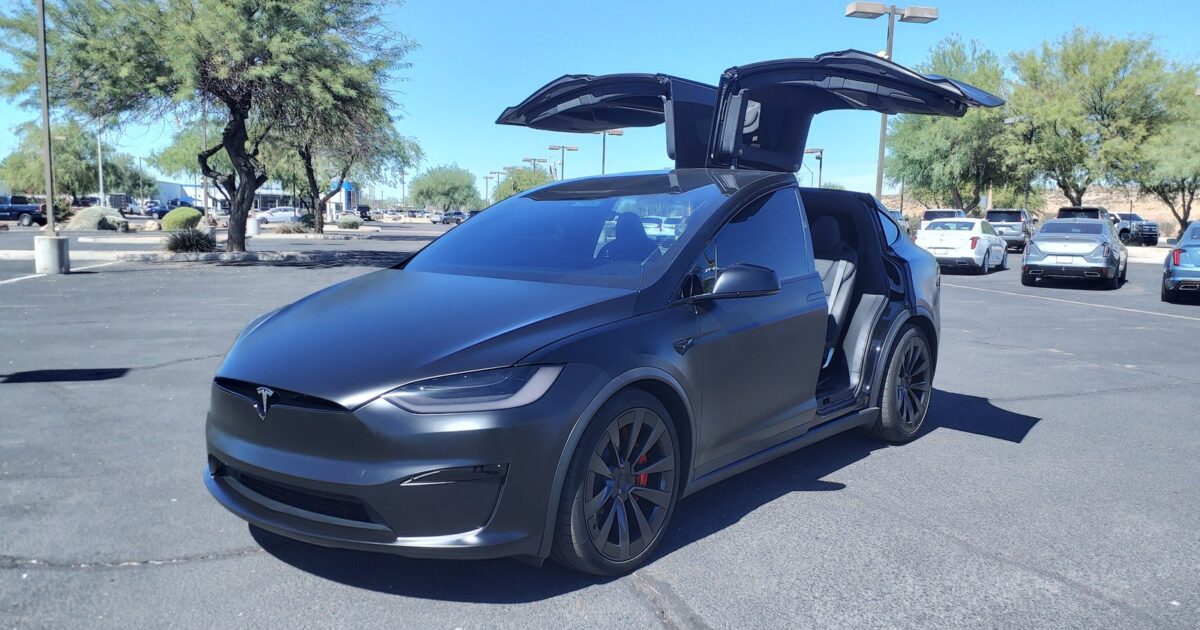
The final Model S and final Model X have rolled off the Fremont line, but according to two of the people who shaped those cars, the story might not be over.
Tesla VP of Vehicle Engineering Lars Moravy and Chief Designer Franz von Holzhausen sat down with Ryan McCaffrey on Episode 564 of the Ride the Lightning podcast, published May 24, to reflect on the legacy of both vehicles. The conversation turned fascinating when McCaffrey asked whether a total redesign or an entirely new S and X had ever been on the table.
The relevant exchange on Ride the Lightning laid out the decision this way:
McCaffrey framed the question around whether Tesla had ever weighed a true next-generation S and X, not just another light update. Moravy’s answer was that a complete refresh was discussed around 2020, but the company’s manufacturing priorities shifted as Optimus, Cybercab, and Semi became larger programs.
He described the older S and X line as dramatically less space-efficient than newer Tesla manufacturing programs, which made a clean-sheet redo a very different decision from keeping the existing cars alive. A proper return would need to use the kind of production thinking Tesla is now building around Cybercab, not simply preserve an aging layout for sentimental reasons.
The point was not that the nameplates could never return, but that reviving them properly would mean starting over with newer manufacturing ideas and choosing the right moment in Tesla’s broader roadmap. That is why Moravy’s answer landed as a door-left-open comment rather than a hidden product confirmation.
Moravy explained that around 2020, Tesla started seriously discussing a complete refresh of the S and X platforms. But priorities shifted.
Optimus came online quickly and needed a manufacturing home.
The older S and X production line was far less efficient than Tesla’s newer manufacturing programs, and a genuine redo would have required starting from zero with more advanced technology along the lines of what Tesla developed for Cybercab.
In Moravy’s assessment, now was simply not the right time to keep the current program going.
Then came the line that perked up every Tesla fan listening.
“I never say never,” Moravy said.
McCaffrey pressed the point, noting that Tesla was not ruling out a possible return someday. Moravy acknowledged that S and X did what they needed to do and that Tesla sees new opportunities looking forward.
Franz von Holzhausen was characteristically thoughtful about the decision. He said he is emotionally connected to both products and that it is hard to end something great.
But he framed the retirement as “making space for something greater,” a nod to Tesla’s forward-looking mission and the next generation of vehicles and robots on the horizon.
EV also focused on the future-door-open angle after the podcast aired:
EV treated Moravy’s comment as a meaningful nuance rather than a product announcement, tying it to the same week Tesla delivered the final special Model S and Model X units. Its report emphasized that the podcast discussion left the future door open while still making clear that Tesla had not announced a replacement program.
The write-up also connected the decision to the age of the platform, rising safety and regulatory expectations, the cost of a deep redesign, and Tesla’s need to shift people and factory space toward autonomous products and Optimus. That context matters because it frames the retirement as a resource and manufacturing decision, not as Tesla dismissing the role S and X played.
In other words, the current S and X run ended because Tesla chose the next generation of manufacturing priorities while still respecting what the vehicles made possible. For longtime owners, that distinction is the reason the podcast exchange feels less like a hard goodbye and more like an open-ended chapter.
Later in the episode, both executives made a point of thanking Model S and Model X owners directly, calling the cars foundation products that shaped everything Tesla builds today.
That gratitude tracks with the official sendoff Tesla gave both vehicles earlier this month.
The last Model S & the last Model X have been produced at Fremont Factory
— Tesla (@Tesla) May 10, 2026
14 years of history for Model S, 11 years for Model X
🫡 pic.twitter.com/5sSscIe1f3
Tesla’s post marked the final units produced at Fremont after 14 years for the Model S and 11 years for the Model X. It was a milestone moment for the company and for the community that rallied behind those cars from the beginning.
To be clear, nothing in this conversation should be taken as a confirmation that a new Model S or Model X is in development. Tesla did not announce a return.
What Moravy did was leave the door open, and for fans of these iconic vehicles, that alone is worth celebrating.
The S and X proved that electric cars could be desirable, fast, and premium. If Tesla’s next wave of manufacturing technology ever makes a spiritual successor possible, it sounds like the people who built the originals would welcome it.
Join the conversation!
Please share your thoughts about this article below. We value your opinions, and would love to see you add to the discussion!