

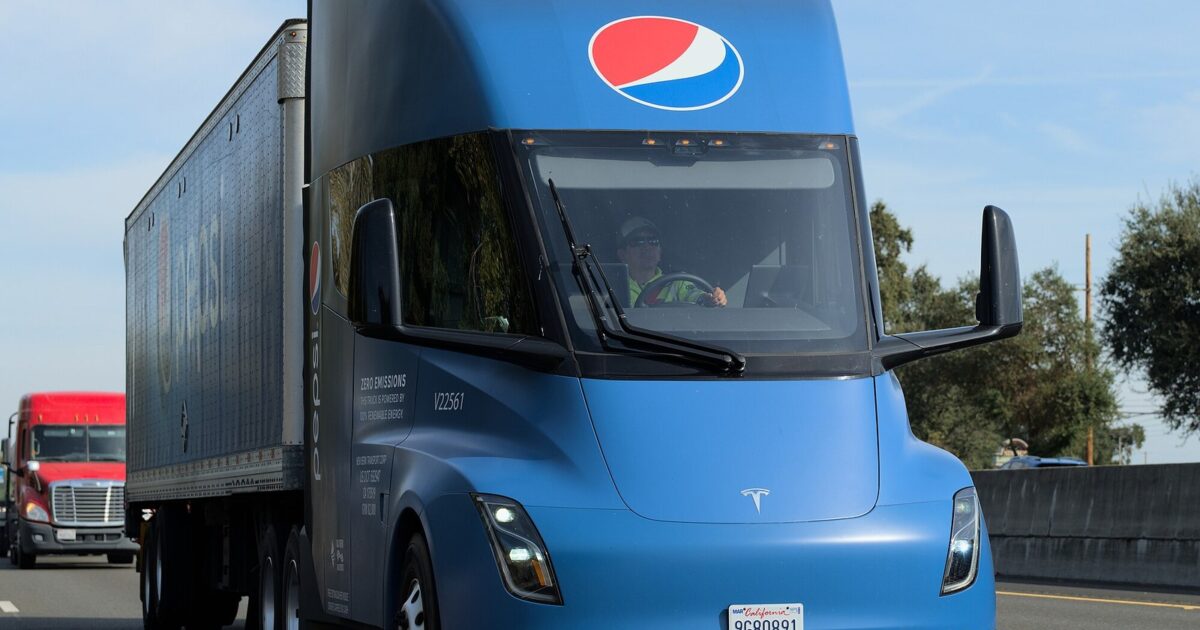
We now have official battery specs for the production Tesla Semi, and they come from a source that does not do marketing fluff.
A California Air Resources Board executive order, filed April 9, certifies the model year 2026 Tesla Semi powertrain family for heavy-duty zero-emission vehicle standards. The document pins down exact usable battery capacities and peak power figures for both the Long Range and Standard Range variants.
The Long Range Semi carries an 822.029 kWh NCMA lithium-ion pack with 800 kW of peak and steady power. The Standard Range comes in at 548.019 kWh with 525 kW peak and steady.
These are certified, regulatory numbers. Not estimates, not investor-deck projections.
First Semi off high volume line pic.twitter.com/fI1AdQrJFH
— Tesla Semi (@tesla_semi) April 29, 2026
The timing matters. Tesla’s high-volume production line produced its first Semi on April 29, and the CARB certification had already been filed weeks earlier.
The regulatory paperwork was quietly in place before the truck rolled off the line.
According to the California Air Resources Board executive order:
Executive Order A-374-0095 identifies Tesla for new heavy-duty zero-emission powertrains, model year 2026, powertrain family TTSL4ELCPSHD, and powertrain type battery-electric. The intended service class is heavy-duty, with GVWR greater than 33,000 pounds, and the order says the listed family meets the standards for which certification was requested.
The order also states that the powertrain family is deemed to have zero exhaust emissions for criteria pollutants or greenhouse gases under the cited California regulation. Attachment 1 gives the powertrain-family date as April 9, 2026 and then lists the two production Semi configurations.
Tesla Semi Long Range is listed with Li-Ion NCMA chemistry, 822.029 kW-hr usable capacity, 822.029 kW-hr rated capacity, 800 kW peak power, and 800 kW steady power. Tesla Semi Standard Range is listed with Li-Ion NCMA chemistry, 548.019 kW-hr usable capacity, 548.019 kW-hr rated capacity, 525 kW peak power, and 525 kW steady power.
Sharp-eyed fans will notice that 822 kWh is well below the roughly 900 kWh figure Elon Musk referenced back in 2022 for a 500-mile Semi. Tesla’s current product page still claims approximately 500 miles for the Long Range at 82,000 pounds gross combination weight.
If Tesla hits that range target with a smaller pack than expected, the story is efficiency, not a downgrade. Doing 500 miles on 822 kWh instead of 900 kWh means less weight, less cost per truck, and a better energy-per-mile figure.
Electrek made a similar observation in its coverage:
The CARB numbers put a sharper frame around the Semi than earlier estimates did. The Long Range pack comes in below the roughly 900 kWh figure Elon Musk discussed in 2022, while Tesla’s current product page still presents the truck as a 500-mile machine at full Class 8 gross combination weight.
That makes the efficiency claim the center of the story. If the production truck delivers the published range with an 822 kWh usable pack, Tesla gets a material-cost, battery-weight, and energy-per-mile advantage that matters directly to fleet economics.
The Standard Range version may be the truck that opens more doors for regional hauling. A 548 kWh pack paired with about 325 miles of range lets fleets avoid paying for the larger battery when the route profile, depot charging, and daily mileage do not require it.
The comparison also puts the Semi beside other electric Class 8 options that carry large packs with shorter advertised ranges. In that framing, Tesla’s advantage is less about one huge headline number and more about range, charging speed, weight, and price working together.
That Standard Range variant is worth paying attention to. At 548 kWh and roughly 325 miles, it covers a huge slice of regional and distribution routes where most Class 8 trucks actually operate day to day.
The Tesla Semi page fills in the charging and capability picture:
Deliveries start in 2026, and Tesla presents the Semi around three headline specs: 1.2 MW charge capability, 1.7 kWh per mile energy consumption, and an estimated 500 miles of range. The company says the truck can recover up to 60 percent of range in 30 minutes using Tesla’s Semi Chargers.
The specs page lists the truck at 82,000 pounds gross combination weight, with Standard Range at approximately 325 miles and Long Range at approximately 500 miles. Both variants list three independent motors on the rear axles, drive power up to 800 kW, MCS 3.2 charge type, and electric power take-off up to 25 kW.
Tesla also says electricity can be cheaper per mile than diesel and that battery-electric maintenance costs are lower because the truck avoids diesel aftertreatment systems. For fleets, those operating-cost claims sit right beside the CARB capacity numbers and the charging specs.
That 1.7 kWh per mile consumption figure, paired with the CARB-certified 822 kWh pack, gives you a theoretical 483 miles. Tesla’s published “approximately 500 miles” estimate likely assumes some favorable loading or route conditions, but the math is in the right neighborhood.
Power your refrigerated trailer & other equipment with up to 25kW from Semi’s ePTO pic.twitter.com/LgIf0bQyxf
— Tesla Semi (@tesla_semi) May 7, 2026
The 25 kW ePTO is a practical detail that fleet managers will appreciate. Powering a refrigerated trailer off the truck’s own battery instead of running a separate diesel generator is exactly the kind of total-cost argument that moves purchase orders.
Speaking of purchase decisions, California’s HVIP program has already listed the Long Range Semi for incentive vouchers. According to the California HVIP page:
The Tesla Semi Long Range Battery Electric Truck is listed under OEM Tesla as a Class 8 battery-electric tractor. The page lists a Class 8 base voucher amount of $120,000 and says Class 8 tractors performing eligible drayage operations qualify for a $150,000 voucher amount.
The program describes battery-electric technology as zero-emission when stationary or operating, and it says battery-electric medium- and heavy-duty vehicles have been proven to emit zero emissions while operating. The page says HVIP makes trucks and buses easier to sell and helps achieve cost parity with traditional technology.
That is the piece fleet buyers care about before the truck ever starts saving money on fuel or maintenance. A six-figure voucher can move the upfront purchase decision closer to the diesel comparison many operators already know.
It also explains why the certified pack sizes matter beyond a spec-sheet argument. The battery, range, charging plan, and incentive amount all feed the same buying decision for fleets that have to make the truck work every day.
A $120,000 voucher on a Class 8 tractor is significant. For drayage fleets working ports and rail yards, that number jumps to $150,000.
Voucher eligibility depends on HVIP funding availability and specific fleet qualifications. For California operators who do qualify, a six-figure incentive stacked on top of lower per-mile energy costs and reduced maintenance changes the math fast.
Between CARB-certified production specs, a charging architecture built for 1.2 MW throughput, and California incentives already live in the system, the Tesla Semi is entering the market with more concrete, verifiable data behind it than any Class 8 electric truck we have seen.
The hype phase is over. The spreadsheet phase has begun.
Join the conversation!
Please share your thoughts about this article below. We value your opinions, and would love to see you add to the discussion!