
SpaceX is gearing up to test a part of the space business that still looks surprisingly unfinished.
Getting cargo to orbit has become routine by SpaceX standards. Bringing it back cheaply and often is the harder return trip.
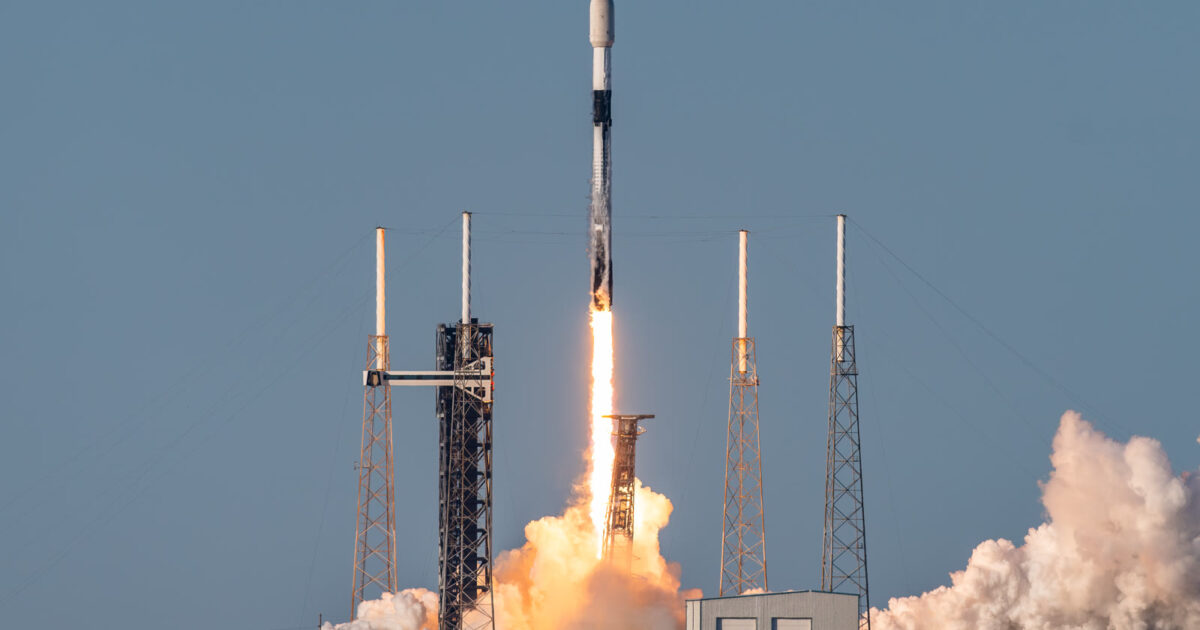
The mission is called Starfall Demo, and it is targeted for early Tuesday morning, June 23, 2026, from Cape Canaveral.
The vehicle does not look like a normal space capsule. It looks like a hockey puck.
That odd shape is the hook. The business case sitting underneath it is even more interesting.
SpaceX is set to launch its first Starfall Demo mission this Tuesday aboard its Falcon 9 rocket.
— Sawyer Merritt (@SawyerMerritt) June 22, 2026
The mission will test a new cargo return vehicle (pictured below) designed to bring materials back to Earth from orbit.
Unlike SpaceX’s Cargo Dragon, which primarily returns cargo… pic.twitter.com/pqkUnfUSxj
The official SpaceX launch listing gives this mission its timing and location. SpaceX is targeting Tuesday, June 23 for a Falcon 9 launch of Starfall Demo to low-Earth orbit from Space Launch Complex 40 at Cape Canaveral Space Force Station in Florida.
The one-hour launch window opens at 6:43 a.m. Eastern, with a backup opportunity at the same time on Wednesday, June 24 if the first try slips. SpaceX is also treating this as a public mission, with a live webcast listed on the company launch page and X.
That official page keeps the description tight, which is part of what makes the mission interesting. SpaceX is putting a new return-vehicle concept on a Falcon 9 schedule, and the bigger details come from local reporting, launch databases, and FAA-filed material around the Starfall program.
So what exactly is flying?
Local coverage from WFTV describes Starfall as a technology demonstration built to change how cargo returns from space. The station reports that the mission will fly from Cape Canaveral on Falcon 9 and test a new vehicle designed to bring materials back to Earth from orbit.
Space analyst Ken Kremer told WFTV the spacecraft resembles a hockey puck or a Frisbee, and that it will deploy from the Falcon 9 payload fairing before heading back to Earth. That is a very different visual from Dragon, Apollo, Soyuz, or the other cone-shaped capsules people usually picture.
The return profile is expected to use a parachute-assisted system. WFTV says Starfall could bring back up to 2,500 pounds of cargo, including scientific research and commercially manufactured products, while eventually pointing toward rapid cargo uses beyond normal orbital missions.
The comparison that frames the whole thing is Cargo Dragon. Dragon is the proven workhorse, but Starfall appears aimed at a different lane: simpler repeat cargo return where the payload matters more than crew-rated complexity.
The dimensions tell you why the shape is so unusual.
Spaceflight Now lists the June 23 Falcon 9 Starfall Demo with the same 6:43 a.m. Eastern window from SLC-40 and cites FAA-filed documents for the hardware details. Those filings are where the strange shape starts to make sense.
The documents describe Starfall as a capsule roughly 0.75 meters tall and 3.1 meters in diameter, weighing about 2,100 kilograms. It is rated to carry around 1,000 kilograms of payload, putting total vehicle-plus-payload weight near 3,100 kilograms.
Spaceflight Now also notes that SpaceX requested two Starfall reentries in the Pacific Ocean, though it is not clear whether one spacecraft or two are launching on this demo. That uncertainty matters because Tuesday’s flight is still a test, not a normal operational service.
The flat, wide form factor is the point. A disc reenters differently than a cone, and SpaceX is designing around bulk cargo coming down, not people riding up.
That current timing check is why this belongs in a WTT morning slot: the window is close, and the mission is concrete.
🔥 LATEST: SpaceX targets June 23 for the Falcon 9 Starfall Demo Mission launch to low-Earth orbit from Cape Canaveral, with a backup window on June 24. pic.twitter.com/OGAWuklqI9
— Cointelegraph (@Cointelegraph) June 22, 2026
The launch database Next Spaceflight adds the operational layer. It lists Starfall Demo on Falcon 9 from SLC-40 with a 10:43 UTC liftoff time on Tuesday, June 23, and describes Starfall as a mass-produced reentry vehicle for autonomously transporting experiments and other payloads safely back from space.
That same listing points at in-orbit manufacturing as one of the target markets. It also identifies booster B1078 on its 29th flight, with the first stage slated for a droneship landing on A Shortfall of Gravitas after launch.
The phrase mass-produced is the tell. SpaceX does not build one-off science projects for long.
When the company finds a reusable shape that works, it usually starts driving cost and cadence in the same direction.
That is the real story here. Getting things back down cheaply and often is the leg almost nobody has built.
If Starfall works, SpaceX is selling more than rides up. It is selling the round trip.
For now it is a demo, and demos are how SpaceX learns. But the company has a habit of turning quiet test flights into entire markets.
Tuesday morning, weather permitting, we find out if the puck flies.
Join the conversation!
Please share your thoughts about this article below. We value your opinions, and would love to see you add to the discussion!