

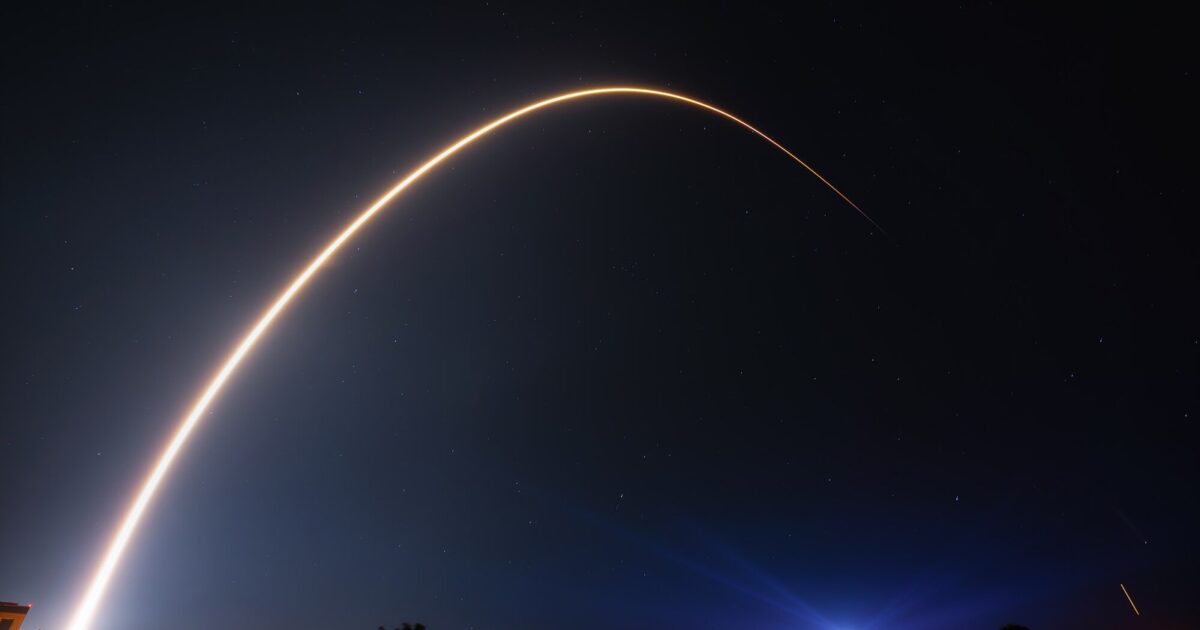
SpaceX started Sunday on the West Coast and planned to finish it on the East Coast.
The company launched the Starlink 17-40 mission from Space Launch Complex 4 East at Vandenberg Space Force Base on June 28, 2026, with liftoff at 9:09 a.m. PDT.
The Falcon 9 carried 24 Starlink broadband satellites to low Earth orbit.
Booster B1088 flew for the 17th time and landed on the droneship Of Course I Still Love You in the Pacific a little more than eight minutes after liftoff.
Guardians and Airmen at Vandenberg Space Force Base supported the launch of a SpaceX Falcon 9 rocket carrying the Starlink 17-40 mission to low-Earth orbit, Sunday, June 28, 2026 at 9:09 a.m. from Space Launch Complex 4 East. Today’s mission marked the 44th launch of 2026. pic.twitter.com/rOyP8W8620
— Vandenberg Space Force Base (@SLDelta30) June 28, 2026
That official range note shows just how busy the West Coast spaceport has been this year.
Space Launch Delta 30 put the West Coast side of the day in official range terms. The DVIDS item identified the mission as a Falcon 9 carrying Starlink 17-40 to low Earth orbit from SLC-4E at Vandenberg Space Force Base, California, on Sunday morning.
It also marked the launch as Vandenberg’s 44th of 2026 from the U.S. Space Force West Coast Spaceport and Test Range. That matters because the range now works as part of the regular launch engine that keeps SpaceX’s Starlink buildout moving.
The official photo record also supports the image trail on this story: it is a real U.S. Space Force/DVIDS launch item, not a recycled generic rocket card or synthetic filler visual.
Spaceflight Now called Starlink 17-40 SpaceX’s final Starlink mission of June 2026 and gave the hard launch details behind it. The Falcon 9 lifted off from SLC-4E at 9:09 a.m. PDT, flew south-southwest out of Vandenberg, and carried 24 more Starlink satellites toward the company’s low Earth orbit broadband constellation.
The same report tracked B1088 on its 17th flight, with previous missions including NROL-126, Transporter-12, SPHEREx, NROL-57, and 12 Starlink deliveries. A little more than eight minutes after liftoff, the booster came back to the Pacific droneship Of Course I Still Love You.
Spaceflight Now also laid out the bigger picture on volume. After Starlink 17-40, SpaceX had flown 75 Falcon 9 missions in the first half of 2026, with 59 of those supporting Starlink, including 10 Starlink launches in June alone.
That is the engine room of the operation, and it kept running into the evening.
Later the same Sunday, SpaceX set up the SXM-11 mission from Space Launch Complex 40 at Cape Canaveral Space Force Station.
The launch window opened at 10:25 p.m. EDT and ran nearly four hours, giving plenty of room to find clear sky.
The 45th Weather Squadron forecast gave an 80 percent chance of favorable weather at the open, improving to 90 percent later, with cumulus and anvil clouds as the only real concerns.
SiriusXM has been one of SpaceX’s steady customers, and this payload was a big one.
Spaceflight Now reported SXM-11 at roughly 7.5 tons, with about 60 percent of that mass made up of onboard fuel. The Florida launch window opened at 10:25 p.m. EDT from SLC-40, and the 45th Weather Squadron put the odds at 80 percent favorable at the open, improving to 90 percent later in the window.
The plan called for booster B1085 to make its 17th flight, then land on A Shortfall of Gravitas in the Atlantic about eight and a half minutes after liftoff. Spaceflight Now listed B1085’s previous work across Crew-9, RRT-1, Blue Ghost Mission 1, Fram2, SXM-10, MTG-S1, EchoStar XXV, and nine Starlink flights.
The satellite itself is part of a SiriusXM constellation refresh. SXM-11 and a future SXM-12 are meant to replace XM-5 from 2010 and Sirius FM-5 from 2009, while the new spacecraft is built to expand and strengthen the radio network’s coverage footprint.
The veteran booster picked for the night job has a deep flight log.
Falcon9 SLC-40からSXM-11打上げhttps://t.co/nqKonfbaSR
SpaceXはSXM-11を6月28日夜にSLC-40から打ち上げ予定で、予備日は6月29日ぽい。Booster 1085は17回目の飛行で、分離後は無人船A Shortfall Of Gravitasへ着船し、衛星はT+34分35秒ごろ投入予定ぽい。— Guppy@ロケみる集会 (@vr_guppy) June 28, 2026
Space.com listed SXM-11 at about 15,400 pounds and put deployment at roughly 34.5 minutes after liftoff into elliptical geosynchronous transfer orbit. It framed the mission as another heavyweight Falcon 9 customer flight rather than a Starlink batch, which is what makes the same-day pairing interesting.
The Space.com rundown also noted SpaceX has already flown SXM-8 in 2021, SXM-9 in 2024, and SXM-10 in 2025 for SiriusXM, all on Falcon 9. SpaceX has become a repeat launch partner for a continuing satellite-radio fleet refresh that still has older spacecraft from the 2009 and 2010 era to replace.
SiriusXM calls SXM-11 the most powerful high-powered satellite in its fleet. The company says it is built to sharpen signal reception, expand coverage in Alaska, and support audio entertainment and information across the United States, Canada, and the Caribbean.
One Falcon 9 sent two dozen Starlink satellites toward orbit from the West Coast in the morning, and another stood ready to send a 7.5-ton radio satellite over the Atlantic after dark.
That is the kind of coast-to-coast Sunday that now barely registers as unusual, and that says everything about how routine SpaceX has made the hard part.
Join the conversation!
Please share your thoughts about this article below. We value your opinions, and would love to see you add to the discussion!