

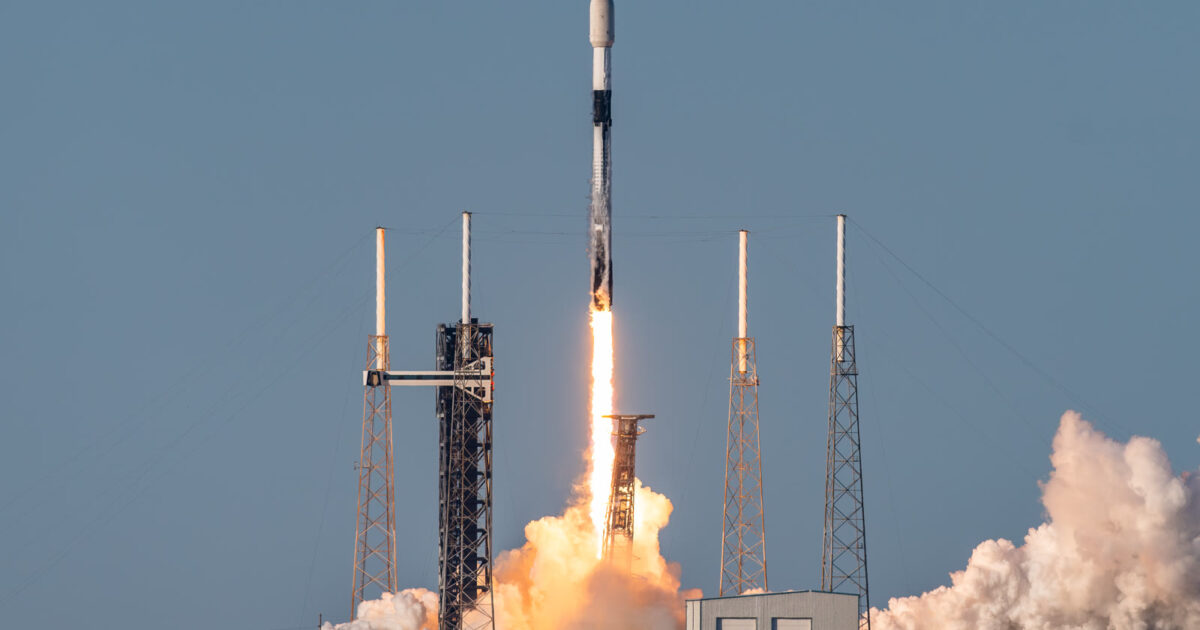
SpaceX is setting up one of those nights that makes the Falcon 9 machine hard to ignore.
Two rockets are targeting liftoff from opposite coasts, one from California on Monday evening and another from Florida early Tuesday morning.
The current target times are five hours and 59 minutes apart.
If both missions stay on schedule, 53 Starlink satellites could be headed toward low-Earth orbit before sunrise in Florida.
24 Satellites will be added to the @Starlink constellation today 🚀🛰
— Brian Basson (@BassonBrain) July 13, 2026
SpaceX is targeting Monday, July 13 for a Falcon 9 launch of 24 Starlink (Group 15-14) satellites from Vandenberg SFB, CA
—> Liftoff: 6.16 p.m. PDT
▪︎ F9 first stage booster: B1093 (15th flight)
▪︎… https://t.co/72X3N3FB76 pic.twitter.com/WsxQRlHqra
California gets the first shot.
On its mission page, SpaceX says Starlink 15-14 will carry 24 satellites from Space Launch Complex 4 East at Vandenberg Space Force Base.
The first-stage booster is preparing for its 15th flight. Its record includes two Space Development Agency missions, Transporter-16 and 11 previous Starlink missions.
After stage separation, the booster is scheduled to land on the Of Course I Still Love You droneship in the Pacific. The flight plan puts that landing about eight minutes and 18 seconds after liftoff, following main-engine cutoff near 2:25 and stage separation four seconds later.
The second stage is scheduled to restart near the 52-minute mark, with all 24 satellites deploying at about one hour, one minute and 11 seconds. SpaceX plans to start its webcast roughly 10 minutes before launch.
SpaceX also says people in Santa Barbara, San Luis Obispo and Ventura counties could hear one or more sonic booms. Weather and other local conditions will determine how much reaches the ground.
The current federal launch windows turn this into a real doubleheader.
The Federal Aviation Administration lists the California window opening at 8:16 p.m. Central on Monday. The Florida window opens at 2:15 a.m. Central on Tuesday.
That is a gap of five hours and 59 minutes between the two target times.
The California primary period runs until 9:59 p.m. Central. The Florida period continues until 6:57 a.m. Central, leaving each range room to work through its own countdown; these are airspace-management periods, not predictions that a rocket will use the entire window.
Both missions have backup windows the following night. The paired primary and backup periods show both ranges preparing for the same two-night rhythm, while weather, range availability or technical readiness can still move either target.
If a delay pushes either mission to its backup, the next windows open at 8:02 p.m. Central Tuesday from California and 1:53 a.m. Central Wednesday from Florida.
Then the operation shifts roughly 2,500 miles east.
For Starlink 10-45, SpaceX lists 29 satellites launching from Space Launch Complex 40 at Cape Canaveral Space Force Station.
The Florida booster is preparing for flight number 28. It has already flown Axiom’s Ax-2 and Ax-3 astronaut missions, the Euclid space telescope, CRS-30, SES Astra 1P, NG-21 and 21 Starlink missions.
Starlink alone accounts for 21 of its 27 completed missions. The rest span crew, science, cargo and commercial communications work on the same first stage.
The booster is scheduled to land on A Shortfall of Gravitas in the Atlantic about eight minutes and 19 seconds after liftoff. Main-engine cutoff is planned around 2:26, followed three seconds later by stage separation as the second stage keeps climbing toward its coast phase.
The fairings are scheduled to come away at about 2:59, clearing the second stage for a long coast. A restart is planned near the 54-minute mark, followed by deployment of the 29 Starlink satellites at about one hour, three minutes and 31 seconds.
Florida’s Space Coast is already looking ahead to the early-morning attempt.
A SpaceX Falcon 9 rocket is expected to launch during early Tuesday, July 14 from Cape Canaveral. Here's when to expect liftoff. https://t.co/M9kfC46LbI
— TCPalm (@TCPalm) July 13, 2026
One mission calls for a 15-flight booster. The other calls for a 28-flight booster.
Two launch ranges, two droneships and 53 satellites are all lined up inside one overnight stretch.
Falcon 9 flies so often now that another launch can disappear into the calendar. Put two of them on opposite coasts in the same night, and the scale snaps back into focus.
Join the conversation!
Please share your thoughts about this article below. We value your opinions, and would love to see you add to the discussion!