

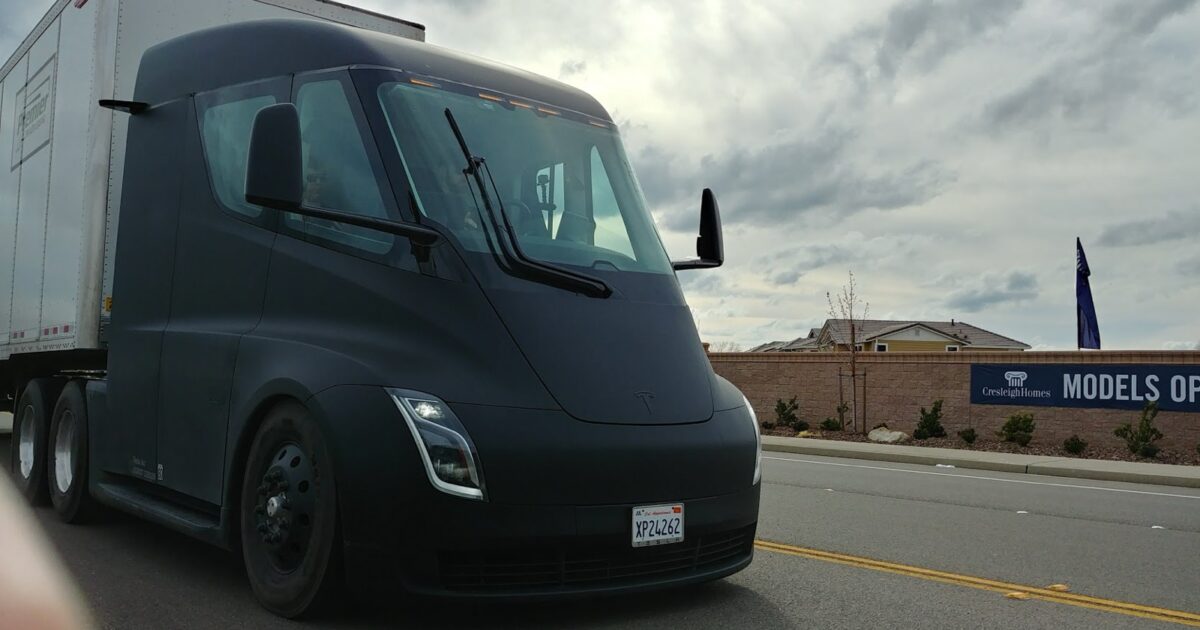
Tesla Semi is moving into another kind of work that can tell fleets far more than a showroom display ever could.
Paper Transport is putting the Semi Long Range into dedicated freight operations in the Chicago market.
The Wisconsin carrier will evaluate how the electric Class 8 truck performs when the route, mileage and daily demands are known in advance.
This is an evaluation, not a disclosed fleet order. That makes the miles ahead especially interesting.
The truck is already wearing a Paper Transport trailer as the Chicago operation gets underway.
Paper Transport today announced a partnership with @Tesla to evaluate the Tesla Semi Long Range in dedicated operations within the Chicago market.
— Sawyer Merritt (@SawyerMerritt) July 13, 2026
"We are excited to partner with Tesla, leveraging their ever-evolving technology. We are bullish in our estimation of the parallels… pic.twitter.com/akuUZI7ySA
In its announcement, Paper Transport says dedicated operations give the Semi a demanding but measurable proving ground. Predictable routes and consistent mileage let the company compare battery-electric performance without guessing what the truck will be asked to do from one day to the next.
PTI says the evaluation will look beyond emissions. Performance, reliability, cost efficiency, service and operating economics all have to hold up if an electric tractor is going to earn a lasting place in the business.
The carrier brings more than 15 years of alternative-fuel experience to the test. It says its trucks have covered more than 87 million miles using compressed and renewable natural gas, so the Tesla Semi is entering a fleet that already knows how to measure a new fuel system against real customer work.
Battery-electric transportation now joins renewable natural gas and intermodal service in PTI’s sustainability portfolio. The company did not announce how many Semis are involved, how long the evaluation will run, which customer lanes will be used or whether a purchase commitment is attached.
The truck PTI chose is the version built for the longer end of Tesla’s new two-model lineup.
On its official Semi page, Tesla lists an estimated range of about 500 miles for the Long Range model. Tesla also claims energy consumption of 1.7 kWh per mile and says its Semi Chargers can recover up to 60 percent of range in 30 minutes.
Three independent motors drive the rear axles, with Tesla listing up to 800 kW of drive power. The Long Range truck has a stated curb weight of 23,000 pounds and uses the MCS 3.2 charging standard.
Tesla says the platform can accept up to 1.2 MW of charging power. It also points to remote diagnostics, over-the-air software updates and a simpler electric powertrain as tools for keeping trucks out of service bays and on the road.
The specifications look strong on paper. PTI’s Chicago freight work will show how well the package fits a carrier outside Tesla’s earliest customer group.
The evaluation arrives as Tesla says the Semi is finally moving from years of limited customer testing toward broader production.
In its Q1 2026 update, Tesla said it further prepared production lines for the start of Semi production during the quarter. The same update showed a Semi production line among Tesla’s manufacturing photographs.
Tesla said volume production remained scheduled to begin in 2026. That is the company’s stated timetable, and the actual pace of the ramp will decide how quickly more carriers can move from reservations or trials into regular fleet use.
The official update grouped Semi with Cybercab and Megapack 3 as programs whose production infrastructure advanced during the quarter. Semi is now part of Tesla’s larger factory push alongside those two programs.
For fleet operators, production capacity is only one part of the equation. The trucks also need charging that fits freight schedules, dependable service and enough real-world uptime to keep customer commitments intact.
A second current view shows the PTI-branded rig from the passenger side and keeps the announcement in its proper lane: a Chicago-region pilot.
🚨 Paper Transport, a Wisconsin-based logistics company, announced this morning that it would be utilizing the Tesla Semi Long Range for internal operations in a new pilot program.
— TESLARATI (@Teslarati) July 13, 2026
The company will test the Tesla Semi in the Chicago region pic.twitter.com/oSxe5t3351
The dedicated-lane setup gives PTI a sensible place to start.
Electrek notes that repeated routes make range and charging easier to plan than irregular long-haul work. A carrier knows the daily mileage, the stops and the time available to recharge, which turns the evaluation into a test of a defined duty cycle instead of a collection of unrelated trips.
The report also draws a firm line between an evaluation and a fleet order. PTI has announced a real truck in real freight operations, but it has not announced a purchase total or promised a wider deployment.
Tesla’s Semi program has been adding carrier experience around that same basic progression. Electrek points to earlier testing by ArcBest and port drayage operator MDB, while PepsiCo continues operating the largest publicly known early fleet.
ArcBest’s ABF Freight test produced an average of 1.55 kWh per mile, according to the report, giving another operator a result below Tesla’s listed 1.7 kWh-per-mile figure. MDB put the truck into container work around Southern California ports, a different freight pattern with its own demands.
The bigger constraint remains charging. A predictable Chicago lane can make a pilot manageable, but a broad fleet rollout needs high-power charging in the right places, enough grid capacity and schedules that keep tractors moving instead of waiting.
Clean operating data from this evaluation could be more valuable than an early order headline.
Paper Transport has fuel experience, recurring freight lanes and its own history of testing lower-emission transportation against the economics of daily trucking. Tesla now has a production-intent Semi Long Range to put into that system.
The next useful facts will come from the work itself: how reliably the truck runs, how charging fits the route and whether the operating costs make sense after enough freight miles pile up.
If the Semi can deliver there, PTI will have more than a sustainability announcement. It will have a business case built on actual Chicago freight.
Join the conversation!
Please share your thoughts about this article below. We value your opinions, and would love to see you add to the discussion!