
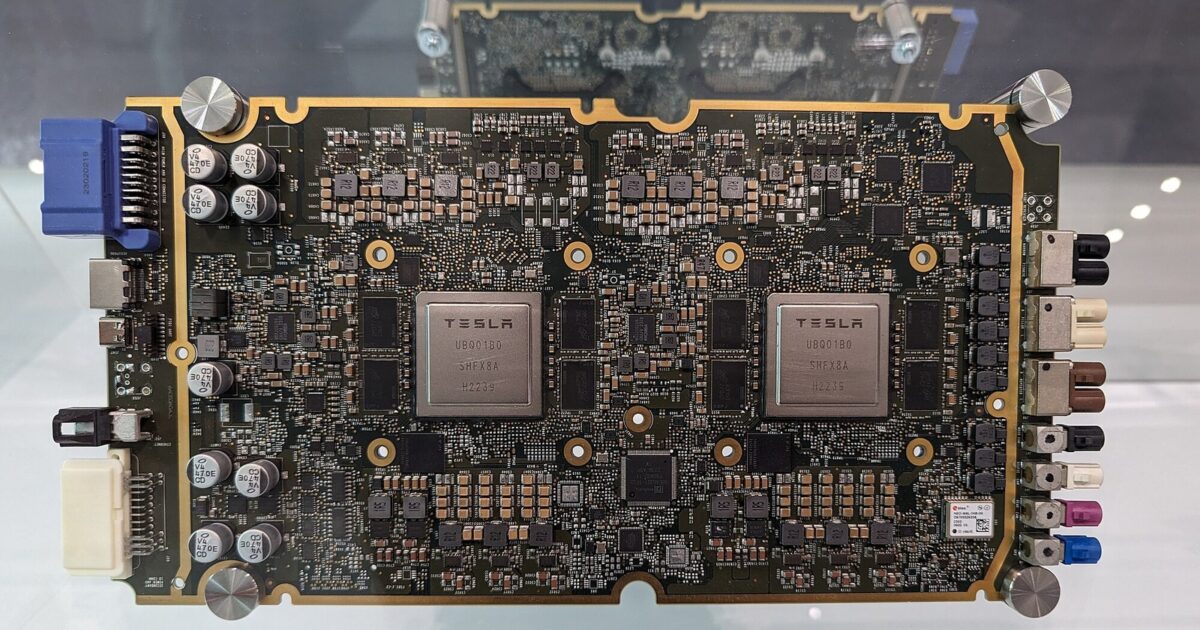
Tesla’s next-generation AI chip just hit one of the biggest milestones in silicon — and Elon Musk is not holding back on the hype.
Musk confirmed this week that the AI5 chip has officially taped out at TSMC in Arizona. For non-chip people: “tape-out” is the point where the design is finalized and frozen, then sent to the fab to start making real physical silicon. It’s the moment years of architecture work stops being a PowerPoint and becomes a thing you can hold.
Musk called the AI5 design “quite stunning” — and promised that the follow-up AI6 will be even better. Take a look:
Congrats to the @Tesla_AI chip design team on taping out AI5!
— Elon Musk (@elonmusk) April 15, 2026
AI6, Dojo3 & other exciting chips in work. pic.twitter.com/hm54TdIzBx
And here’s the follow-up, where Elon laid out what AI5 unlocks for Tesla going forward:
Optimus and our supercomputer clusters.
— Elon Musk (@elonmusk) April 15, 2026
AI4 is enough to achieve much better than human safety for FSD.
This is a huge moment. AI5 is the chip that will power Tesla’s next leap in Full Self-Driving, the Optimus humanoid robot, and — eventually — the Robotaxi fleet. Up until now, Tesla has been running the show on HW4 silicon. AI5 is supposed to be a massive jump, not a small one.
Teslarati broke down what makes this such a big deal:
Tesla’s AI5 chip has officially taped out at TSMC’s Arizona facility, a major milestone that moves the in-house designed accelerator one step closer to production. Elon Musk confirmed the news this week and described the AI5 design as “stunning,” adding that the next-generation AI6 is expected to be even more capable.
The AI5 chip is expected to drive a significant leap in compute for Tesla’s Full Self-Driving software, as well as for the Optimus humanoid robot program. Tesla has repeatedly said that chip supply, not software, is the real near-term constraint on scaling autonomy.
Translation: once AI5 is in volume production, Tesla stops being compute-limited. That changes everything — from FSD rollouts to how fast Optimus can actually be trained.
Electrek put the timeline in perspective:
Tape-out is the point of no return in chip development. From here, TSMC takes the finalized design and begins the physical fabrication process in Arizona, which typically runs 12 to 16 weeks before the first engineering samples come back for validation.
If everything holds, Tesla could have first silicon in hand this summer, with volume production ramping into 2027 vehicles and the next wave of Optimus units.
First silicon by summer. Volume ramp into 2027. This is the kind of roadmap Tesla investors have been waiting on for years.
And the fact that AI5 is being fabbed in Arizona — not Taiwan — is its own story. That’s domestic US semiconductor production at the highest end of the stack, for one of the most important AI chips in the world. This is exactly what the CHIPS Act was aiming at.
The AI5 era is officially starting. And if Musk is right that AI6 will push even further, the compute runway for Tesla’s entire autonomy and robotics stack just got a whole lot longer.
Join the conversation!
Please share your thoughts about this article below. We value your opinions, and would love to see you add to the discussion!