

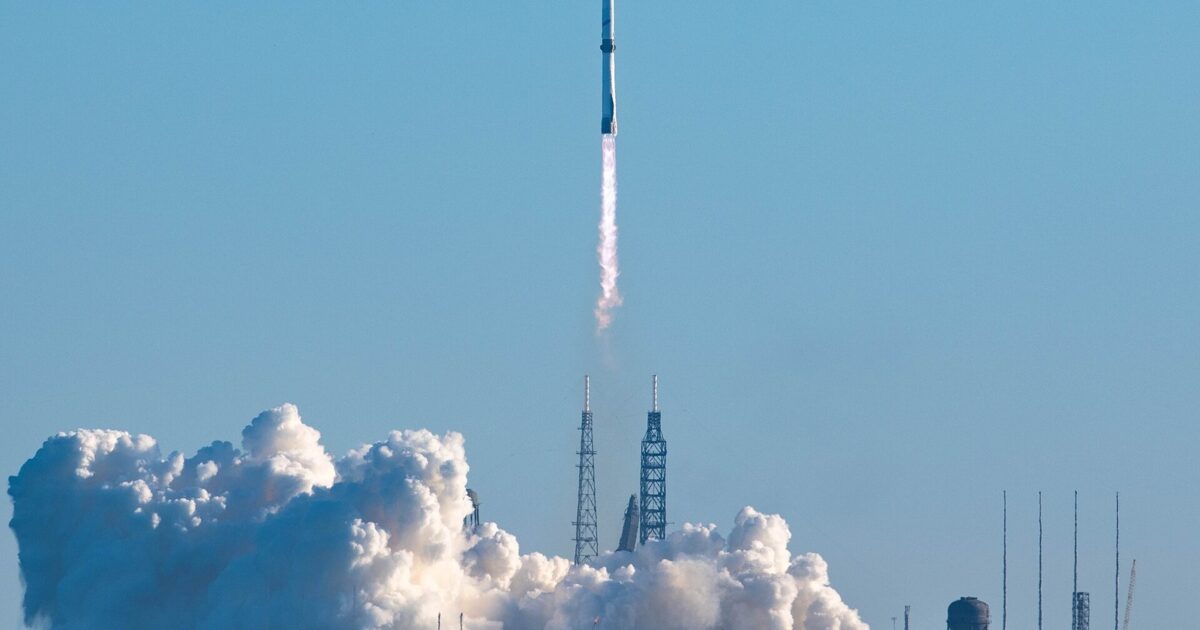
Blue Origin just made history today. And also made a pretty costly mistake in the very same mission.
Jeff Bezos’ space company launched its New Glenn rocket for the third time this morning from Cape Canaveral, Florida, and for the very first time, the company successfully reused a booster that had already flown. The first-stage booster nicknamed “Never Tell Me The Odds” touched down on the drone ship “Jacklyn” in the Atlantic Ocean about six minutes after liftoff. That part went perfectly.
The problem? The satellite the rocket was carrying never made it to the right orbit. And it’s not going to.
For context, SpaceX hit its 600th Falcon booster landing just yesterday. Six hundred. Blue Origin is celebrating its first booster reuse. The gap between these two companies is staggering, and today’s mission only made it more obvious.
Bloomberg summed up the milestone and the rivalry perfectly:
Blue Origin’s flagship New Glenn rocket launched to space on its third flight, reusing a booster for the first time in a milestone for the Jeff Bezos-backed company in its quest to rival SpaceX. https://t.co/0ITbu8vB1c
— Bloomberg (@business) April 19, 2026
The mission was carrying AST SpaceMobile’s BlueBird 7 satellite, one of the largest communications satellites ever built with a 2,400-square-foot antenna designed to deliver cellular broadband directly to mobile phones from space. New Glenn’s upper stage was supposed to deliver it to a precise low Earth orbit. Instead, roughly two hours after launch, Blue Origin confirmed the satellite ended up in the wrong place entirely.
Blue Origin acknowledged the issue on X:
NG-3 Update: We have confirmed payload separation. AST SpaceMobile has confirmed the satellite has powered on. The payload was placed into an off-nominal orbit. We are currently assessing and will update when we have more detailed information.
— Blue Origin (@blueorigin) April 19, 2026
Translation: the satellite powered on, but it was placed so low that it can’t sustain operations. AST SpaceMobile confirmed the orbit was “lower than planned” and the satellite will have to be de-orbited, meaning it burns up in the atmosphere. A total loss. Insurance covers it, but the setback is real.
TechCrunch broke down what this means for Blue Origin’s trajectory:
This represents New Glenn’s first major failure after over a decade in development. The mishap carries implications for Blue Origin’s broader ambitions, particularly its NASA Artemis contracts aimed at returning humans to the moon before the end of President Trump’s current term.
That’s a big deal. Blue Origin isn’t just building rockets for fun. They have contracts with NASA to build a lunar lander. If they can’t reliably deliver a satellite to low Earth orbit, it raises real questions about their readiness for missions that are orders of magnitude more complex.
Fortune pointed out the strategic comparison that everyone is thinking about:
SpaceX remains the only other company to successfully land a booster vertically after launch, underscoring Blue Origin’s achievement in this reusability milestone. CEO Dave Limp expressed ambitions to conduct 8-12 New Glenn launches annually, though the company achieved only two launches in 2025 despite initially projecting six to eight.
Eight to twelve launches a year is the goal. SpaceX does that in a month. And SpaceX doesn’t put customer payloads on test flights. Blue Origin chose to fly a real, expensive satellite on just their third mission. SpaceX spent years flying dummy payloads on Starship to work out the kinks before risking anything real. Different philosophy, and today we saw the risk of that approach play out in real time.
Credit where it’s due: landing a reused booster is genuinely impressive and Blue Origin should be proud of that achievement. But when you’re competing against a company that has landed 600 boosters and is about to take Starship V3 to orbit, the celebration gets a little quiet. Especially when the satellite you were supposed to deliver is burning up in the atmosphere instead of connecting phones to the internet from space.
Join the conversation!
Please share your thoughts about this article below. We value your opinions, and would love to see you add to the discussion!