

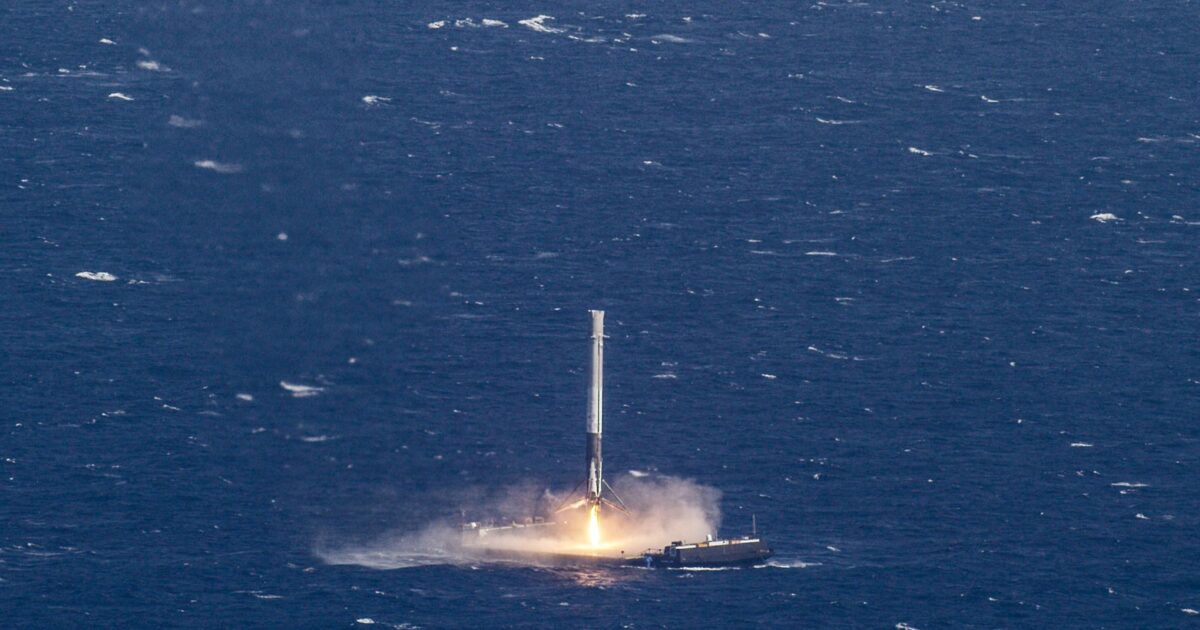
SpaceX is on the verge of a milestone that nobody outside Hawthorne thought was possible ten years ago. Today’s Starlink 17-22 mission from Vandenberg Space Force Base is set to deliver the company’s 600th successful Falcon booster landing. Let that number sink in for a second: 600.
The mission is targeting a 7:35 AM Pacific liftoff on Sunday, April 19, carrying 25 Starlink V2 Mini satellites into low Earth orbit. About eight minutes after launch, the first-stage booster, B1097, will attempt to touch down on the drone ship “Of Course I Still Love You” in the Pacific Ocean. If it sticks the landing, it will mark the 191st recovery on that vessel alone.
B1097 is flying for the seventh time. Its resume includes Sentinel-6B, the Twilight mission, and five previous Starlink batches. In SpaceX’s world, seven flights on a single booster barely raises an eyebrow anymore. That’s the whole point.
And this isn’t even the only Falcon 9 mission SpaceX is working right now. Check it out:
Teams encapsulated the @USSpaceForce's final GPS III satellite into Falcon 9’s fairing earlier this week. Falcon 9 is targeted to launch GPS III-8 on Monday, April 20 from pad 40 in Florida → https://t.co/5GHO2CGJn9 pic.twitter.com/TSI0Rys9Lb
— SpaceX (@SpaceX) April 18, 2026
That’s right. While SpaceX is about to clinch landing number 600, teams in Florida are simultaneously prepping Falcon 9 to launch the U.S. Space Force’s final GPS III satellite on Monday. Two major missions, back to back, on opposite coasts. That’s the kind of operational tempo that no other launch provider on Earth can match.
Spaceflight Now laid out the full context of today’s milestone:
SpaceX is positioned to complete its 600th Falcon booster landing during a Starlink mission now planned for Sunday morning. The flight will deliver 25 new Starlink broadband satellites to low Earth orbit, continuing the steady drumbeat of constellation expansion that has pushed the network to 11,828 satellites launched, 10,258 currently in orbit, and 10,242 actively operational.
Those numbers are staggering. Over 10,000 operational Starlink satellites, and the constellation just keeps growing. Every single one of them rode a Falcon 9 to orbit.
The demand for Starlink service is spreading fast, too. As the constellation expands, so does its global footprint:
A lot of misinformation from legacy media about Starlink’s entry into South Africa. Here’s the truth 👇
— DogeDesigner (@cb_doge) April 19, 2026
• ❌ “Starlink wants to bypass B-BBEE”
✅ False — it supports transformation via EEIP, a legal framework already used by companies like Microsoft, IBM, and Amazon Web… pic.twitter.com/KN5YCgNJcB
Starlink is pushing into new markets around the world, and every one of those satellites needs a Falcon 9 to get there. That’s the engine behind SpaceX’s relentless launch cadence.
edhat reported on what residents near Vandenberg can expect from today’s launch:
Residents across Central Coast counties, including Santa Barbara, San Luis Obispo, and Ventura, were advised to expect sonic booms as the Falcon 9’s first-stage booster returned to Earth. The booster was scheduled to land on the “Of Course I Still Love You” droneship in the Pacific Ocean.
Sonic booms from routine rocket landings. That’s the world SpaceX has built. A decade ago, landing a rocket at all was science fiction. Now it happens so often that local news stations issue sonic boom advisories the same way they’d warn about a thunderstorm.
When SpaceX first stuck a Falcon 9 landing back in December 2015, it changed the entire conversation about what spaceflight could be. Six hundred landings later, they’ve turned it into an assembly line. And with booster reuse records climbing past 20+ flights on individual cores, the pace is only going to accelerate from here.
Join the conversation!
Please share your thoughts about this article below. We value your opinions, and would love to see you add to the discussion!