
Tesla just had one of those “move fast and break things” moments that reminds you why this company operates differently from every other robotics outfit on the planet.
The United States Patent and Trademark Office recently published Tesla’s detailed patents for the Optimus V3 robot hand. The filing describes a tendon-driven system with 22 degrees of freedom, actuators relocated to the forearm, and a complex wrist-routing mechanism designed for human-level dexterity. It was the kind of deep technical reveal that gets robotics engineers excited.
Then Elon Musk hopped on X and casually dropped the truth: Tesla already abandoned the design. The rolling contact mechanism that looked so promising in simulations failed in the real world, and the team has already moved to something better.
Take a look at what Musk had to say:
We already changed the design. This one didn't actually work.
— Elon Musk (@elonmusk) April 19, 2026
That is about as blunt as it gets. The patent office publishes your cutting-edge hand design, and you tell the world it is already in the rearview mirror. That is the kind of iteration speed that separates Tesla from companies still stuck on prototypes.
Teslarati broke down the significance of Musk’s admission and what it means for the Optimus program going forward:
The rolling contact mechanism, intended to provide smooth, low-friction articulation in the fingers, had already been scrapped after real-world testing exposed its shortcomings. What looked promising on paper and in simulations failed to deliver the reliability required for a robot expected to handle delicate tasks like folding laundry, assembling electronics, or assisting in factories and homes.
Musk has previously described the Optimus hand as representing roughly 60 percent of the total engineering difficulty of the entire robot. The human hand has 27 bones, a network of tendons and ligaments, and sensory feedback systems that took millions of years of evolution to develop. Replicating that in a machine that needs to survive factory-grade duty cycles is brutally hard.
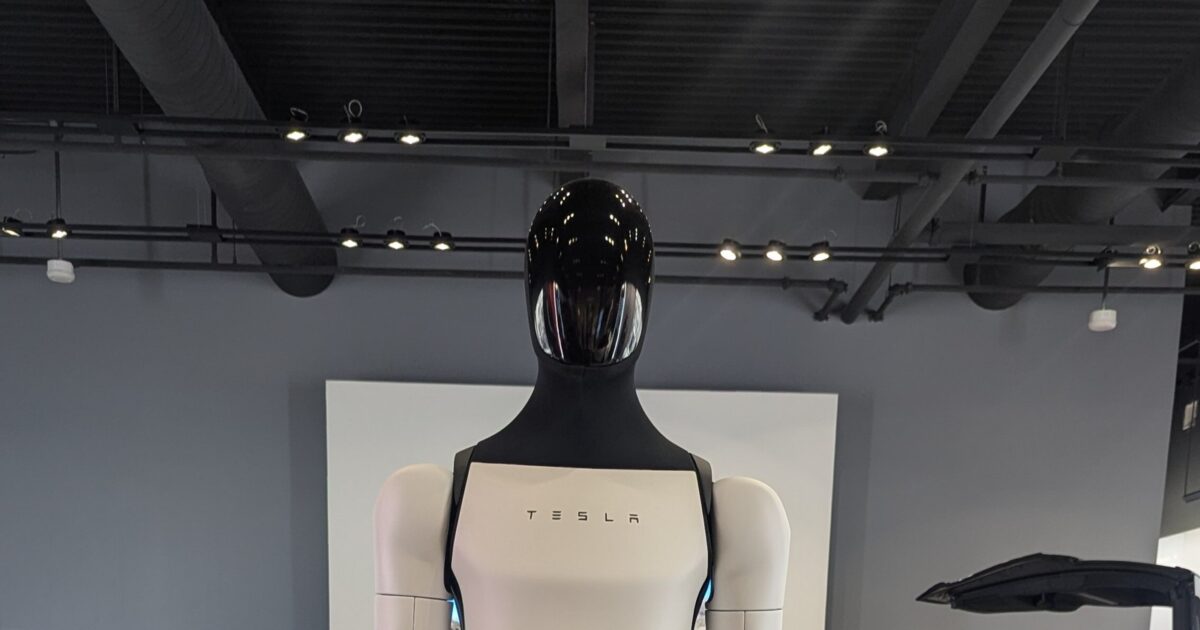
Meanwhile, Tesla had Optimus out greeting fans at the Boston Marathon this weekend. The robot was stationed at the Tesla Boylston Street showroom, right along the final mile of the race, posing for photos with spectators and cheering from the sidelines.
Just got this email. @Tesla's Optimus robot is coming to Boston.
— Sawyer Merritt (@SawyerMerritt) April 18, 2026
“Join us from April 19 to 20, 2026, at Tesla Boston Boylston Street showroom to meet Optimus, our humanoid robot, for Marathon Monday. Optimus will be cheering with you on the sidelines and posing for photos.” pic.twitter.com/chxoooO2xV
The robotics analysis newsletter Droids dug into the specifics of the now-abandoned patent design and found it was genuinely impressive on paper:
Tesla’s design targets three simultaneous requirements: interface with legacy human tooling and fixtures, survive automotive-grade duty cycles, and remain cheap enough to manufacture in volume, positioning the V3 hand as genuinely production-ready rather than merely conceptually advanced.
That is what makes this so interesting. Tesla did not scrap a sloppy first draft. They threw out a design that experts considered production-ready because real-world testing revealed something better was possible. The next version of those hands is already in testing, and Tesla has said they overcame the “hardest” problems in Optimus development by early 2026, including human-level dexterity and volume production scalability.
Tesla plans to deploy over 200 Optimus Gen 3 robots at Gigafactory Texas this year for internal logistics, with broader mass production expected before the end of 2026. Musk has said the Optimus program could eventually be worth more than Tesla’s entire automotive business. If the team keeps iterating at this pace, that timeline starts looking less like a dream and more like a plan.
Join the conversation!
Please share your thoughts about this article below. We value your opinions, and would love to see you add to the discussion!